
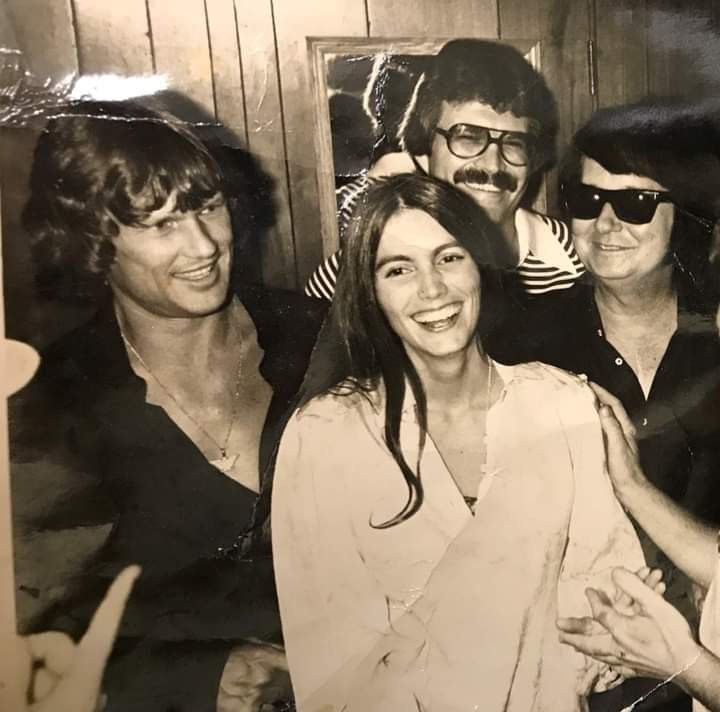
“The Ship on His Arm” feels less like a song than a haunted memory passed down in whispers—strange in its imagery, tender in its heartbreak, and so vivid that once it enters the mind, it refuses to leave.
There are songs that explain themselves the first time through, and then there are songs like “The Ship on His Arm”—songs that seem to arrive already wrapped in mist, carrying just enough story to draw you in and just enough mystery to keep you unsettled. That is part of what makes this Emmylou Harris recording so extraordinary. It was released not as a single, but as an album track on Hard Bargain, her 2011 studio album for Nonesuch Records. The song sits at track 10, runs 4:46, and was written by Emmylou Harris herself. Because it was not a single, it did not have its own separate Billboard chart peak; instead, it lives inside an album that debuted at No. 3 on Billboard’s Top Country Albums and No. 18 on the Billboard 200, one of the strongest chart starts of Harris’s later solo career.
That factual frame matters, because “The Ship on His Arm” is not one of those famous Emmylou titles that announced itself with radio glory. It is a deeper kind of song, the kind that waits for the listener rather than chasing them. And once it is heard, it lingers for a very particular reason: the imagery is so unusual, so physical, so cinematic. Even the title carries a strange charge. A ship is not merely a decoration here; it feels like fate, distance, danger, longing, and memory all at once. Billboard described the song as chronicling wartime separation, and that phrase gets to the heart of it. This is not ordinary absence. It is love tested by history, by oceans, by uniform, by fear, by the possibility that the body may return altered—or may not return at all.
The backstory makes the song even more gripping. In a detailed account tied to the album’s release, Harris explained that the title came from a Terry Allen drawing that Susanna Clark, wife of Guy Clark, had given her. From there she built the lyric into the story of a young couple separated by war. More deeply still, she said the song was inspired by her own parents’ history—specifically the strain placed on their marriage when her father, a Marine, was missing in action during the Korean War. Harris also said the song was her “roundabout way” of telling a little of their story, even though the tattoo image itself was imagined: her father, she noted with a touch of amused honesty, never actually had a tattoo. That one detail says so much about the song’s power. It is personal truth transformed into mythic image.
And that is why “The Ship on His Arm” feels so hard to escape. It does not behave like a diary entry. It behaves like folklore. Harris takes a family memory and turns it into something almost archetypal: the waiting woman, the absent man, the emblem carried on the skin, the long war between tenderness and uncertainty. A lesser writer might have made the song merely decorative, leaning too hard on period detail or romantic melancholy. Harris does something finer. She lets the image of the ship remain both literal and symbolic. It becomes a vessel of hope, but also a mark of vulnerability—as if love itself had been inked into flesh and sent into danger. That is what makes the song so vivid. You do not just hear it; you see it. And once seen, it stays. The title alone feels like the beginning of a novel one wishes one could finish.
Musically, the song belongs to the late-style beauty of Hard Bargain, a record made quickly but with remarkable atmosphere. Nonesuch’s release notes describe the album as comprising 11 original songs by Harris and two covers, produced by Jay Joyce. Reviews at the time emphasized the record’s intimacy and emotional gravity, while Harris herself spoke of the small, close-knit nature of the sessions. In that setting, “The Ship on His Arm” acquires an almost dreamlike hush. One source described the album’s sound as having a “floaty, dreamy quality,” and that phrase fits this song especially well. It does not march like a war song. It drifts like memory. The arrangement feels less interested in declaration than in atmosphere, which makes the narrative all the more haunting.
There is also something quietly moving about what the song reveals regarding Emmylou Harris as a writer. Many listeners first loved her as an interpreter of other people’s songs, one of the great voices ever to move through country, folk, and Americana. But on Hard Bargain, she was writing from deeper within her own weather, and Paste observed that songs like “The Ship On His Arm” let the listener hear Harris “coming to terms with her past, the places she’s stood and the people who have been important.” That may be the most revealing description of all. The song is strange, yes. But its strangeness is not ornamental. It is the natural shape taken by memory when memory has lived long enough to become legend in the heart.
So why does “The Ship on His Arm” feel like a story you cannot quite escape? Because it never fully closes its doors. It gives you history, but not too much. It gives you lovers, but through shadows. It gives you an image so peculiar and so perfect that the whole song seems to hang from it like a lantern in fog. And above all, it gives you Emmylou Harris in one of her most quietly spellbinding modes: not merely singing a narrative, but breathing life into a private myth about war, devotion, and the fragile ways people endure separation. Some songs pass through the ear and vanish. “The Ship on His Arm” does something rarer. It lingers like an old family story half-remembered at dusk—beautiful, unsettling, and impossible to lay entirely to rest.
