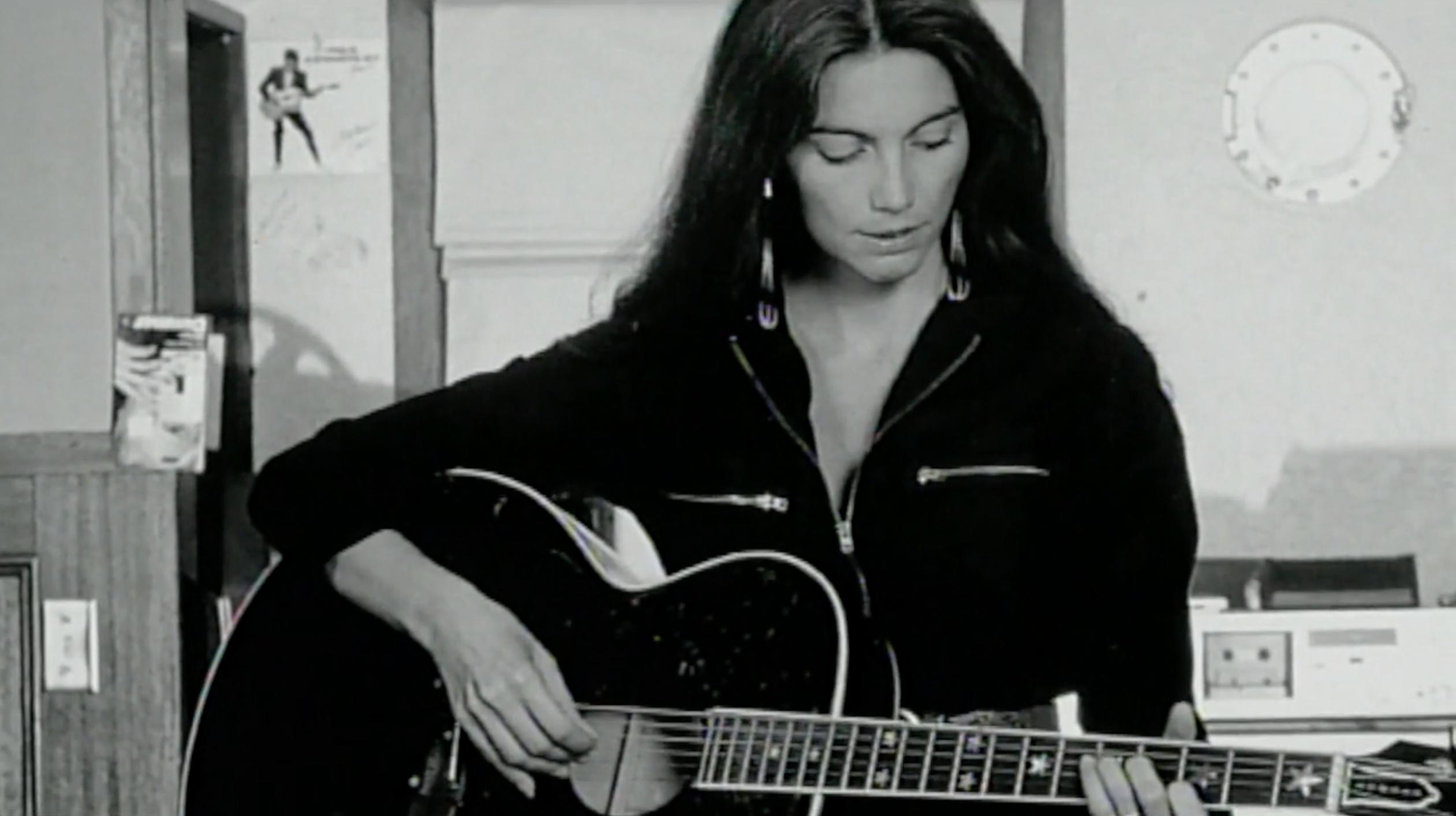
With White Line, Emmylou Harris turned the open road into a private reckoning, using 1985’s The Ballad of Sally Rose to step out of the long Gram Parsons shadow and tell the story from her own side at last.
Released in 1985 as the lead single from The Ballad of Sally Rose, White Line reached No. 8 on Billboard’s Hot Country Singles chart. On paper, that made it another solid hit in a career already rich with them. But the deeper importance of the song lies elsewhere. For Emmylou Harris, White Line was not simply another beautifully sung country-rock record. It was the doorway into one of the most personal and daring artistic turns of her career, a moment when she stopped being merely the graceful interpreter of other people’s songs and began reshaping her own history in public.
That is what makes The Ballad of Sally Rose such a remarkable album even now. It was a semi-autobiographical concept record, written with a degree of emotional exposure that surprised many listeners who had long associated Harris with exquisite readings of songs by others. Across the album, she and collaborator Paul Kennerley created the characters Sally Rose and Harlan, fictional names carrying unmistakably real emotional weight. The story was veiled, yes, but only lightly. Anyone who knew the outline of Harris’s early years could hear what was happening beneath the surface: she was revisiting the chapter of her life and career most strongly linked to Gram Parsons, but this time on terms she controlled.
That distinction matters. Gram Parsons had been central to the public mythology of Emmylou Harris ever since their work together on GP and Grievous Angel. He helped bring her into wider view, and she, in turn, became essential to the sound and afterlife of his music. After Parsons died in 1973, Harris responded with Boulder to Birmingham, one of the most moving songs of grief in modern country music. But Boulder to Birmingham came from the raw center of loss. White Line, more than a decade later, comes from somewhere different. It comes from memory after it has had time to harden, soften, and complicate itself. It is not the sound of a wound opening. It is the sound of a life being reorganized.
The title image is deceptively simple. A white line on the highway is a guide, a boundary, a direction, and a warning all at once. In the emotional world of White Line, it becomes a symbol of motion that never quite feels free. The road is not just romance here. It is work, distance, restlessness, and the strange loneliness that follows anyone whose life is always moving forward even when the heart is still looking back. That image fits Harris perfectly. Few singers have conveyed travel, longing, and emotional restraint with such natural authority. On this song, the road becomes more than scenery. It becomes biography.
Musically, White Line carries that meaning with quiet confidence. The arrangement has the flowing ease of classic country-rock, but there is a tension inside it, as if the wheels keep turning because there is no honest way to stand still. Harris sings with that rare combination that made her such a singular presence from the start: tenderness without weakness, clarity without coldness, ache without theatrical excess. She does not force autobiography upon the listener. She lets it rise naturally through tone, pacing, and detail. That may be the song’s greatest strength. It reveals itself slowly, the way memory itself does.
And that is why it feels so important within The Ballad of Sally Rose. By writing through the mask of Sally Rose, Harris found the artistic distance she needed. The fictional frame did not hide the truth; it made the truth bearable and shapeable. She could write about devotion, imbalance, ambition, dependence, and self-discovery without turning the album into a literal diary. In doing so, she accomplished something finer than confession. She revised the narrative. The old public story had often positioned her as the gifted woman standing beside a brilliant, doomed man. On White Line and throughout The Ballad of Sally Rose, she subtly refused that arrangement. She became the principal storyteller.
Some listeners at the time were startled by the move. Emmylou Harris had already built a distinguished career through interpretation, taste, and a nearly unmatched instinct for song selection. To hear her step so directly into authorship, and to do so through a conceptual, personal cycle, was a genuine artistic risk. But time has only deepened the value of that choice. Today, The Ballad of Sally Rose is often heard as one of the bravest records in her catalog, and White Line stands near its emotional center: accessible enough to work as a hit single, yet rich enough to carry the weight of reinvention.
What lingers, decades later, is the dignity of the gesture. White Line does not erase the Gram Parsons chapter, nor does it sensationalize it. Instead, it reclaims it from legend. It says that memory belongs not only to the one who became myth, but also to the one who kept driving, kept singing, kept living with the afterimage. In that sense, White Line is one of the most revealing songs Emmylou Harris ever recorded. It marks the moment she stopped circling a story everyone thought they knew and finally redrew the map herself.
