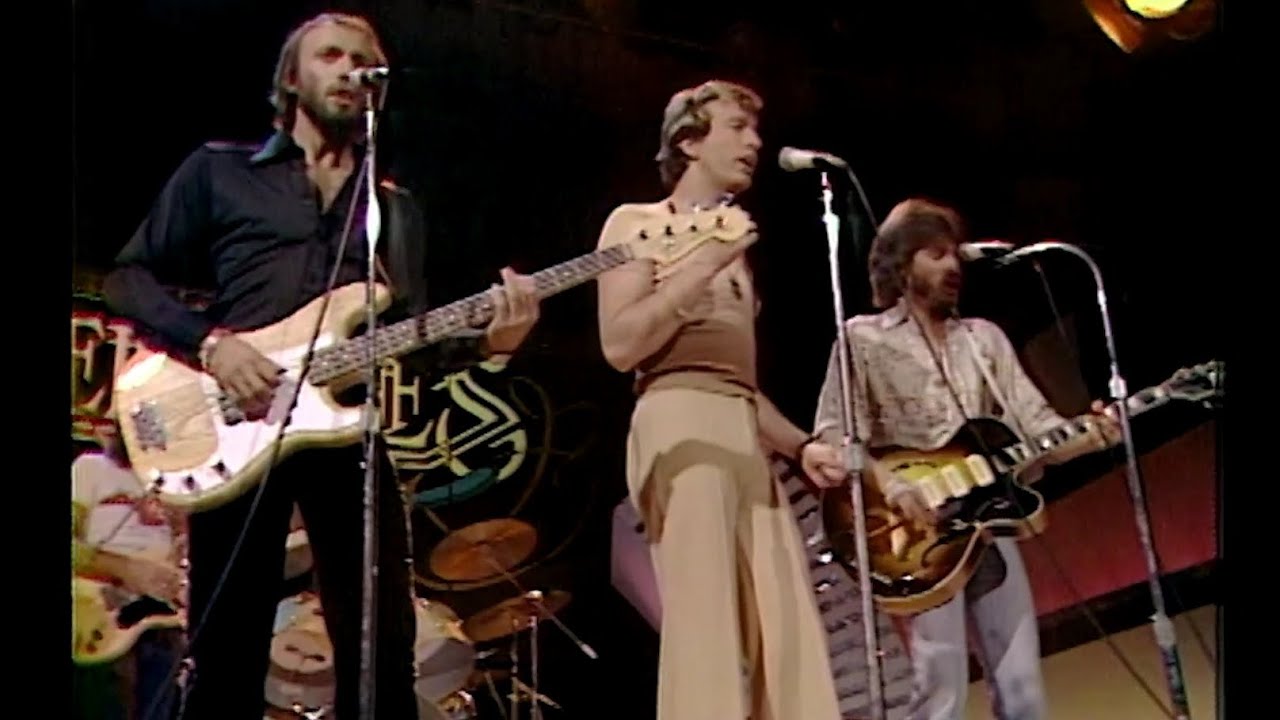
More than a hit single, “Lonely Days” was the sound of the Bee Gees finding each other again—and America hearing that reunion in real time.
When the Bee Gees released “Lonely Days” at the end of 1970, it did far more than return them to the radio. It announced, with aching tenderness and then sudden emotional force, that the brothers were back together after a painful split that had left many listeners wondering whether the magic was gone for good. Drawn from the reunion-era album 2 Years On, the single climbed all the way to No. 3 on the Billboard Hot 100 in early 1971. That chart position mattered. In America especially, it was proof that Barry Gibb, Robin Gibb, and Maurice Gibb were not just reconciling privately—they were reclaiming their place in popular music.
To understand why the record hit with such force, one has to remember the uncertainty that surrounded the group in 1969 and 1970. The brothers had endured internal strain, creative disagreements, and the very public fracture that saw Robin Gibb leave for a solo path. For a time, the future of the Bee Gees seemed painfully unclear. This was not a minor quarrel in the background of a successful act; it felt like the unraveling of one of pop’s most distinctive family groups. Their harmonies had always carried something unusually intimate—three voices that sounded not merely arranged, but bonded. When that bond appeared broken, fans heard the loss.
That is why “Lonely Days” landed as more than a well-crafted single. It felt like a return of spirit. The song was among the earliest clear public signs that the reunion was real and musically alive. There is something fitting about that. The Bee Gees did not come back with a hard-edged statement or a triumphant piece of swagger. They returned with vulnerability. The opening has a reflective, almost private quality, and then the record expands into a soaring, full-bodied chorus that feels like emotion breaking through restraint. It is a brilliant structure for a comeback: first the wound, then the release.
Musically, “Lonely Days” is one of the most revealing singles of the group’s early-1970s period. It carries the rich melodic ambition that had always set the brothers apart, but it also moves with unusual dramatic shape. The verses are gentle and wistful, then the chorus opens outward with layered harmonies, rhythmic lift, and that unmistakable sense of scale the Bee Gees could summon when they were fully locked in together. Some listeners have long heard echoes of the grand British pop craftsmanship of the late 1960s in its design, but the emotional identity is unmistakably their own. It sounds both bruised and hopeful, as if uncertainty itself had been transformed into melody.
Lyrically, the song speaks in the language of longing: lonely days, lonely nights, the fear of absence, the ache of needing someone’s presence to feel whole. On the surface, it is a love song, plain and sincere. But because of when it arrived, many listeners naturally heard something more in it. Whether or not it was written as a coded statement about the brothers’ reunion, the timing made that reading irresistible. A song about separation and emotional dependence suddenly came from a band healing its own division. That gave “Lonely Days” a second life beyond its literal words. It became one of those records whose meaning is enlarged by biography, by history, by the simple fact of who was singing it and what they had just come through.
The chart success confirmed that audiences were ready to welcome them back. Rising to No. 3 on the Billboard Hot 100, “Lonely Days” became the Bee Gees’ biggest American hit since the late 1960s and restored momentum at exactly the right moment. It reopened the path that would soon lead to another major peak with “How Can You Mend a Broken Heart”, which would go all the way to No. 1 later in 1971. In that sense, “Lonely Days” stands at a turning point. It was not merely a nice comeback single; it was the bridge between uncertainty and renewed stature. Without it, the story of the group’s 1970s resurgence feels very different.
The album 2 Years On also deserves mention here, because it holds the atmosphere of transition so well. It is the sound of a group reassembling itself without surrendering its craft. There is maturity in the writing, patience in the arrangements, and a sense that the brothers had something to prove—not in a loud way, but in a serious one. “Lonely Days” became the emotional calling card of that period because it carried both accessibility and depth. Radio could embrace it instantly, yet devoted listeners could hear the human history inside it.
What still moves people about the song now is that it never feels calculated. So many comeback records try to sound monumental from the first second, as if they are demanding to be treated as events. “Lonely Days” does something finer. It earns its power gradually. It lets sorrow speak first. Then it lets harmony answer. That shape gives the record its staying power. It reminds us that reunions are rarely neat, and that some of the most convincing returns in music do not arrive with spectacle, but with feeling.
For the Bee Gees, this was the record that changed the mood. After the split, after the doubt, after the whispers that perhaps the brothers had already said what they needed to say together, “Lonely Days” rose up and told a different story. It told the public that the voices still belonged together. It told the charts that the audience had not forgotten. And it told anyone listening closely that sometimes the most important comeback song is not the loudest one—it is the one that sounds as though the heart has found its way back before the world even fully realizes it.
