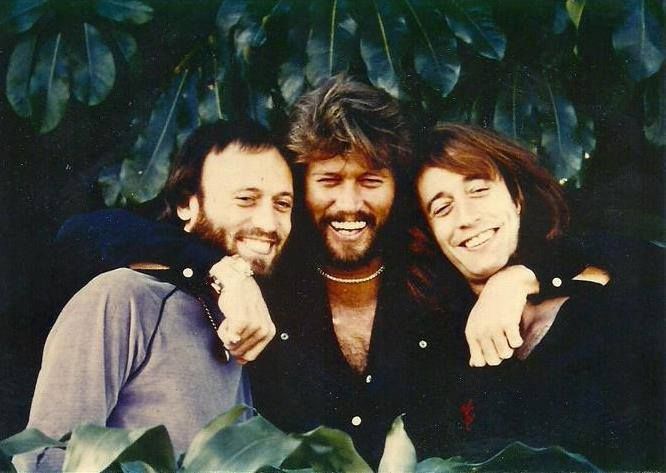
Jive Talkin’ was more than a hit for the Bee Gees—it was the sound of reinvention, the rhythm of a new decade, and the song that carried them back to the top in 1975.
When “Jive Talkin’” arrived in 1975, it did not simply introduce a catchy new single from the Bee Gees. It announced a transformation. By the time the song climbed to No. 1 on the Billboard Hot 100, it had become their first American chart-topper since “How Can You Mend a Broken Heart” in 1971, and that fact alone made it a milestone. For a group that many listeners had begun to think of mainly through their earlier melodic ballads and richly harmonized pop records, this was the record that changed the conversation. It also became one of the defining moments of Main Course, the 1975 album that marked the beginning of the Bee Gees’ most dramatic creative rebirth.
Chart-wise, the song was a major event on both sides of the Atlantic, though its deepest impact came in America. “Jive Talkin’” reached No. 1 in the United States and No. 5 on the UK Singles Chart, proving that the group had not merely returned—they had found a new language for pop radio. In the United States especially, this mattered. The Bee Gees had known immense success before, but by the mid-1970s they were in need of a fresh identity, a record that sounded current without abandoning their gifts for melody and arrangement. “Jive Talkin’” was that record.
Part of its legend comes from its origin story, one of those rare bits of music folklore that feels too vivid to forget. The song’s pulse has long been linked to a drive over Miami’s Julia Tuttle Causeway, where the brothers were hearing the repeated clatter of tires crossing the bridge joints. That mechanical rhythm became a kind of accidental percussion, a groove carried from the road into the studio. In its earliest stage, the idea was even reportedly known as “Drive Talking” before the phrase shifted into “Jive Talkin’”. Whether one hears the exact bridge rhythm in the finished recording or not, the image remains irresistible: a song being born from movement, from pavement, from a city’s infrastructure turning into music.
And what music it was. Recorded during the Main Course sessions at Criteria Studios in Miami, the track captured the Bee Gees at a creative crossroads. Barry Gibb, Robin Gibb, and Maurice Gibb had already written songs of tenderness, ache, and vulnerability. But here, they leaned into a harder, funkier, more rhythmic style. The bass line pushed forward with confidence. The guitars were sharp and tight. The beat had a restless urban snap. And perhaps most importantly, the vocal approach pointed toward a future that would soon become inseparable from the Bee Gees’ name. Barry’s higher register, used here with striking effect, helped give the song its sleek tension and unmistakable attitude.
The meaning of “Jive Talkin’” is not difficult to grasp, yet the song works because it never overstates itself. At heart, it is about deception, charm without truth, the exhausting experience of being fed words that sound smooth but mean very little. The phrase “jive talkin’” carries both irritation and recognition. Most people know that feeling—someone smiling, persuading, flattering, circling with confidence, while sincerity stays just out of reach. The brilliance of the song is that it delivers this frustration not as a sorrowful confession, but as something rhythmically irresistible. The groove seduces while the lyric pushes back. That tension is exactly why it still feels so alive.
There is also something deeply revealing about where the song sits in the Bee Gees story. Before “Jive Talkin’”, they were already admired craftsmen, but Main Course showed they could survive a changing musical era by changing with it. Not by chasing fashion blindly, but by recognizing that their songwriting could inhabit a new sound. In retrospect, this single stands as a bridge between two Bee Gees identities: the late-1960s and early-1970s hitmakers of ornate pop balladry, and the late-1970s giants whose command of rhythm would dominate the decade. Without “Jive Talkin’”, the later triumphs may have looked very different.
It is worth remembering, too, that Main Course itself was no ordinary album in their catalog. It was the record that restored momentum, confidence, and direction. Songs like “Nights on Broadway” would carry that new energy further, but “Jive Talkin’” was the door opening. It proved that the Bee Gees could sound modern, muscular, and radio-ready while remaining unmistakably themselves. Their harmonies were still there. Their melodic sense was still there. But the clothing of the song—the beat, the bite, the texture—had changed.
That is why the record still carries such emotional force all these years later. Not simply because it was a hit, and not only because it was catchy enough to cross generations, but because listeners can hear a turning point inside it. Some songs top the charts and then belong to their season. “Jive Talkin’” belongs to a moment when an artist reclaims the future. The Bee Gees were not looking backward when they made it. They were finding the road ahead, and fittingly, that road seems to have begun on a drive across a Miami causeway.
In that sense, the achievement of “Jive Talkin’” is larger than a chart statistic, though the statistic matters. Yes, it gave the Bee Gees their first US No. 1 in four years. Yes, it anchored the breakthrough of Main Course. But more than that, it gave them momentum at the exact moment they needed it. It turned motion into groove, frustration into style, and a chance rhythmic spark into one of the most important records of their career. Few comeback records sound this confident. Fewer still sound this effortless.
