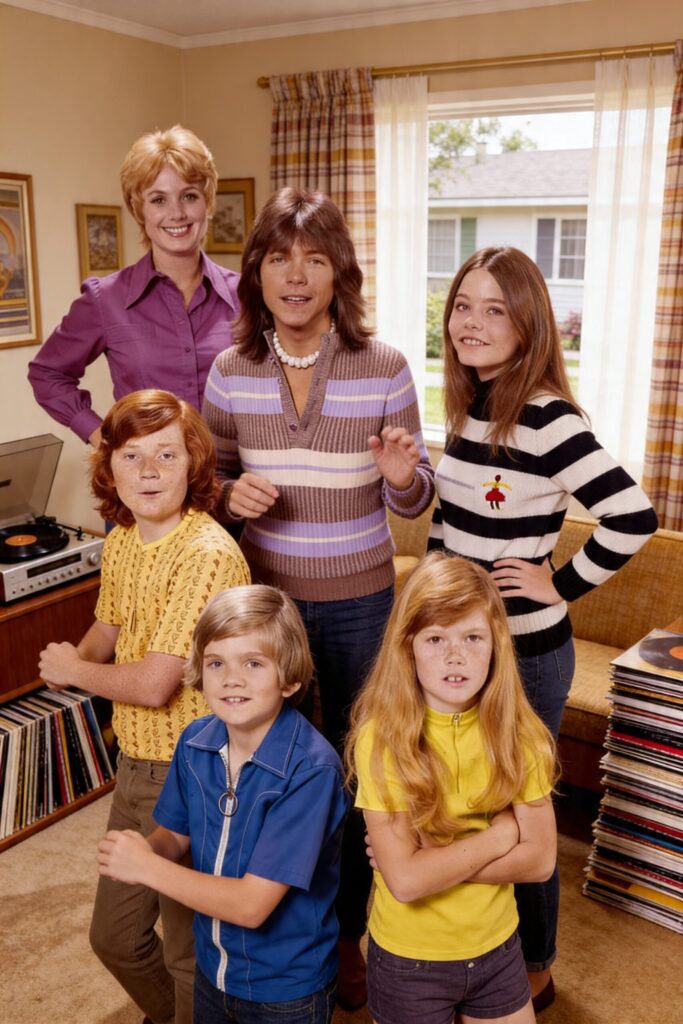
“Roller Coaster” sounds like youthful excitement on the surface, but time has given it a deeper echo. In the world of The Partridge Family, it now feels like the sound of joy holding on while an era quietly changed.
There are songs that arrive like fireworks, and there are songs that reveal their real heart only years later. “Roller Coaster” by The Partridge Family belongs to the second kind. At first listen, it has the bright charge people always loved in this group: a quick pulse, a catchy melody, and that unmistakable sense of youthful motion that defined so much early-1970s pop. But when heard now, with distance and memory in the room, the song carries something more touching. It feels less like a simple burst of bubblegum pop and more like a snapshot of momentum itself, thrilling, a little unstable, and impossible to hold forever.
From a chart standpoint, “Roller Coaster” was not one of the group’s major U.S. Billboard Hot 100 triumphs. It did not reach the towering commercial heights of earlier signature hits such as “I Think I Love You”, which went to No. 1 in 1970, or “Doesn’t Somebody Want to Be Wanted”, which climbed to No. 6 in 1971. That smaller chart footprint is part of what makes the song so interesting today. It belongs to the later phase of the Partridge Family story, after the first wave of frenzy had begun to settle, when the records were still polished and tuneful but the cultural weather around the group had started to shift.
That changing atmosphere matters. The Partridge Family was never just a band in the ordinary sense. It was a television phenomenon built around a fictional musical family, with David Cassidy and Shirley Jones as its most visible voices, and with many of the recordings crafted by top Los Angeles studio professionals under producer Wes Farrell. The formula was brilliant: irresistible hooks, radio-friendly arrangements, and the clean emotional rush of songs that felt immediate without ever becoming heavy. Yet by the time later recordings like “Roller Coaster” appeared, that bright machine was operating in a more complicated emotional landscape. Cassidy was no longer just the fresh-faced center of a TV fantasy; he had become a major star, a serious singer in the eyes of many listeners, and a young man increasingly aware of the limits of the image around him.
You can hear some of that tension in the song’s energy. “Roller Coaster” moves with bounce and confidence, but it is not static happiness. The very title suggests speed, risk, rise and drop, exhilaration and uncertainty all tangled together. That metaphor was perfect for pop music, of course, because young love has always been described as a dizzying ride. But with The Partridge Family, the image reaches further. The song now seems to describe the group itself: the sudden climb, the screaming excitement, the breathless motion, and the knowledge that every ride eventually slows back to the station.
Musically, that is where the record earns its lasting affection. The arrangement is tight and efficient, driven by the kind of craftsmanship that made the best Partridge Family sides so easy to underestimate. These records were often labeled lightweight because they were popular and melodic, but that misses the discipline behind them. “Roller Coaster” is built for movement. The rhythm pushes forward, the tune is clean and memorable, and David Cassidy‘s vocal gives the song its human center. He had a gift for sounding both eager and emotionally exposed at the same time. That quality mattered enormously. It is the reason so many of these songs still feel alive after the fashions around them have changed.
The deeper meaning of “Roller Coaster” lies in that contrast between surface and undertow. On the surface, it is a lively pop song about emotional ups and downs. Underneath, especially for listeners hearing it with years of memory attached, it becomes a song about how fleeting excitement can be, how fame can feel breathless from the inside, and how the most cheerful records sometimes preserve a little sadness without meaning to. That is not because the song is dark. It is because time has a way of adding shadows to bright music.
There is also something profoundly nostalgic about hearing The Partridge Family in this later mode. The early hits were cultural events, songs that seemed to leap out of transistor radios and television sets all at once. Later recordings did not always dominate the charts in the same way, but they often reveal the group more clearly. Without the blinding glare of initial phenomenon, the craftsmanship stands out, and so does the emotional texture. “Roller Coaster” may not be the first title named in every summary of their career, yet that is exactly why it can hit so hard. It feels discovered rather than repeated, remembered rather than overplayed.
And perhaps that is why the song matters. It captures a familiar truth with unusual grace: the most exciting seasons of life are often the hardest to understand while they are happening. Only later do we recognize the swerves, the climb, the drop, the laughter, and the ache all as part of the same ride. In that sense, “Roller Coaster” is more than a catchy entry in the Partridge Family catalog. It is a small, shining record of motion itself, and of how pop music can preserve a feeling long after the moment has passed.
