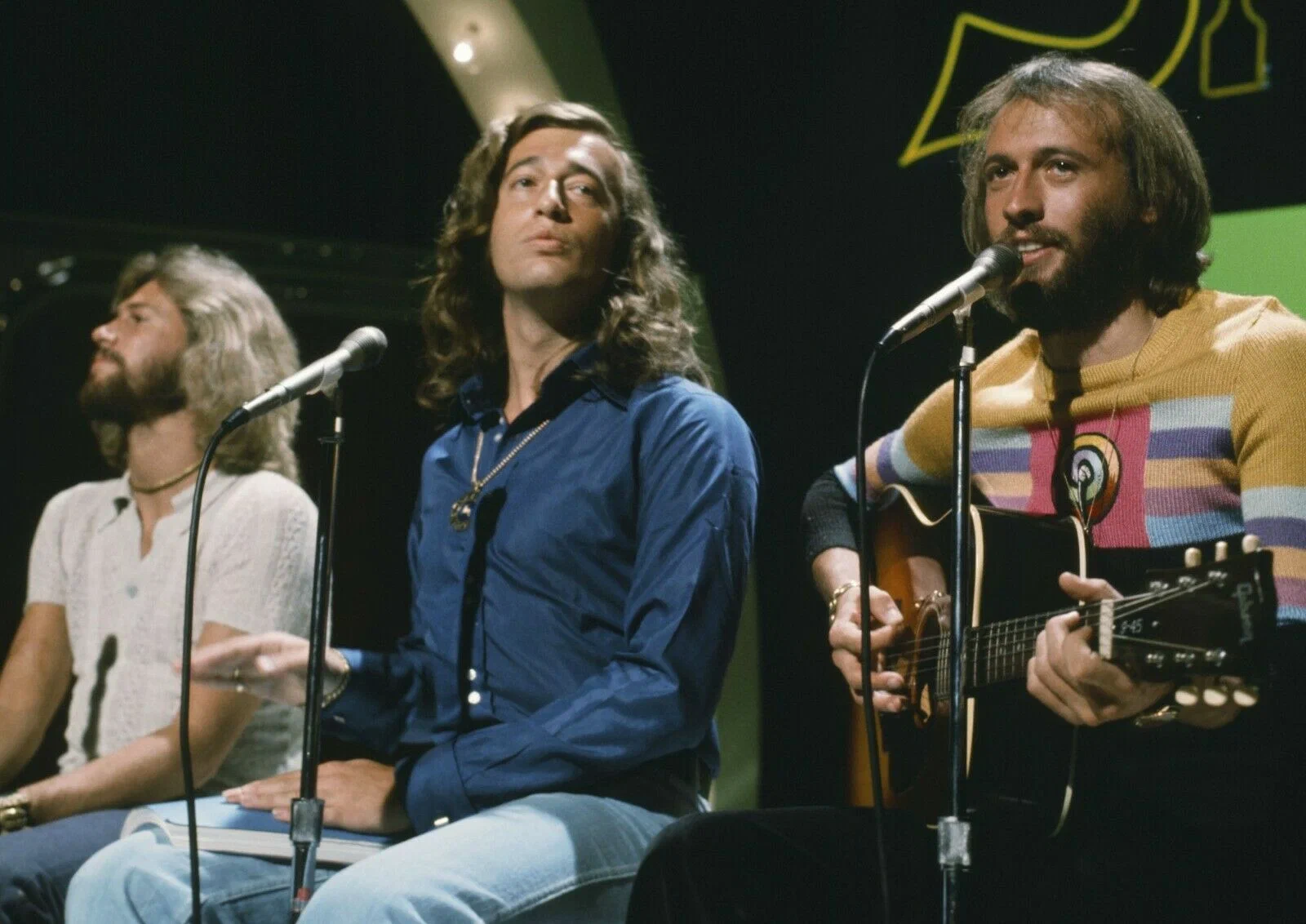
A strange, intimate corner of Bee Gees’ 1st, “Craise Finton Kirk Royal Academy of Arts” strips away the era’s bright ornament and leaves behind something lonelier, more fragile, and far more revealing.
Among the colored lights, chamber-pop flourishes, and psychedelic ambition of the Bee Gees in 1967, “Craise Finton Kirk Royal Academy of Arts” remains one of the most arresting surprises in their catalog. It was never the obvious song. It was not a hit single, it did not chart on its own, and it has never carried the household-name status of “New York Mining Disaster 1941,” “To Love Somebody,” or “Massachusetts.” Yet for listeners who have lived with Bee Gees’ 1st for years, this deep cut can feel like the album’s stillest and most private room.
That matters because Bee Gees’ 1st, released in 1967, arrived at a moment when the group was introducing itself internationally with extraordinary confidence. The album reached No. 7 on the UK album chart and No. 16 on the Billboard album chart in the United States, a remarkable showing for a record full of ambition, melody, and shifting moods. But “Craise Finton Kirk Royal Academy of Arts” was not built for the charts. It feels almost deliberately removed from commercial instinct. In the middle of an album often praised for its baroque-pop textures and late-1960s imagination, this song stands apart as a stark piano-and-voice meditation, hushed enough that it can seem to arrive from another emotional climate altogether.
The title alone has helped give the song a near-mythic reputation among devoted fans. “Craise Finton Kirk Royal Academy of Arts” sounds eccentric, literary, faintly surreal, and perfectly at home in the Bee Gees’ early period, when words could be both playful and mysterious. But the recording itself is far less decorative than the title suggests. Instead of grand theatricality, the performance leans toward restraint. That contrast is part of what gives the track its power. You expect something ornate; what you receive is something exposed.
As a listening experience, the song feels almost like overhearing a thought before it hardens into a statement. The piano is not there to impress. It carries the piece with a plain, melancholy dignity, leaving the vocal to do what the Bee Gees did so well in their early years: turn uncertainty into atmosphere. The brothers were already capable of rich harmonic architecture, but here the effect is more inward than expansive. The beauty of the track lies in its hesitancy, in the sense that the emotion is being approached carefully rather than declared. That is one reason it continues to linger with listeners who return to the album not just for its famous songs, but for its hidden emotional passages.
In terms of authorship, the song bears the songwriting credit shared by Barry Gibb, Robin Gibb, and Maurice Gibb, which is essential to understanding the Bee Gees at this stage. Their early records were not simply collections of catchy tunes; they were attempts to build whole inner worlds. Even on lesser-known tracks, there was a seriousness of purpose. “Craise Finton Kirk Royal Academy of Arts” may be a deep cut, but it is not a throwaway. It reflects the literary, melancholy, and highly English mood that drifted through parts of Bee Gees’ 1st, an album shaped by the atmosphere of 1967 London as much as by pop competition.
That London context matters. In 1967, many groups were widening the possibilities of pop music, adding orchestration, abstraction, and mood to songs that might once have been simpler in design. The Bee Gees were often compared to their contemporaries, sometimes too quickly, but their gift was distinct. They could be ornate without losing tenderness. On this song, however, they chose minimalism over adornment. That decision makes it one of the most emotionally naked recordings on the album. The silence around the notes matters almost as much as the notes themselves.
As for meaning, the song resists neat summary, and perhaps that is why it has lasted so well. It carries the feeling of dislocation, inward searching, and delicate sadness that defined so much of the Bee Gees’ finest early work. Rather than delivering a straightforward narrative, it creates an emotional space. The listener is invited to sit inside it, to feel its distance and ambiguity. In that way, it behaves less like a pop single and more like a private sketch from a notebook—except the melody is too haunting, and the atmosphere too carefully shaped, for it to remain merely incidental.
There is also something revealing in the way this track sits inside Bee Gees’ 1st. Albums from that era often gained their reputations through the singles, but their deeper truths were tucked into the non-hits. “Craise Finton Kirk Royal Academy of Arts” shows the Bee Gees not as polished hitmakers, but as young artists drawn to mood, character, and emotional mystery. Long before the disco era would redefine their public image, they were making intimate, haunted, beautifully peculiar records like this one.
That is why the song still matters. Not because it was famous, but because it was fearless in a quieter way. It trusted stillness. It trusted suggestion. It trusted that a listener might lean in rather than wait to be dazzled. For those who know only the Bee Gees of later radio history, this track can come as a small shock. For those who already love their 1960s work, it remains one of the clearest signs that beneath the melodies and harmonies was a deep instinct for atmosphere, fragility, and emotional understatement.
And perhaps that is the lasting beauty of “Craise Finton Kirk Royal Academy of Arts.” On an album that helped establish the Bee Gees as major voices of the late 1960s, this unassuming deep cut quietly reveals another truth: sometimes the songs that say the least on the surface are the ones that stay with us the longest.
