
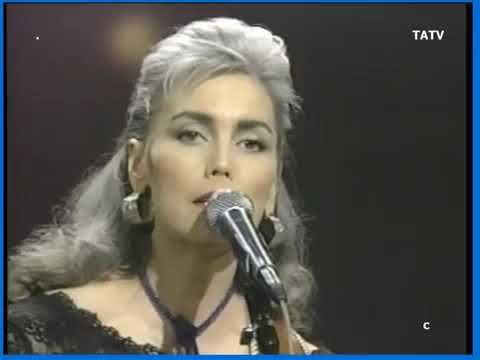
Tulsa Queen is one of those rare Emmylou Harris recordings that turns a fleeting figure into a lasting ache, giving beauty, distance, and longing the shape of a woman you never quite forget.
Released in 1978 on Quarter Moon in a Ten Cent Town, Tulsa Queen was written by Rodney Crowell and recorded by Emmylou Harris during one of the richest creative stretches of her career. While the song itself was not a major chart single, it belongs to an album that reached No. 3 on Billboard’s Top Country Albums chart and also crossed into the Billboard 200, further proving how powerfully Harris could bridge country tradition and broader American songwriting. Produced by Brian Ahern, the record carried the polish of a studio masterwork without ever losing the dust, heart, and open-road feeling that made Harris so distinctive.
That matters, because Tulsa Queen is not simply a pleasant album track tucked between bigger titles. It is part of the reason Quarter Moon in a Ten Cent Town still feels so rich decades later. The song comes from Rodney Crowell, a writer Harris believed in deeply, long before the rest of the world fully caught up to his gifts. She had an extraordinary instinct for songwriters, and her catalog is filled with examples of that discerning ear. In Crowell, she found someone who understood the poetry of restless lives, late-night highways, and people who seem almost too vivid to belong to ordinary life. Tulsa Queen carries all of that.
What gives the song its lasting power is the way it lives between portrait and myth. The woman at its center is not introduced with grand explanation. Instead, she arrives like many unforgettable people do in memory: partly real, partly imagined, sharpened by distance, and made larger by longing. That is one of the quiet miracles of the song. The word queen does not suggest royalty in the literal sense; it suggests presence, charisma, and the kind of magnetic identity that can dominate a room, a town, or a heart. And the word Tulsa does something equally important. It grounds the song in a real American place, but it also opens a landscape of motion, departure, and emotional geography. In country music, towns are never just towns. They are markers of who we were when we passed through them.
Emmylou Harris understood that kind of emotional map better than almost anyone. Her voice on Tulsa Queen is tender, luminous, and beautifully restrained. She does not crowd the song with dramatics. She lets it breathe. That choice gives the performance its spell. Rather than tell the listener what to feel, she allows admiration and sadness to exist side by side. The result is haunting. You hear fascination in the phrasing, but also a sense that this woman can never be fully held, fully known, or fully kept. In lesser hands, a song like this could become decorative. In Harris’s hands, it becomes deeply human.
The arrangement helps enormously. Like so much of the music Harris made with her gifted circle in the late 1970s, the sound is graceful, unforced, and full of space. There is movement in it, but not hurry. It feels like a song made for windows, distance, and reflection. That was one of the great strengths of Quarter Moon in a Ten Cent Town as an album. It could deliver songs with chart power, but it also made room for pieces that lingered more quietly, revealing themselves over time. Tulsa Queen is exactly that kind of song. It does not overwhelm on first contact. It settles in, and then it stays.
There is also something especially revealing about where the song sits in Emmylou Harris’s broader legacy. By 1978, she was already far more than a singer with impeccable taste. She was becoming one of the defining interpreters of modern country and country-rock, an artist who could honor tradition while gently expanding what belonged inside it. Her recordings often elevated songs that might have remained modest in other hands. She did not merely sing good material; she uncovered emotional dimensions inside it. With Tulsa Queen, she transforms a finely written character sketch into something almost cinematic, a small drama carried on mood, memory, and suggestion.
That is why the song continues to resonate. It understands a truth that age only deepens: some people are unforgettable not because they stayed, but because they passed through with such force. They become symbols in our private histories. We remember the way they sounded, the way they moved through a season of our lives, the way a place seemed changed because they once stood inside it. Tulsa Queen captures that feeling with uncommon delicacy. It is about admiration, yes, but also about the loneliness hidden inside admiration when the object of it remains just beyond reach.
In the end, this is one of those deep album cuts that explains why Emmylou Harris still commands such devotion. The hits may open the door, but songs like Tulsa Queen are what make listeners stay. It is elegant without being fragile, intimate without being confessional, and nostalgic without softening the ache at its center. On a record as strong as Quarter Moon in a Ten Cent Town, it might not have been the loudest statement. But it remains one of the loveliest, and one of the most quietly unforgettable.
