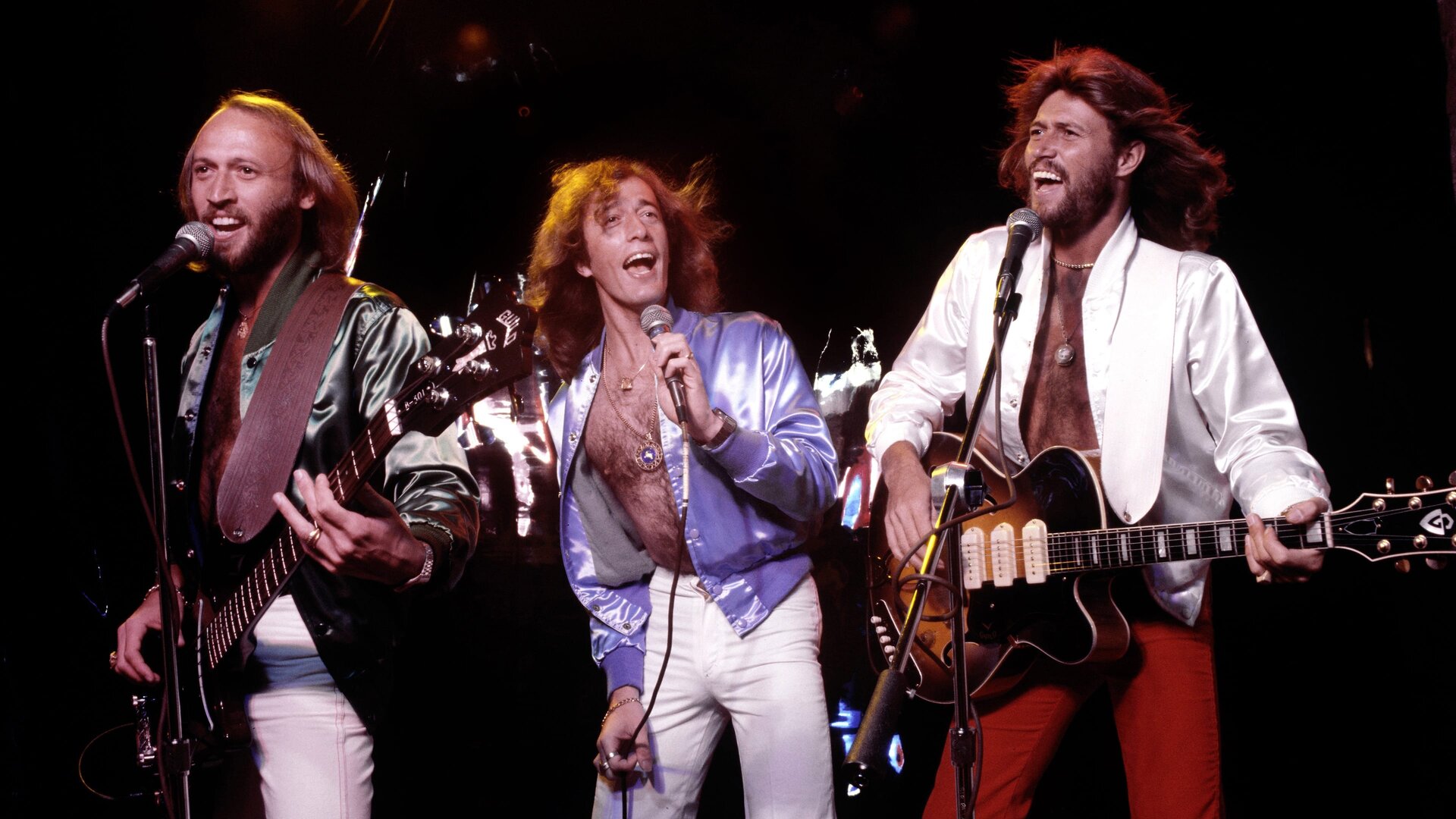
There is a special kind of confidence in “Boogie Child”—the sound of the Bee Gees pushing deeper into rhythm, swagger, and chart momentum without losing their melodic nerve.
By the time “Boogie Child” arrived as the third single from the Bee Gees’ 1976 album Children of the World, the group had already made their direction clear. They were no longer simply revisiting the ornate pop melancholy that had first defined them in the late 1960s. They had stepped into a sharper, more physical kind of music, one built on movement, clipped precision, and the unmistakable force of Barry Gibb’s falsetto. If “You Should Be Dancing” announced that change in flashing lights, “Boogie Child” confirmed it with something tougher and leaner: a hard-driving R&B groove that felt built for motion from the first bar.
Released from an album that became a crucial bridge between the Bee Gees’ earlier era and the global sweep that would soon follow, Children of the World captured the brothers at a moment of reinvention. They had already found success again with Main Course in 1975, but this next record sounded even more committed to rhythm. On “Boogie Child”, that commitment turns almost combative. The track moves with a tight, muscular pulse, its bass and drums locking into a groove that owes as much to contemporary soul and funk as to the polished pop craftsmanship the Bee Gees always carried with them. Over it all, Barry sings not with soft elegance but with a cutting edge, his falsetto sounding urgent, insistent, almost fierce.
That aggressive vocal approach is one of the song’s defining pleasures. The Bee Gees’ falsetto period is often remembered for smoothness, glide, and seductive sheen, but “Boogie Child” reminds listeners that there was bite in that sound too. Barry does not float above the rhythm here; he drives into it. The performance has a kind of push that makes the song feel less like atmosphere and more like impact. Even when the arrangement stays disciplined, there is a sense of pressure inside it, as though the track is always leaning forward.
From a chart-history perspective, that matters. “Boogie Child” did not become the defining Bee Gees single that some of its neighbors in the catalog would become, but it extended an important run. In the United States, it reached the Top 20 on the Billboard Hot 100, a strong showing that proved the group’s groove-centered reinvention had depth, not just novelty. As the third single from Children of the World, it helped show that the album was not built around one spectacular crossover hit alone. There was real range inside this era: dance-floor electricity, romantic sophistication, and songs like “Boogie Child” that hit with a more direct rhythmic force.
That chart performance also says something larger about the Bee Gees’ position in 1976 and early 1977. The group was no longer an act surviving on memory or trying to force its way back into relevance. They had become current again, and not by chasing trends timidly. They absorbed American R&B textures, disco energy, and studio clarity with conviction. “Boogie Child” stands as one of the clearest examples of that confidence because it never sounds hesitant about what it wants to be. It is not dressed up in nostalgia. It is not apologizing for rhythm. It sounds like three seasoned songwriters and performers understanding exactly where the pulse of popular music had moved—and then answering it in their own voice.
The song’s place within Children of the World is especially revealing. That album, released on RSO Records, contains some of the Bee Gees’ most significant mid-1970s work, and “Boogie Child” gives it a rougher edge than casual memory sometimes allows. When people speak about the Bee Gees’ ascent into the disco era, the story can become simplified into a few giant titles and a few familiar images. But the real transition was more textured than that. “Boogie Child” is part of what makes the period feel substantial rather than symbolic. It shows the group not just adopting a fashionable beat, but developing command over rhythmic tension, arrangement, and vocal attack.
There is also something appealing about the song’s slight underdog quality in the catalog. Because it lives in the shadow of larger Bee Gees milestones, it can catch listeners by surprise all these years later. Put it on now, and what comes through is not a historical footnote but a record with real snap and appetite. The groove still feels compact and purposeful. The vocal still cuts through cleanly. And the performance still carries that distinct mid-1970s Bee Gees sensation: melody sharpened into motion.
In that sense, “Boogie Child” deserves to be heard not merely as the third single after bigger headlines, but as a vital chapter in the Bee Gees’ climb. It is the sound of a band proving that its transformation could hold across a full album cycle, across multiple singles, across changing expectations. Some songs announce an era. Others strengthen it from within. “Boogie Child” did the latter, and it did it with a rhythm that still feels like it has somewhere urgent to go.
