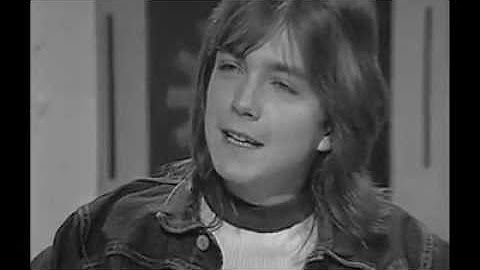
In “I’ll Never Stop Loving You”, David Cassidy sounded less like a former idol chasing yesterday than a grown singer trying to make tenderness feel earned.
David Cassidy’s “I’ll Never Stop Loving You” belongs to his 1992 album Didn’t You Used to Be…, a record whose very title seemed to understand the strange pressure of being recognized before being heard. The song was co-written by Cassidy with John Wetton, the English bassist, vocalist, and songwriter known for his work with King Crimson, U.K., and Asia. On paper, that pairing can look unexpected: Cassidy, forever shadowed by the bright glare of The Partridge Family and early-1970s pop stardom, joining creative hands with a musician associated with progressive rock weight, arena-sized melody, and serious musicianship. But that unlikely connection is exactly what gives the song part of its quiet fascination.
By 1992, Cassidy was no longer trying to introduce himself to the world. That had happened too loudly, too young, and too completely. The problem was different now. He had to sing past the memory people carried of him: the television image, the magazine covers, the screaming audiences, the youthful face that had become a kind of public property. Didn’t You Used to Be… was not just an album title; it sounded like a question he had probably heard in one form or another for years. Used to be what? A teen idol? A television star? A chart regular? A voice from someone else’s adolescence? The unfinished phrase leaves a little sting in the air.
That is why “I’ll Never Stop Loving You” feels more interesting than a simple romantic pledge. Its title promises devotion, but in the context of Cassidy’s later recording life, the words carry a second meaning. They can be heard as a love song, certainly, but also as a statement from an artist who had survived the complicated aftermath of early fame. There is a difference between singing love as a young star surrounded by noise and singing it after years of being measured against the person the public refuses to let go. In that later setting, the phrase becomes steadier, less decorative, more adult.
The presence of John Wetton deepens that reading. Wetton’s best-known work often balanced strength with melancholy, building songs that could be polished and direct while still carrying emotional weather beneath the surface. With Asia, he helped shape rock songs that reached wide audiences without losing a sense of inner drama. With Cassidy, that gift for melodic seriousness suited a singer looking for material that could move beyond nostalgia. Their collaboration suggests not a novelty pairing, but a meeting point between two musicians who understood how a strong melody can hold both confidence and ache.
In the early 1990s, the pop landscape was shifting quickly. Radio was making room for rougher guitars, sharper edges, and a different kind of confession. For an artist associated with the polished glow of another era, the challenge was not simply to sound contemporary; it was to sound honest without pretending the past had not happened. Cassidy’s voice, often underestimated because of the machinery that first made him famous, had always carried more vulnerability than his image allowed. On a song like “I’ll Never Stop Loving You”, that vulnerability matters. The emotional force does not come from spectacle. It comes from restraint, from the sense of a man singing words that might have once sounded easy, but now feel tested by time.
There is also a bittersweet tension in the album’s setting. Didn’t You Used to Be… arrived long after the first burst of Cassidy’s fame, and long before the wider culture became more generous about reassessing performers once dismissed as teen sensations. For many listeners, the old label stuck. But songs like this ask for a different kind of attention. They invite the listener to hear craft, survival, and the slow reshaping of identity. Cassidy was not erasing the young man the world remembered; he was singing from the other side of him.
That is what gives “I’ll Never Stop Loving You” its lasting emotional pull. It is not only the sentiment of the lyric, but the life surrounding the performance. The song stands at the intersection of memory and reinvention, where a familiar name tries to speak in a more seasoned voice. Cassidy had lived with adoration, dismissal, expectation, and the uneasy privilege of being recognized everywhere for a version of himself frozen in time. In that light, a simple vow of love becomes something more fragile and more human.
To hear the song now is to hear a performer working against the easy story. It is a reminder that pop history often flattens people into moments, while songs preserve the parts that remain in motion. David Cassidy did not need to outrun the past on “I’ll Never Stop Loving You”. He needed only to sing through it, with enough sincerity to make the promise feel less like a line and more like a quiet act of endurance.
