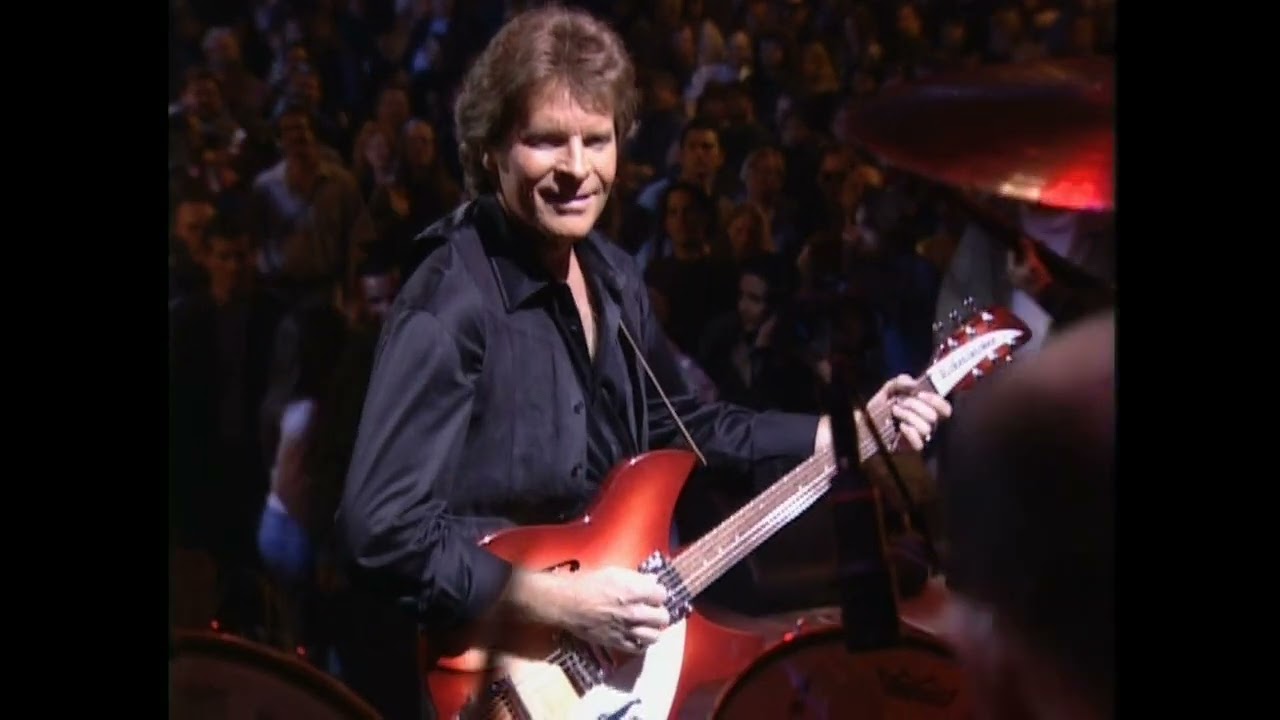
With “Hot Rod Heart,” John Fogerty turned the road song into a declaration: the old fire had not vanished, it had simply been waiting for the right engine to start again.
John Fogerty released “Hot Rod Heart” on his 1997 solo album Blue Moon Swamp, a record that carried unusual weight because it was not merely another chapter after Creedence Clearwater Revival. It was a long-awaited return to the sound, grit, humor, and rural electricity that had made Fogerty one of American rock’s most recognizable voices. The song’s place in that comeback became even clearer when “Hot Rod Heart” earned Fogerty a Grammy nomination for Best Male Rock Vocal Performance, a recognition that framed the track not as a nostalgic exercise, but as proof that his voice could still cut through the noise with force and personality.
By the time Blue Moon Swamp arrived in 1997, Fogerty had already lived through more than one musical lifetime. In the late 1960s and early 1970s, his songs with Creedence Clearwater Revival seemed to come from some mythic American crossroads: part swamp, part garage, part radio tower, part front-porch warning. But his solo career had been shaped by long silences, legal burdens, and the difficult shadow of his own past. His previous album of original material, Eye of the Zombie, had appeared in 1986, and the gap that followed made Blue Moon Swamp feel less like a routine release than a reemergence.
That is what makes “Hot Rod Heart” so telling. On the surface, it is a brisk, road-hungry rocker, full of motion, chrome, pulse, and the simple pleasure of forward momentum. Fogerty had always understood the symbolic power of cars in American music. A car was never only transportation. It was escape, courtship, pride, youth, danger, freedom, and sometimes denial. In “Hot Rod Heart”, that imagery lets him do something wonderfully direct: he turns the machinery of rock and roll back on, not with a grand statement, but with a grin, a riff, and a rhythm that refuses to sit still.
The track belongs naturally to the world of Blue Moon Swamp, an album steeped in roots textures without sounding like a museum piece. Fogerty drew from rockabilly snap, country twang, blues phrasing, swamp-rock atmosphere, and the compact discipline of classic singles. He had always been a craftsman of brevity and impact, and here that craft returns with sharpened confidence. “Hot Rod Heart” does not wander. It moves with purpose. The guitars bite cleanly, the beat keeps its shoulders squared, and Fogerty sings as though the miles are opening up in front of him.
What separates the song from mere retro styling is the vocal performance. Fogerty’s voice had always carried a strange blend of youthfulness and weather: a high, urgent, cutting tone that could sound like warning siren, preacher, mechanic, and runaway teenager all at once. On “Hot Rod Heart”, that voice is not trying to imitate the past. It is inhabiting a language he helped invent. There is joy in the delivery, but also defiance. After years in which his relationship with his own history was complicated, even painful, hearing him lean into this kind of muscular American rock felt like a man reclaiming a set of tools he had never truly lost.
The Grammy nomination for Best Male Rock Vocal Performance matters because it recognized that specific quality. The song is built for movement, but the performance is what gives it personality. Fogerty does not sing it like a relic from an old jukebox. He sings it like someone who knows exactly how much mileage a simple groove can carry when the engine is tuned right. The nomination placed him among contemporary rock voices of the late 1990s while also acknowledging the deep continuity of his own work. He was not returning as a guest from another era. He was still part of the conversation.
Blue Moon Swamp itself went on to win the Grammy Award for Best Rock Album, a remarkable moment for an artist who had spent years negotiating the distance between public memory and private artistic renewal. But “Hot Rod Heart” holds a special place within that story because it captures the album’s spirit in motion. It is not the most solemn track, nor the most overtly reflective, yet it says something essential about Fogerty’s solo legacy. Sometimes survival in music is not announced through confession. Sometimes it is heard in the way a snare drum kicks, the way a guitar line leans into the curve, the way a singer sounds suddenly unburdened by the question of whether he still belongs.
For listeners who first knew Fogerty through the thunder of Creedence, “Hot Rod Heart” offered a familiar spark in a new frame. For those who encountered him through the 1997 comeback, it showed why his style had endured without becoming stiff. The song’s charm lies in its confidence. It does not ask to be treated as a monument. It asks to be driven. And perhaps that is why it remains such a revealing piece of his catalog: beneath the car imagery and rock-and-roll lift, there is a man finding speed again after a long stretch of difficult road.
In the larger arc of John Fogerty’s solo career, “Hot Rod Heart” sounds like more than a lively album cut with Grammy recognition. It sounds like the moment when motion itself becomes a kind of answer. The past is still there in the rearview mirror, impossible to erase and too important to ignore. But the song keeps its eyes forward. The engine catches, the rhythm settles in, and Fogerty’s voice rides out with the rare assurance of someone who knows the road because he helped pave part of it.
