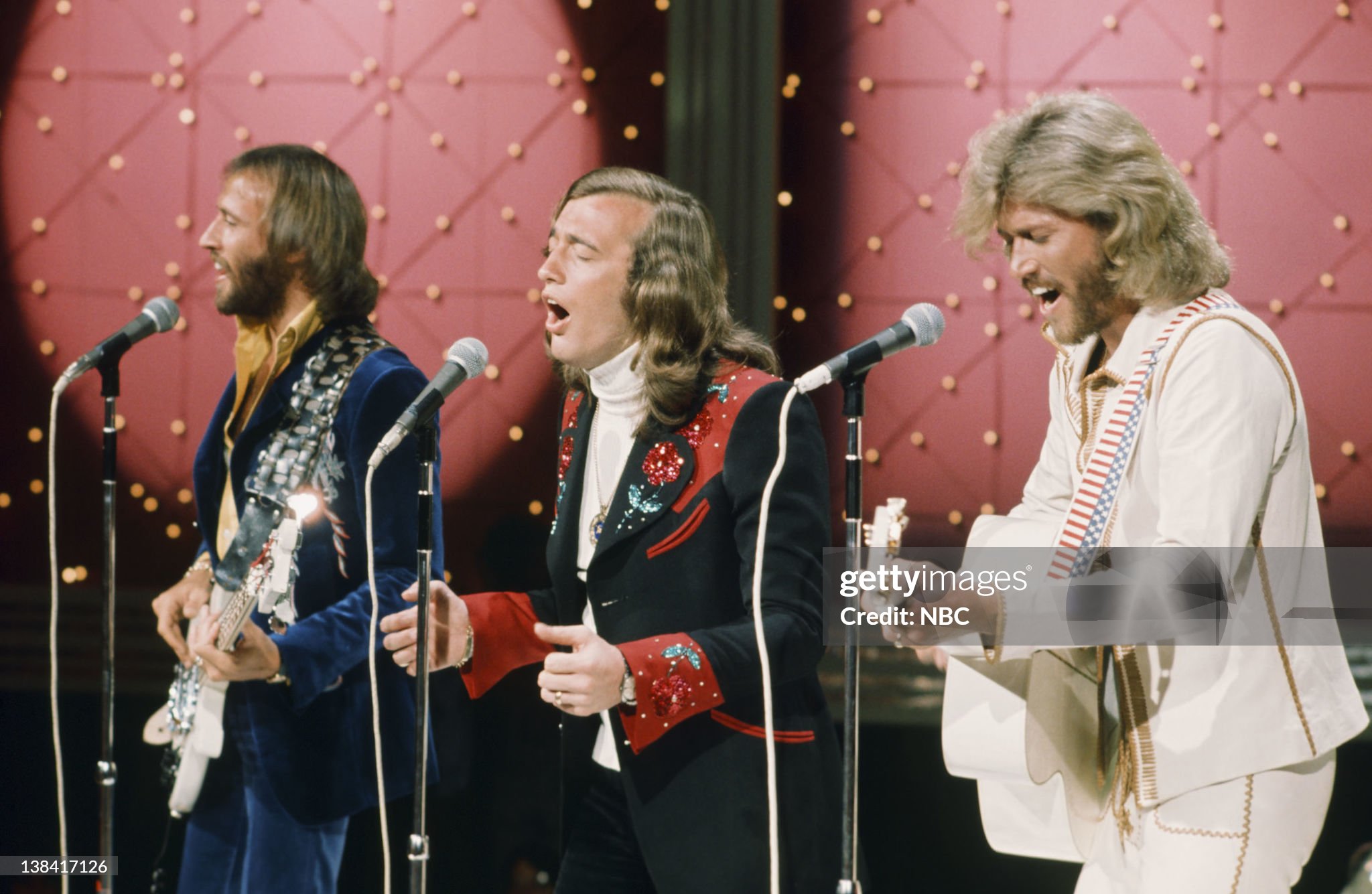
On Omega Man, the Bee Gees let Maurice Gibb carry the pulse, revealing a brotherly harmony that felt grounded, rhythmic, and quietly resilient.
Released on the Bee Gees’ 1993 album Size Isn’t Everything, Omega Man stands apart as a rhythmic mid-tempo track anchored by a lead vocal from Maurice Gibb. That detail matters. In a group so often publicly defined by Barry’s falsetto and Robin’s tremulous emotional edge, Maurice’s voice could sometimes be treated by casual listeners as part of the architecture rather than the front door. But when he stepped into the lead, the whole room changed shape.
Size Isn’t Everything arrived during a period when the Bee Gees were no longer simply defending their past; they were still writing, arranging, adapting, and testing the language of brotherhood inside contemporary pop. The album contained polished adult-pop craft, sleek early-1990s production, and the unmistakable fraternal blend that had carried them from the 1960s through disco-era global fame and into later reinventions. In that setting, Omega Man does not need to announce itself as the album’s grand statement. Its strength is more internal. It moves with a steady groove, a controlled sense of momentum, and a vocal center that gives Maurice room to show a side of the Bee Gees story that is easy to miss if one only follows the biggest hits.
Maurice was often described through his musicianship: bass, keyboards, guitar, studio instincts, arrangement sense, and the essential middle presence in the brothers’ vocal stack. He helped hold the Bee Gees’ sound together not only as a performer, but as a stabilizing musical mind. On Omega Man, that stabilizing quality becomes expressive. His lead vocal is not built around theatrical drama. It does not chase the sky the way Barry could, nor does it ache in quite the same exposed manner as Robin. Maurice sings with a grounded clarity, a rhythmic confidence, and a slightly understated emotional pressure. The effect is intimate without being fragile.
The track’s mid-tempo feel is crucial to that impact. It gives Maurice space to ride the beat rather than float above it. The groove keeps moving forward, but it does not overpower him. Around him, the familiar Bee Gees harmony appears not as decoration, but as kinship made audible. Barry, Robin, and Maurice had spent decades turning blood relation into musical language. Their harmonies were not merely accurate; they carried the strange closeness of voices that knew one another before fame, before studios, before audiences. In Omega Man, that closeness feels less like spectacle and more like support. Maurice may be in front, but the brothers are still around him, shaping the air.
That is what gives the song its special pull. It reminds listeners that the Bee Gees were never only a sequence of eras: beat group, ballad craftsmen, disco giants, pop survivors. They were three brothers negotiating identity through sound. Sometimes one voice dominated. Sometimes the blend became almost anonymous in its perfection. But on tracks like Omega Man, the balance shifts just enough to reveal the human arrangement beneath the famous name. Maurice’s lead does not separate him from the Bee Gees; it clarifies his place inside them.
Hearing the song within Size Isn’t Everything also gives it a particular emotional color. By 1993, the Bee Gees carried a long history behind every new recording. Any fresh track had to exist in the shadow of songs that had already become part of public memory. Yet Omega Man does not sound like a band trying to reenact an old triumph. It sounds like experienced musicians trusting their own internal chemistry. The rhythm is measured, the melodic movement is clean, and the arrangement leaves enough room for Maurice’s personality to come through without forcing a dramatic spotlight.
There is a quiet dignity in that. Maurice’s presence in the Bee Gees was sometimes most powerful because it was connective. He could be the bridge between Barry’s commanding pop instinct and Robin’s wounded, keening intensity. When he sang lead, the listener could hear that bridge become a road of its own. Omega Man is valuable for exactly that reason. It does not require mythmaking to be meaningful. It simply lets a central member of one of pop’s great family groups step forward and remind us that harmony is not only about voices blending perfectly. It is also about trust, placement, restraint, and the deep knowledge of when to lead and when to surround.
For fans who return to the Bee Gees beyond the obvious landmarks, Omega Man offers a rewarding kind of rediscovery. It captures Maurice not as a supporting shadow, but as a rhythmic and emotional anchor. It shows the brothers’ harmony working in service of one of their own. And it leaves behind the feeling that inside the Bee Gees’ vast catalog, some of the most revealing moments are not always the loudest ones. Sometimes they are the songs where a familiar family sound turns slightly, and a different brother’s heart comes into view.
