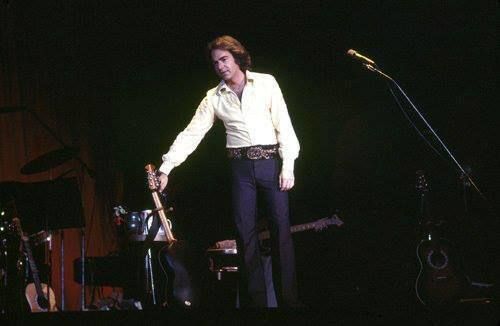
Smokey Lady reveals the shadowed, intimate side of Neil Diamond—a song shaped less by chart glory than by atmosphere, mystery, and the quiet ache of attraction that never fully settles into certainty.
Not every important Neil Diamond song came wrapped in a famous chart number. Smokey Lady was never one of his major Billboard calling cards, and it did not stand beside the big public peaks of Solitary Man, Cherry, Cherry, Sweet Caroline, or Cracklin’ Rosie as a widely celebrated hit single. If one is looking for a headline chart position at the time of release, this song does not really live in that world. It is better understood as a deep-catalog piece rather than a chart-driven success. And yet, that is part of its lasting fascination. Songs like this often tell us something precious about an artist—what he sounded like when he was not chasing the obvious anthem, but following mood, character, and instinct.
That is where Smokey Lady becomes so intriguing. The title alone feels like a room you can step into. Neil Diamond always had a gift for making a person seem larger than a person—turning a name, a memory, or a passing figure into a complete emotional landscape. In this song, the woman at the center is not painted in bright daylight. She comes through in haze and suggestion. She is glamour, distance, temptation, and uncertainty all at once. The title does not just describe her; it surrounds her. That was one of Diamond’s great talents as a writer. He could sketch a whole emotional weather system in a few carefully chosen words.
Part of the story behind Smokey Lady lies in the kind of songwriter Neil Diamond had already become. Long before he was a full-fledged arena institution, he had trained himself in the discipline of strong titles, memorable hooks, and vivid emotional shorthand. His New York songwriting background taught him economy, but his best work always added something more theatrical and more inward. Even in songs that were not major commercial events, he wrote with seriousness. That matters here. Smokey Lady does not feel tossed off or disposable. It feels like the work of an artist interested in emotional tone just as much as commercial impact.
The meaning of the song rests in that tension between desire and distance. This is not love presented as safety or permanence. It is attraction filtered through mystery. The very word smoky suggests beauty, but it also suggests concealment. You can see the outline, but not the whole truth. That emotional ambiguity gives the song its pull. Like many of Neil Diamond’s more underrated recordings, it understands that the heart is not always drawn to what is clear. Sometimes it is drawn to what is elusive, to what seems to flicker just outside complete understanding. Smokey Lady captures that feeling beautifully.
There is also something unmistakably cinematic about it. Even without the public mythology that surrounds Diamond’s biggest hits, the song feels visual. One can imagine late hours, a room thick with memory, the kind of moment when conversation slows and every glance seems to carry a second meaning. This is one reason the song stays with people who find it. It does not insist on itself the way a chorus-built smash does. It lingers. It moves by suggestion. It asks the listener to lean in.
That quality sets it apart from the brighter, more communal side of Neil Diamond. Where Sweet Caroline opens its arms, Smokey Lady keeps part of itself hidden. Where Holly Holy rises toward something almost spiritual, this song stays closer to the ground, closer to the dimly lit places where charm and uncertainty mingle. And in that sense, it enlarges the picture of Diamond as a songwriter. He was never only the man of sing-along choruses and thunderous crescendos. He was also a writer deeply drawn to mood, to nuance, and to emotional half-light.
For many listeners, that is exactly why a lesser-known song can become so personal. Hits belong to everybody. Deep cuts often feel like they belong to the listener alone. Smokey Lady rewards that kind of private attention. The more one sits with it, the more it seems to reveal about Neil Diamond’s artistic temperament: his fondness for vivid female portraits, his feel for atmosphere, and his ability to make longing sound elegant rather than merely sad. He understood that not every song had to shout its meaning. Some songs could simply drift into the room and change its temperature.
So while Smokey Lady may not carry a famous chart peak, it carries something else that matters just as much over time: character. It reminds us that the richness of Neil Diamond’s catalog cannot be measured only by radio staples and gold-selling landmarks. Sometimes the truest measure of an artist is found in the songs that live just outside the spotlight. This is one of those songs—a quiet, dusky, memorable piece of writing that still feels like midnight long after the record stops spinning.
