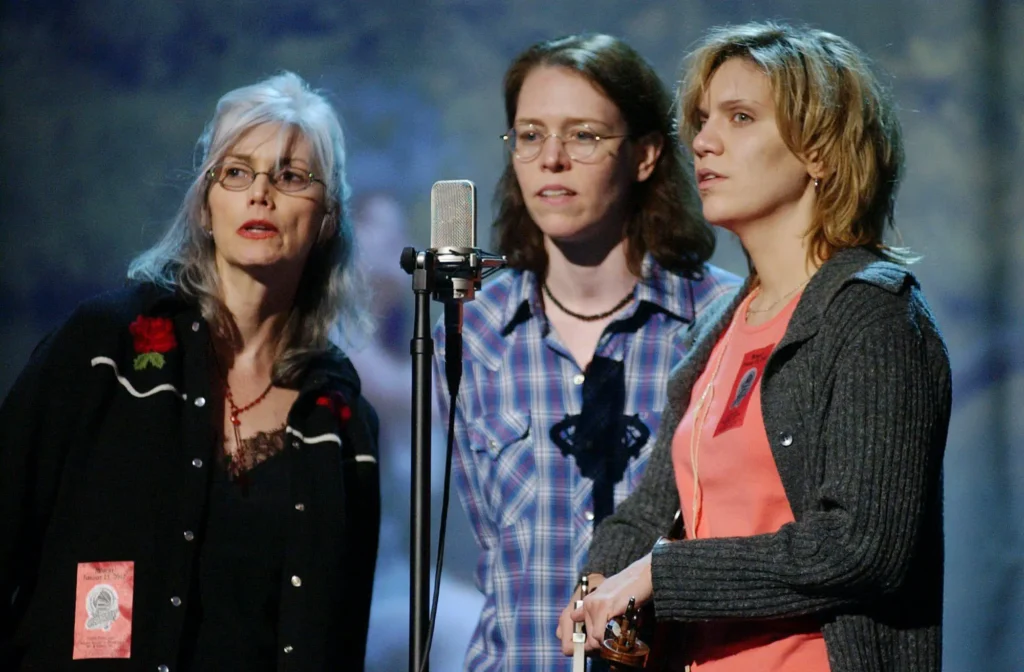
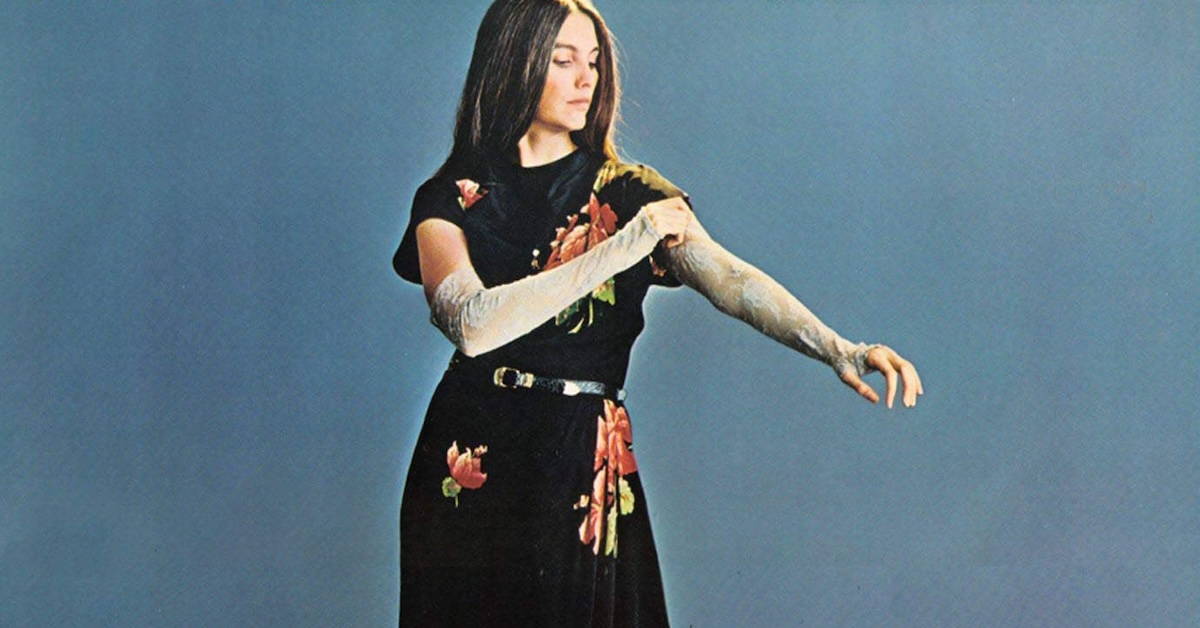
“Didn’t Leave Nobody But The Baby” feels less like a song than an old Southern spell—part lullaby, part warning, part whispered temptation drifting in from a darker, older America.
When Emmylou Harris joined Alison Krauss and Gillian Welch on “Didn’t Leave Nobody But The Baby,” the result was one of the eeriest, most unforgettable moments on the O Brother, Where Art Thou? soundtrack. The track appeared as song No. 10 on the album, released in 2000 and produced by T Bone Burnett for the Coen brothers’ film. The song itself was not a standalone chart hit, but the album around it became a phenomenon: it reached No. 1 on the Billboard 200, No. 1 on Billboard’s Top Country Albums, No. 1 on Billboard’s Soundtrack Albums, won the Grammy for Album of the Year, and has since been certified 8× Platinum in the United States. That matters, because this recording did not survive as a cult curio tucked away on a soundtrack. It lived inside one of the most culturally important roots-music albums of the modern era.
The title may sound rough-hewn and old, and in truth it is. The song was drawn from a traditional lullaby source rather than written from scratch in the modern pop sense. The soundtrack credits list it as traditional, performed by Emmylou Harris, Alison Krauss, and Gillian Welch. But the version most listeners know was not simply copied from some fixed, ancient master text. As later critical accounts explained, Welch and Burnett expanded the lullaby from a field recording of Sidney Lee Carter collected by folklorist Alan Lomax. That is one reason the song feels so uncanny: it carries the authority of something old, yet it was shaped with remarkable intelligence for the atmosphere of the film.
And atmosphere is everything here. “Didn’t Leave Nobody But The Baby” enters O Brother, Where Art Thou? like a dream turning dangerous. In the film, it accompanies the scene with the river women, and that setting helps explain why the recording lodges so deeply in memory. The song is sung as a lullaby—“Go to sleep, little baby”—but it does not feel merely comforting. It feels seductive, half maternal and half fatal, as though tenderness itself has become a veil over something more mysterious. That tension is what gives the performance its distinctly Southern Gothic force. It belongs to folk music, yes, but also to folklore in the darker sense: enchantment, danger, sleep, forgetting, surrender.
This is where Emmylou Harris becomes essential to the spell. Her voice had long carried qualities that made her uniquely suited to music where beauty and sorrow meet in the same breath. On this recording, however, she is not alone at the center. The brilliance lies in the blend—Harris, Krauss, and Welch moving together so closely that the harmonies feel less like three singers taking turns than one old spirit speaking through three human voices. A later reassessment of the soundtrack described the track as a “siren song” and noted how those aligned harmonies intensify the song’s subtext without ever becoming explicit. That is exactly right. The performance never shouts its darkness. It glides. And because it glides, it unsettles more deeply.
Its mystery also comes from what the song refuses to explain. Many folk songs survive because they leave room for unease. “Didn’t Leave Nobody But The Baby” is outwardly simple, almost childlike in repetition, but repetition in old folk music can do strange work. It can soothe, but it can also hypnotize. The line “go to sleep” is a comfort in one setting and a threat in another. In the world of O Brother, where roots music is constantly tied to wandering, judgment, memory, and homecoming, that ambiguity becomes especially powerful. The soundtrack as a whole was carefully designed to feel period-appropriate to Depression-era Mississippi, drawing on bluegrass, gospel, blues, and Southern folk traditions. This song, then, is not decorative mood-setting. It is central to the old, haunted world the film wanted to summon.
There is also a deeper reason the recording has lasted. The O Brother, Where Art Thou? soundtrack did more than support a movie; it helped trigger a broad modern revival of interest in Americana, old-time music, and traditional song. Critics have since described it as a record that primed a generation for a modern folk revival, bringing neglected sounds back into the mainstream and reshaping how many listeners heard Southern roots music. Within that larger story, “Didn’t Leave Nobody But The Baby” remains one of the soundtrack’s most singular tracks because it does not arrive as a crowd-rouser or a rootsy singalong. It arrives like folklore preserved in amber—beautiful, strange, and slightly frightening.
So yes, folk, mystery, pure Southern Gothic—all of that is in this performance. But what makes Emmylou Harris so unforgettable on “Didn’t Leave Nobody But The Baby” is that she never treats the song like an antique curiosity. She sings it as living material, with all its old shadows still intact. Surrounded by Alison Krauss and Gillian Welch, she helps turn a traditional lullaby into something far more haunting than a mere revival piece. It becomes a whisper from the deep past, carried into modern ears without losing its chill. And that is why the song still lingers: not because it explains the South, but because it preserves one of its oldest musical gifts—the ability to make beauty and dread sound inseparable.
