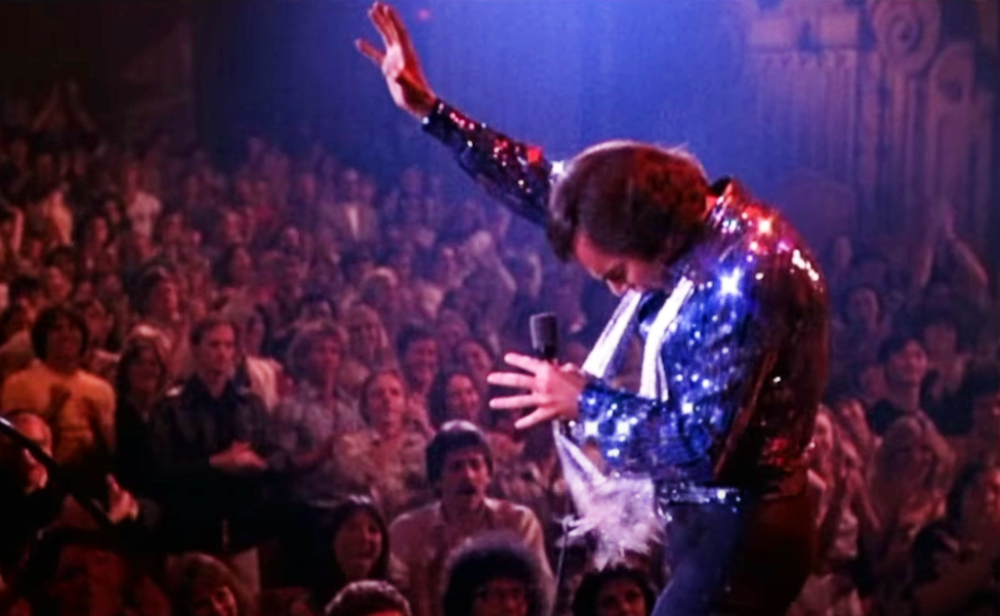
In Neil Diamond’s “Dry Your Eyes”, heartbreak is met with dignity instead of melodrama, and in The Last Waltz that calm ache revealed a far deeper songwriter than the public singalong image ever suggested.
When Neil Diamond appeared in The Last Waltz, he did more than sing a song. He changed the temperature of the room. By the time Martin Scorsese’s concert film reached audiences in 1978, the performance of “Dry Your Eyes” had become one of those moments that quietly rearranged a reputation. Many listeners already knew Diamond as the man behind huge, communal hits, the kind of records people sang with their arms around each other. But in this setting, preserved from The Band’s farewell concert at Winterland Ballroom in San Francisco on Thanksgiving night, 1976, he came across not as a crowd-pleaser first, but as a writer of adult feeling, restraint, and bruised wisdom.
The timing matters. “Dry Your Eyes” came from Beautiful Noise, Diamond’s 1976 album produced by Robbie Robertson. That album reached No. 6 on the Billboard 200, confirming Diamond’s commercial power, yet “Dry Your Eyes” was never treated in popular memory as one of his giant singalong trademarks. In a way, that helped. It arrived without the burden of familiarity. Instead of walking into The Last Waltz as a guaranteed crowd eruption, it entered as a song that had to make its case by writing, mood, and delivery. And it did.
The story behind the song is essential to understanding why the performance landed so strongly. Robbie Robertson did not merely invite Diamond into an already historic concert; he had already been working closely with him. Their collaboration on Beautiful Noise gave Diamond a setting that leaned less on easy polish and more on atmosphere, texture, and emotional complexity. “Dry Your Eyes”, co-written by Diamond and Robertson, is built on a hard kind of consolation. It does not promise reunion. It does not romanticize pain. Its central message is almost startlingly mature: gather yourself, accept the truth, keep moving. That emotional discipline is one reason the song has aged so well. It speaks softly, but it does not blink.
In the world of The Last Waltz, that kind of writing mattered. This was not just another televised variety-show appearance. It was a gathering of towering musical personalities: Bob Dylan, Joni Mitchell, Van Morrison, Muddy Waters, Neil Young, and others, all orbiting The Band at a moment already framed as the end of an era. For some rock purists, Diamond may have seemed like an unexpected guest on paper. But that is exactly why the performance is so revealing. With The Band behind him and Scorsese’s camera refusing to let the song drift into mere showmanship, Diamond had to stand on craft. There was nowhere to hide, and he did not need to.
What emerges on screen is a version of Neil Diamond that still surprises people who know him mainly through the broad glow of “Sweet Caroline”, “Song Sung Blue”, or “Cracklin’ Rosie”. Those songs are part of his greatness, of course, but they also created an easy shorthand: Diamond the mass entertainer, Diamond the singalong specialist, Diamond the hitmaker with the raised arm and the open-throated chorus. “Dry Your Eyes” complicated that picture. In The Last Waltz, he looked like something else as well: a precise songwriter who understood emotional aftershock, who knew how to write not just for uplift but for recovery.
That distinction is important because “Dry Your Eyes” is not built around a giant release. Its force comes from control. The lyric offers comfort, but it is not sentimental comfort. It recognizes that some endings do not arrive with thunder; they arrive with exhaustion, clarity, and the private work of steadying yourself. Diamond sings it with firmness rather than collapse. That choice gives the song its backbone. In a concert film packed with mythic personalities and dramatic textures, the quiet authority of that performance made its own kind of statement.
It also sharpened Diamond’s standing by association, and not in a shallow way. Being included in The Last Waltz was already a sign of respect from Robbie Robertson and The Band. But the real point is that Diamond justified the invitation artistically. He did not feel like a novelty booking. He felt like a songwriter whose strengths had been underestimated by people too eager to sort artists into easy boxes. Seen in that company, “Dry Your Eyes” sounded less like an album cut and more like a serious piece of late-night writing, the kind of song another songwriter hears and immediately recognizes as the real thing.
There is something deeply moving about the way the film preserved this shift. A concert can alter opinion in the room, but a film can keep altering it for decades. That is what happened here. The 1978 release of The Last Waltz gave viewers a more concentrated look at Diamond than radio ever could. On radio, a hit often becomes shorthand for an image. In film, a face, a pause, a line reading, and the reaction of the musicians around him can reopen the case. Neil Diamond did not need to argue for his seriousness in words. “Dry Your Eyes” argued for him.
And that may be the lasting beauty of the moment. The song did not destroy Diamond’s popular image; it deepened it. It reminded listeners that beneath the famous choruses was a writer capable of adult sorrow, plainspoken mercy, and emotional balance. In The Last Waltz, that truth became impossible to miss. The performance remains one of the clearest examples of how a single concert-film appearance can recast a familiar artist. Not by changing who he was, but by revealing what had been there all along.
