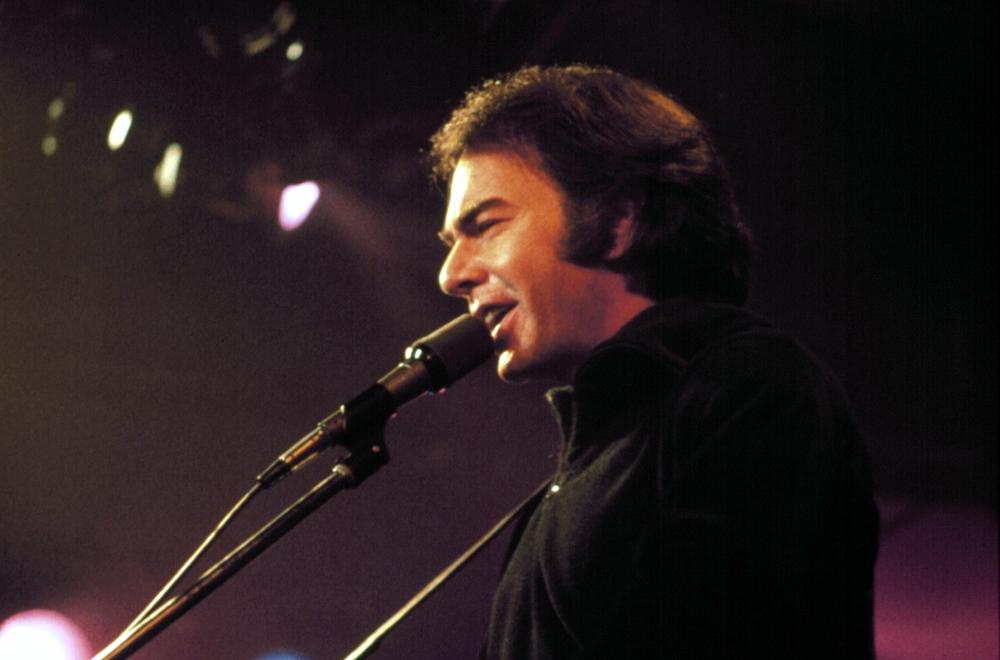
Delirious Love was the sound of Neil Diamond stepping away from polish and back toward feeling, opening a new creative chapter with Rick Rubin that felt weathered, urgent, and startlingly honest.
Released in 2005, ‘Delirious Love’ was far more than a new Neil Diamond single. It was the first clear signal that something had shifted in the way he wanted to be heard. The song served as the lead single from the album that would finally be released as 12 Songs, and for a time the project itself was associated with ‘Delirious Love’ strongly enough that the title felt like a statement of intent. On the charts, the single reached No. 16 on Billboard’s Adult Contemporary chart, while 12 Songs climbed to No. 4 on the Billboard 200. Those were strong numbers, certainly, but the deeper significance was artistic: this was the beginning of Diamond’s first studio partnership with Rick Rubin, and with it came one of the most important late-career turns of his life in music.
That producer shift mattered because Rick Rubin did not approach Neil Diamond as a legacy act in need of respectful handling. He approached him as a songwriter of depth who had, over the years, too often been surrounded by production that softened his edges. Rubin had already earned a reputation for stripping artists back to essence, but what he did with Diamond was not imitation and it was not a stunt. He was not trying to turn Diamond into someone else. He was trying to recover the man who had always been there beneath the sheen: the writer of ache, loneliness, longing, swagger, and self-reckoning. ‘Delirious Love’ was one of the first places listeners could hear that philosophy in action.
And you can hear it almost immediately. The record has grit. It does not glide; it leans forward. There is a dry, earthy physicality to it, a sense that the room has not been overly decorated for comfort. Instead of building the song into a grand adult-contemporary monument, Rubin lets it breathe like a restless, bruised piece of rock and soul. Diamond’s voice is not smoothed into perfection. The grain stays in place. The roughness stays in place. That is precisely why the performance lands. At an age when many singers are encouraged to hide every crack of experience, Neil Diamond sounds willing to let time remain audible. It gives the song authority.
The meaning of ‘Delirious Love’ lives in that tension. This is not innocent romance, and it is not a young man’s fantasy of passion without consequence. The title itself carries instability. Delirium suggests exhilaration, yes, but also disorientation, surrender, even a little danger. Diamond sings as if love can still overwhelm a person long after the illusions of youth are gone. That is what makes the song compelling. It is about desire that has survived experience, desire that knows what it costs and still refuses to retreat. In lesser hands, that idea can sound posed. Here, it sounds earned.
There is also something quietly moving about the timing. By 2005, Neil Diamond no longer needed to prove that he could write a hit or command an audience. The big songs, the arena resonance, the decades of recognition were already secure. What remained to be discovered was whether he could still surprise people by going inward without losing force. ‘Delirious Love’ answered that question with conviction. Rather than presenting maturity as calm or settled, the song insists that emotional life remains turbulent. Love is still ecstatic. Love is still unruly. Love can still leave a dignified man sounding gloriously unsettled.
That is why the Rubin connection feels so important in retrospect. Rick Rubin understood that Diamond’s power had never been limited to polish or scale. It came from the way he could sound both public and private at once, as though he were singing to a crowd and confessing to himself in the same breath. On ‘Delirious Love’, Rubin clears away distraction and lets that duality return. The result is a song that feels older than 2005 in the best possible sense. It does not chase trends. It trusts personality, phrasing, and emotional weather.
When 12 Songs arrived, many listeners and critics heard it as a genuine late-career renewal, and with good reason. The album’s success on the Billboard 200 showed that there was still a substantial audience ready to follow Diamond into this more intimate, less ornamental space. More importantly, the record re-centered the conversation around him as a serious writer and interpreter of feeling. Later projects with Rubin would deepen that path, but ‘Delirious Love’ was the door opening. It was the first handshake in public, the first audible proof that this pairing was not just intriguing on paper but meaningful in sound.
Nearly two decades later, the song remains striking because it does not ask to be admired as a museum piece. It still sounds like a decision being made in real time. A legendary artist, long associated with grandeur, chose roughness. A famed producer, known for subtraction, chose to trust the emotional weight already living inside the singer. And out of that meeting came ‘Delirious Love’, a record that reminded people that reinvention does not always arrive through spectacle. Sometimes it arrives through abrasion, restraint, and the brave decision to sound less protected than before.
That is the lasting beauty of ‘Delirious Love’. It was not simply a strong song from 2005. It was the beginning of a new honesty in Neil Diamond’s recorded life, the first chapter in a partnership with Rick Rubin that helped restore the shadows, scars, and heat that had always given his music its soul.
