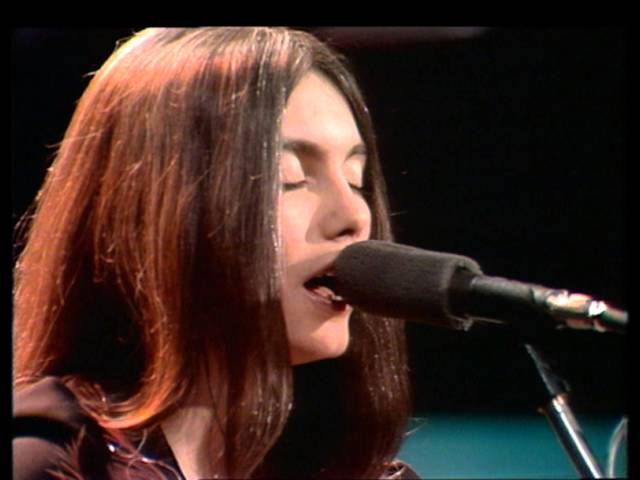
“Tulsa Queen” is a road song with a bruise under its grin—freedom painted in chrome, but powered by longing that refuses to stay parked.
Among the finely chosen covers and tradition-steeped classics on Emmylou Harris’s Luxury Liner, “Tulsa Queen” stands out like a handwritten note slipped into a well-thumbed songbook. It’s not only track 10 on the album; it’s also the one place on this record where Harris steps forward as a songwriter, co-writing the song with Rodney Crowell. That fact alone changes how you hear it. Luxury Liner is famous for Harris’s interpretive brilliance—how she can inhabit other people’s stories as if she lived them—but “Tulsa Queen” feels like a story she helped build, plank by plank, out of memory, desire, and restless motion.
The coordinates of its arrival matter. Luxury Liner was released December 28, 1976, produced by Brian Ahern, and it became Emmylou Harris’s second successive No. 1 on Billboard’s Top Country Albums chart. It also crossed into the pop mainstream, peaking at No. 21 on the Billboard 200, and finishing No. 2 on Billboard’s 1977 year-end Top Country Albums list. In other words, this was not a niche record living in the shadows; it was a major statement—yet within that statement, “Tulsa Queen” plays like a private room you only notice if you linger.
So what is the song’s story? It’s the kind of tale country music tells best: the night is loud with trains and promises, the heart is louder with doubt, and the only honest plan is to keep moving. The title figure—this “Tulsa Queen”—isn’t a pageant fantasy. She’s a symbol of a certain kind of independence: tough, untethered, unromantic about goodbyes. She doesn’t “care where she goes” or “where she’s been,” and she won’t be the one crying when the narrator can’t come back. That’s the ache at the center: the singer admires her freedom, but he’s also haunted by what that freedom costs. Love, in this song, isn’t the warm light in the kitchen window—it’s the cold gleam of distance, the feeling of being pulled toward the horizon because staying still might break you.
The “behind the scenes” detail that deepens the track is the co-writing credit. American Songwriter has pointed out that “Tulsa Queen,” written with Rodney Crowell, was the only song Harris wrote for Luxury Liner—a small but telling exception in an album otherwise built around her curator’s ear. That makes the lyric’s urgency feel even more personal: a singer known for perfect choices allowing one imperfect, human impulse to remain—an original thought among masterpieces, a confession among portraits.
Musically, the performance sits right inside the Hot Band world—tight, seasoned, and emotionally precise. Crowell is credited on the album as a player and vocalist as well, and Harris’s own vocal has that signature blend of steel and tenderness: she can sound composed while revealing exactly where it hurts. If you listen closely, you can feel the song leaning into a classic country contradiction: the narrator says he wants to “ride” away, as far as the wheels can carry him, but the very act of describing the journey is proof that he’s not free of what he’s leaving behind. The road is both escape and shrine.
Meaning-wise, “Tulsa Queen” is less about Tulsa than about the myth of anywhere-else. Tulsa becomes a name you can sing, a location that stands in for the past—maybe a lover, maybe a former self, maybe the version of life that would have been easier if the heart weren’t built for movement. The queen herself becomes a mirror: admired because she seems unbreakable, feared because she proves that attachment always comes with risk. The narrator’s longing isn’t just romantic; it’s existential—he wants the kind of self-possession she represents, even as he knows he’s already lost it by caring.
And perhaps that’s why the song lingers long after the last note. On a record that charted big—No. 1 country, No. 21 pop—“Tulsa Queen” doesn’t sound like a bid for numbers. It sounds like the quieter truth that can’t be marketed: sometimes we don’t leave because we’re brave; we leave because staying would force us to feel everything at once.
