
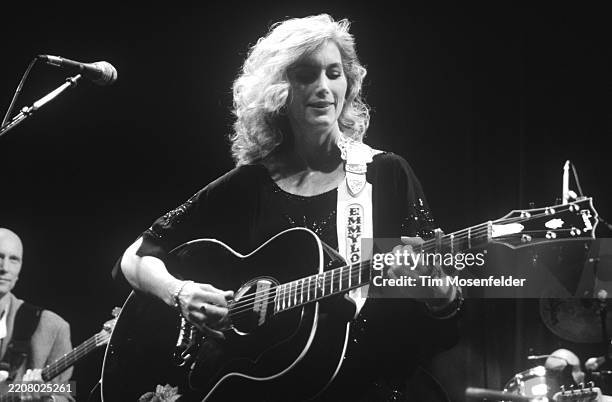
I Will Dream finds Emmylou Harris at her most tender and resolute, turning a simple promise into a song about endurance, inner light, and the grace of carrying hope through uncertain years.
Some songs arrive with fanfare, radio push, and chart momentum. Others come in softly, almost like a private thought, and spend years waiting for listeners to catch up. I Will Dream belongs to that second tradition. Released on Emmylou Harris‘s 1993 album Cowgirl’s Prayer, it was not one of the big Billboard country hits that stamped their numbers into the weekly trade papers. In fact, the song did not become a notable charting country single on its own, which tells you almost nothing about its lasting value. If anything, that lack of chart noise has helped preserve what makes it so beautiful: it still feels personal, unforced, and quietly profound.
Placed in the context of Emmylou Harris‘s long career, I Will Dream now sounds especially important. The early 1990s were a transitional period for her. She had already given country and folk music some of the most elegant recordings of the previous two decades, and she no longer needed to prove that she could sing with purity, intelligence, or emotional depth. What she was searching for by then was something deeper than format. Cowgirl’s Prayer, the album that carries I Will Dream, arrived two years before Wrecking Ball would redefine her artistic image for many listeners. That makes this song feel like a bridge: rooted in the warm earth of classic country and folk, yet already leaning toward a more interior, reflective, almost spiritual mode of expression.
What gives I Will Dream its power is the way it refuses melodrama. Emmylou Harris does not oversell the lyric. She sings it with the kind of calm conviction that only great interpreters possess, as if the act of dreaming is not fantasy at all, but discipline. In lesser hands, a title like this might drift into sentimentality. Here, it becomes a vow. The song suggests that hope is not naive; it is chosen. It is held onto deliberately, especially after disappointment, fatigue, and the long weather of experience have had their say.
That is one reason the song lingers. It understands that faith in tomorrow is often quiet. There is no need for a dramatic crescendo to make the point. I Will Dream moves with patience, and that patience is part of its meaning. The arrangement, understated and spacious, gives Emmylou Harris‘s voice room to do what it has always done so exquisitely well: sound both fragile and unwavering at the same time. Few singers in American music have ever balanced those qualities so gracefully. She never sounds as though she is pretending to be strong. She sounds like someone who has learned what strength really costs.
There is also something deeply moving about where this song sits within Cowgirl’s Prayer. The album itself has often been treated as a smaller chapter in a giant career, overshadowed by the more celebrated reinventions before and after it. But that is exactly why returning to I Will Dream can feel so rewarding. It reveals an artist listening inward. Not chasing trends. Not competing for volume. Not straining for relevance. Simply trusting songcraft, tone, and emotional truth. For listeners who value maturity in music, that matters. A great many records announce themselves. Very few invite you to live with them.
The meaning of I Will Dream is open enough to hold different lives inside it. Some hear perseverance in it. Some hear healing. Some hear the stubborn beauty of remaining openhearted after life has made every practical argument against it. That openness is one of the song’s great strengths. Emmylou Harris has always been gifted at singing from a place where sorrow and hope are not opposites, but companions. In this song, dreaming is not escape from reality. It is a way of surviving it without hardening.
And perhaps that is why the song feels richer today than ever. Commercially, it did not arrive with the force of a major chart event. Artistically, however, it captured something more durable than a ranking: a moment of becoming. Listen closely and you can hear the doorway opening toward the atmospheric courage of Wrecking Ball, but you also hear the timeless Emmylou Harris qualities that had been there all along: taste, restraint, ache, and luminous humanity.
In the end, I Will Dream stands as one of those overlooked songs that says more with less. It does not demand attention. It earns devotion. For anyone who has ever needed music not to shout, but to stay close, this recording offers rare company. It reminds us that dreaming, in the hands of Emmylou Harris, is not weakness. It is a form of courage carried softly, and all the more powerfully for that.
