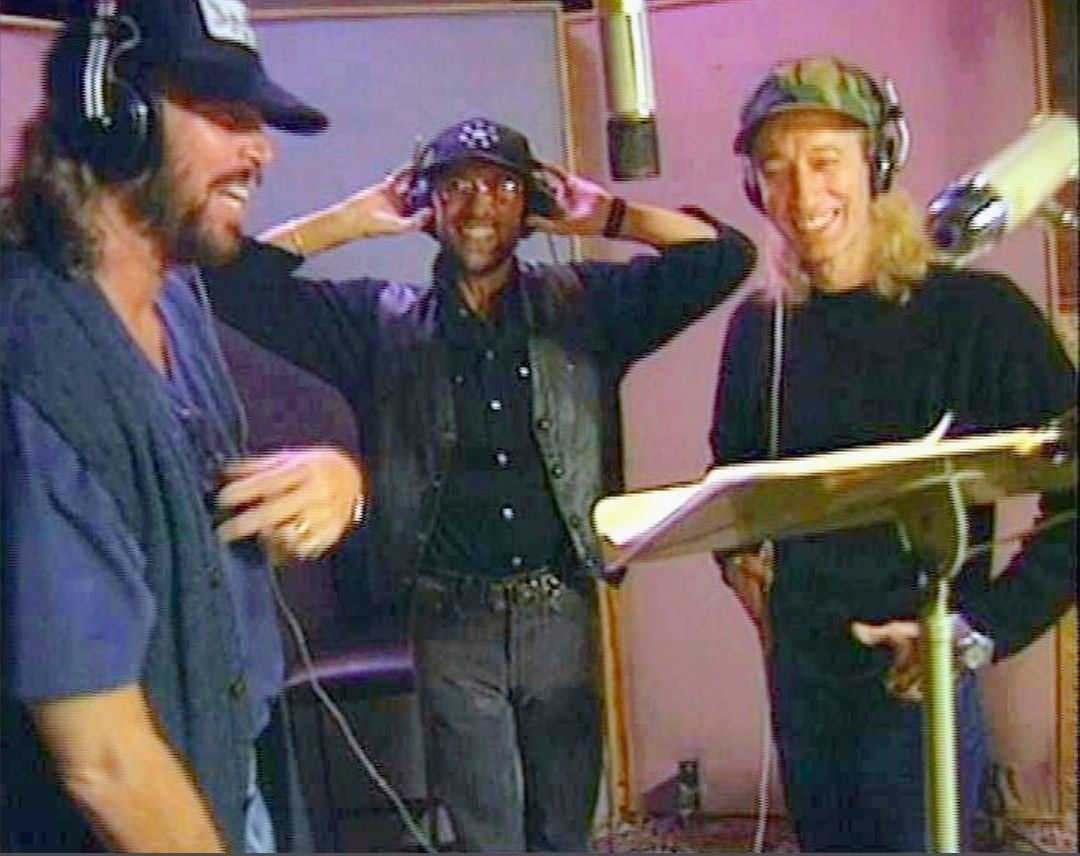
On Dogs, the Bee Gees sound caught between eras, letting Arif Mardin pull weight and grit from a band still known for aching harmony.
Dogs, from the Bee Gees album Mr. Natural, belongs to one of the most revealing passages in the group’s long career: the unsettled, searching stretch of 1974, when Barry Gibb, Robin Gibb, and Maurice Gibb were not yet the global disco-era force they would soon become, but were already moving away from the ornate balladry and baroque pop textures that had defined so much of their earlier success. Produced by Arif Mardin, Mr. Natural did not arrive as a blockbuster rescue or a neat reinvention. It sounds more interesting than that. It sounds like a band in motion, trying to find the next room before the door had fully opened.
That is why Dogs matters, even though it is not usually placed among the Bee Gees songs casual listeners reach for first. It is an album track with the character of a workshop light left on late at night. The song catches the brothers in a transitional mood, their melodic instincts still unmistakable, their harmonies still carrying that familiar emotional pressure, but the ground underneath them feels different. The rhythm section has more bite. The drums and bass are not merely framing the voices; they are helping define the attitude of the track. There is a physicality here that points forward, not in a fully finished way, but in a way that makes the listener hear the band shifting its weight.
By 1974, the Bee Gees had already lived several careers in public. They had been teenage hitmakers, melancholic craftsmen, harmony specialists, and survivors of changing pop fashions. Their late 1960s and early 1970s recordings often carried a finely arranged sadness, where strings, piano, and close vocal blend made the songs feel suspended between confession and theater. But pop music was changing around them. Soul, funk, and harder-edged rhythm tracks were pushing mainstream records toward the body as much as the heart. The Bee Gees did not need to abandon feeling; they needed a new engine for it.
Arif Mardin was crucial to that process. Known for his deep musical intelligence as an arranger and producer, and for his work in the Atlantic Records orbit with soul, jazz, and rhythm-and-blues sensibilities, Mardin did not simply polish the Bee Gees. He helped redirect their attention. On Mr. Natural, and later more decisively on Main Course in 1975, he encouraged a stronger rhythmic foundation and a sharper relationship between voice and groove. Dogs sits inside that development like a clue: not the famous breakthrough itself, but one of the tracks that shows the breakthrough being imagined.
What makes the song compelling is the tension between old and new Bee Gees instincts. The brothers still write with a dramatic melodic pull, and their voices still carry an emotional unity that feels almost familial beyond technique. Yet the track does not float in the same way some of their earlier ballads do. It leans. It presses forward. The rhythm section gives the song a tougher surface, and that toughness changes the emotional temperature. Instead of sounding wounded from a distance, the performance feels closer to the floor, closer to breath, closer to a band testing what happens when melancholy is given weight.
That heavier feel should not be confused with the sleek dance-floor identity that would soon define them in the popular imagination. Dogs is not a disco record, and Mr. Natural is not the album where the Bee Gees suddenly become the sound of the late 1970s. Its importance lies in its in-between quality. The track lets us hear the group before the transformation became obvious, when the ingredients were present but not yet simplified into a myth. There is rhythm, but not formula. There is grit, but not a pose. There is ambition, but also uncertainty.
That uncertainty gives the song its lasting interest. Many famous catalogues are remembered through their peaks, but the transitional recordings often tell the more human story. They reveal artists not as statues, but as workers, listeners, risk-takers, and sometimes wanderers. The Bee Gees of Dogs are not coasting on past elegance, and they are not yet protected by the massive success that would come later. They are listening for a new pulse. They are allowing a producer with a sophisticated rhythmic ear to pull them toward a sound with more muscle. They are trying to become current without losing the strange emotional signature that made them themselves.
In hindsight, Dogs feels like one of those small but telling catalog moments that changes shape once the whole journey is known. Heard after Main Course, after Jive Talkin’, after the fevered cultural explosion of Saturday Night Fever, it becomes easier to recognize the track as part of the road toward reinvention. But it also deserves to be heard on its own terms: as a tight, shadowed, rhythm-conscious album cut from a band learning that harmony could survive inside a harder groove. The Bee Gees did not leap into their next era fully formed. On Dogs, you can hear them taking one of the steps.
