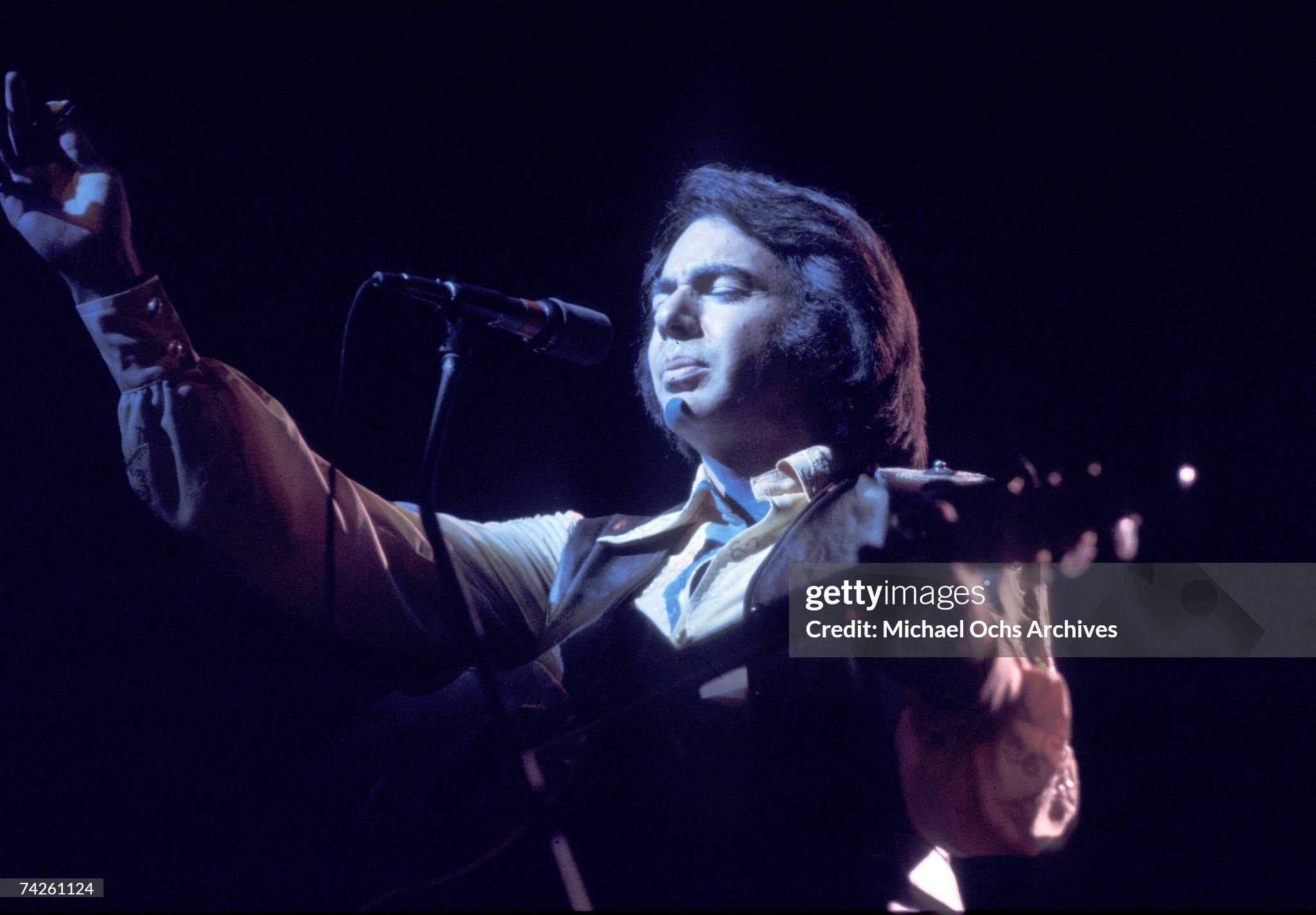
On Create Me, Neil Diamond turns a late-career album track into a quiet request to be remade, heard, and held without the old armor.
Released in 2005 on 12 Songs, Create Me belongs to one of the most revealing chapters in Neil Diamond’s long recording life: the stripped-back album produced by Rick Rubin. That context matters. This is not simply another Diamond love song placed somewhere in a vast catalog. It is a song shaped by the severe intimacy of a project that asked a famous performer, known for sweep, projection, and communal release, to stand closer to the microphone and let the writing carry more of the weight.
By the time 12 Songs arrived, Diamond had already lived several musical lives. He had been the Brill Building craftsman whose songs traveled through other voices, the solitary figure behind Solitary Man, the pop force of Sweet Caroline and Cracklin’ Rosie, the theatrical seeker of I Am… I Said, and the arena performer whose music could fill a room before he sang a word. His public image had grown large enough to become almost immovable. Rubin’s role, as producer, was not to erase that history, but to clear a space around it. On 12 Songs, the sound is deliberately spare: acoustic instruments, careful dynamics, room around the voice, and arrangements that refuse to rescue a song before it has made its emotional case.
Create Me works beautifully inside that atmosphere because it does not depend on spectacle. Its title alone suggests something more vulnerable than romance as performance. The phrase feels like a plea, but not a dramatic one. It carries the sense of someone asking love, faith, memory, or another human presence to participate in the making of the self. In younger hands, that kind of idea might have leaned toward declaration. In Diamond’s late-career voice, it feels more like recognition. The song is not about arriving fully formed. It is about admitting that even after fame, applause, and survival, a person may still be unfinished.
That unfinished quality is one of the reasons Rick Rubin’s production feels so essential here. Rubin had become widely associated with recordings that brought established artists back to essentials, most famously through his work with Johnny Cash. With Diamond, the task was different but related. Diamond did not need to be discovered; he needed to be heard without the protective brightness that can gather around a durable star. In Create Me, the arrangement allows small gestures to matter. A chord change does not have to announce itself. A pause can carry pressure. The grain in Diamond’s voice becomes part of the song’s meaning rather than something to be smoothed away.
The result is a track that asks listeners to adjust their expectations. Many people remember Neil Diamond through big communal moments: choruses shouted back by crowds, melodies that seem built for shared recognition, songs that turn a room into a memory machine. Create Me moves in another direction. It is inward without being small, devotional without becoming ornate, romantic without reducing itself to simple sentiment. The song’s power lies in the feeling that Diamond is not performing certainty. He is circling a need, giving it language, and trusting the listener to come close enough to hear it.
There is also something important about where this song sits in Diamond’s career. Late-career albums can sometimes feel like summaries, as if an artist is polishing the museum glass around familiar achievements. 12 Songs did not feel that way. It presented Diamond not as a monument but as a working songwriter still willing to submit to the discipline of a bare song. Create Me benefits from that discipline. It does not try to compete with the records that made him a household name. Instead, it opens a smaller door. Behind it is a man who has written for decades about longing, identity, devotion, escape, and belonging, now singing as though those themes have not been solved by success.
What makes the track linger is the tension between Diamond’s recognizable melodic instinct and the album’s refusal to dress that instinct too heavily. You can still hear the songwriter who understands the emotional pull of a rising phrase, the way a title can become a prayer if repeated with enough conviction, and the way direct language can feel almost startling when placed in a quiet setting. But the 2005 recording lets those gifts age naturally. It does not ask Diamond to sound young. It lets him sound present.
That presence is the heart of Create Me. It reminds us that a late-career recording can offer more than nostalgia; it can become a different kind of evidence. Here is a celebrated singer-songwriter allowing himself to be measured not by volume, not by crowd response, not by the glow of a familiar hit, but by the strength of a song standing in open air. In that space, the listener hears not a legend trying to reclaim something, but an artist still asking what can be made from what remains: the voice, the words, the wound, the hope, and the quiet courage to begin again.
