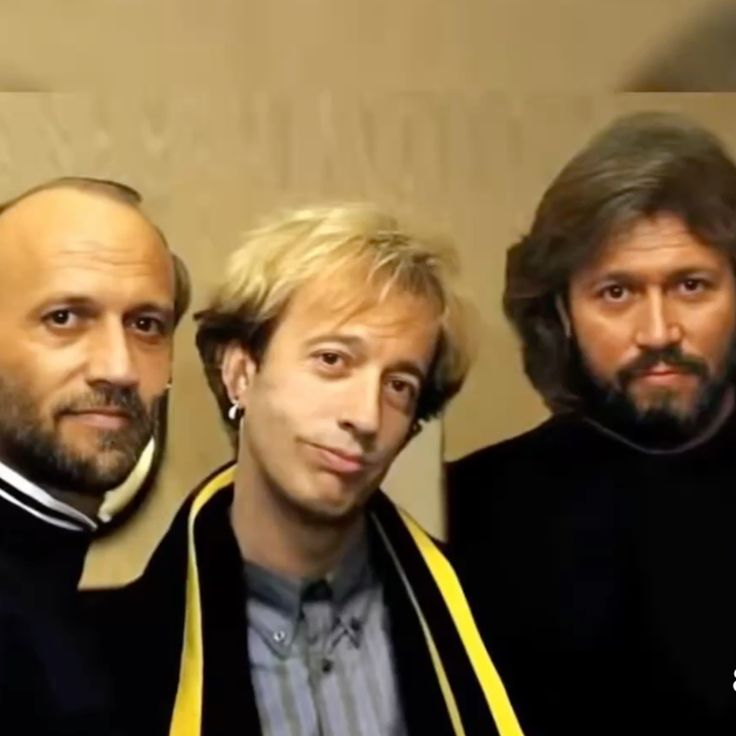
Before the Bee Gees became a symbol of escape, this 1971 single let Barry Gibb turn the band’s harmony inward, toward a room no applause could brighten.
Released in 1971 as a single from Trafalgar, Don’t Wanna Live Inside Myself sits in one of the most revealing corners of the Bee Gees catalog. Written by Barry Gibb, the song arrived during an era when the group had already known international fame, internal fracture, reunion, and the fragile relief of returning to one another musically. It was not the obvious public face of the band’s success that year. Trafalgar also contained How Can You Mend a Broken Heart, the sweeping ballad that became the Bee Gees’ first No. 1 single in the United States. Against that large emotional and commercial moment, Don’t Wanna Live Inside Myself felt more withdrawn, less like a confession delivered from a stage than a thought caught late at night before it could be polished into reassurance.
The early 1970s were a complicated passage for the Bee Gees. The brothers had emerged from the ornate pop world of the late 1960s, moved through the aftermath of their temporary separation, and found a new seriousness in the reunion years. 2 Years On had brought them back to prominence with Lonely Days, and Trafalgar deepened that mood: grand, careful, sometimes almost solemn, with arrangements that favored piano, strings, stately tempos, and voices placed as if in a cathedral of private memory. This was not yet the sleek, rhythmic Bee Gees of the disco era. This was a band listening to the echo of its own survival.
Within that setting, Barry Gibb’s songwriting on Don’t Wanna Live Inside Myself stands out for its inward pull. The title itself is unusually direct. It does not hide behind metaphor or romantic scenery. It names a condition: the weight of being trapped inside one’s own thoughts, the exhaustion of selfhood when memory and longing have nowhere to go. Barry had always been capable of melodic generosity, but here the melody seems to move under a low ceiling. It rises, yet it does not quite escape. That tension gives the record its brooding character.
The arrangement understands the song’s emotional temperature. It does not rush to rescue the singer. The piano foundation feels deliberate and shadowed, while the orchestral coloring expands around the vocal without making it feel triumphant. The Bee Gees’ harmonies, so often associated with lift and radiance, are used here with restraint. They do not turn the song into a communal celebration; they surround Barry’s lead like thoughts gathering in the same room. The beauty is there, but it is a heavy beauty, shaped by stillness and hesitation.
Barry’s vocal is central to the recording’s power. He does not sing it as theatrical despair, and that restraint matters. The performance has a kind of formal dignity, as if the feeling is too serious to be pushed too hard. In the verses, his voice carries the loneliness of someone trying to describe an interior state without asking directly for sympathy. By the time the song opens into its larger melodic gestures, the drama comes not from volume alone but from the sense that the voice has been holding something back. That was one of Barry Gibb’s gifts in this period: he could write a melody that seemed elegant on the surface while allowing a deeper disturbance to move beneath it.
As a single, Don’t Wanna Live Inside Myself did not become the kind of defining hit that How Can You Mend a Broken Heart did. That contrast is part of its fascination. The earlier single gave listeners a universal question wrapped in a sweeping chorus; Don’t Wanna Live Inside Myself offered something narrower, darker, and more interior. It was less an anthem of wounded love than a portrait of emotional confinement. For radio, that may have made it more difficult. For listeners returning to Trafalgar with time and patience, it gives the album one of its most revealing shadows.
The recording also helps explain why the Bee Gees cannot be understood through only one era or one sound. Long before their falsetto-driven reinvention transformed popular music in the second half of the decade, they were already masters of mood, melody, and psychological contrast. Trafalgar captures them in a chamber-pop and orchestral-ballad phase where grandeur and vulnerability often sat side by side. On Don’t Wanna Live Inside Myself, that balance becomes especially intimate. The song is large enough to belong to a band with international ambition, yet private enough to feel like a page Barry Gibb might have hesitated to leave open.
Hearing it now, the single feels less like a minor entry beside a bigger hit and more like a key to the Bee Gees’ emotional architecture. It reminds us that their harmonies were not only built for sweetness, romance, or dance-floor lift. They could also frame unease. They could make loneliness sound formal, almost beautiful, without softening its edges. In 1971, while the band was rebuilding its public momentum, Barry Gibb wrote a song that turned away from the spotlight and looked directly into the quiet pressure of the self. That is why Don’t Wanna Live Inside Myself still lingers: not because it explains everything, but because it admits how difficult it can be to live with what cannot be easily sung away.
