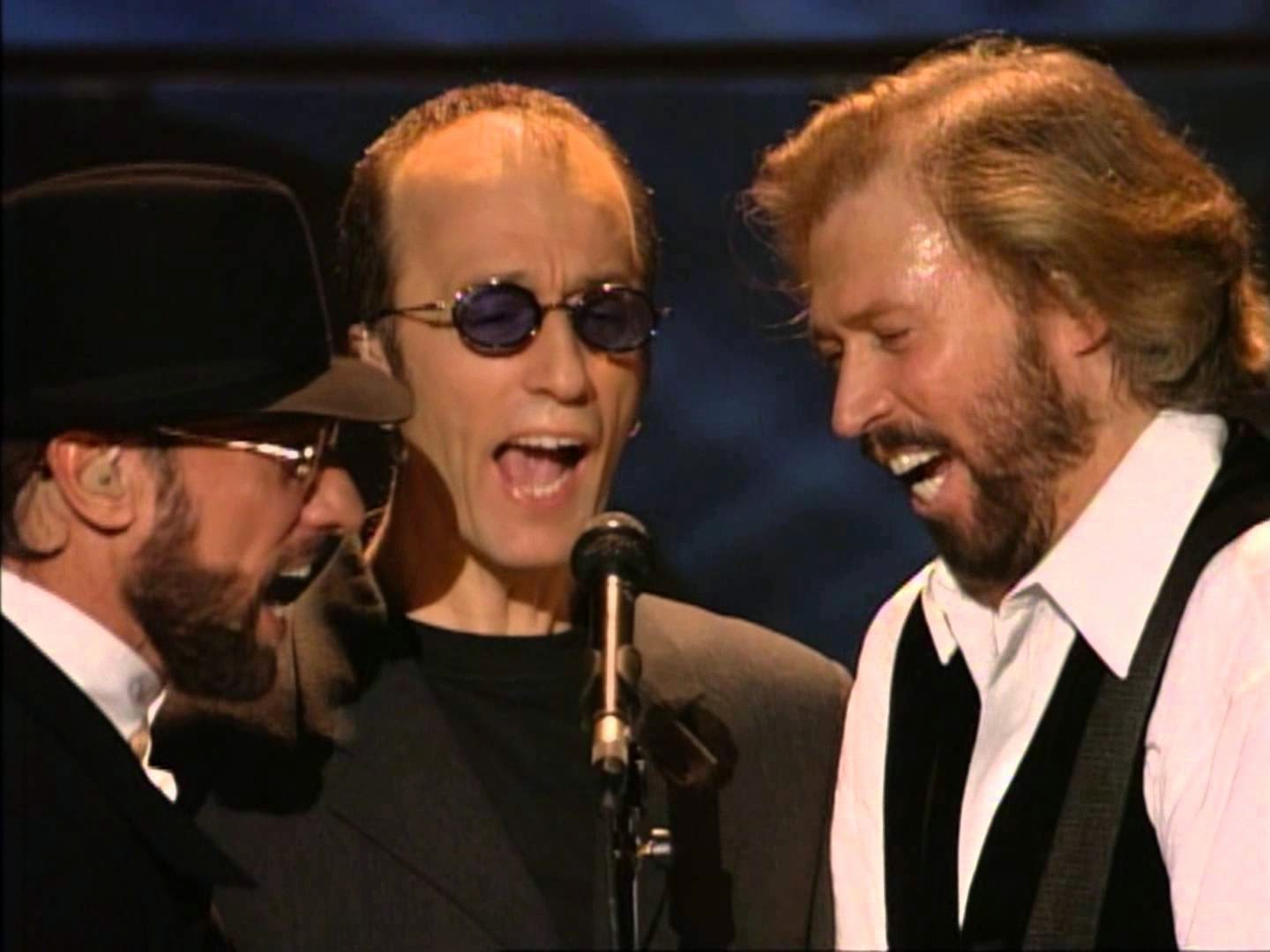
Before the Bee Gees became shorthand for a new dance-floor age, Throw a Penny caught them learning how to make rhythm carry feeling.
Released on the Bee Gees album Mr. Natural in 1974, Throw a Penny belongs to one of the most fascinating in-between chapters in the group’s long career. Produced by Arif Mardin, the album arrived after the Gibb brothers had already lived several musical lives: the elegant orchestral pop of the late 1960s, the dramatic ballad writing, the fraternal harmonies that seemed to float above the machinery of pop. But Mr. Natural was not simply another stop along that road. It was a rehearsal for a new language.
That is what makes Throw a Penny so revealing. It does not announce reinvention with a spotlight and a slogan. Instead, it shifts the center of gravity. The voices are still unmistakably those of Barry Gibb, Robin Gibb, and Maurice Gibb, and the melodic instinct is still rooted in the Bee Gees’ gift for emotional lift. Yet the track breathes differently from much of their earlier work. The rhythm feels less like a frame around the song and more like a current running through it. The groove is not yet the polished, kinetic force that would define their later mid-1970s breakthrough, but it is present, persuasive, and quietly changing the room.
Arif Mardin was central to that change. Known for his deep musical intelligence and his work in soul, jazz, and rhythm-and-blues settings, Mardin did not erase the Bee Gees’ identity. His importance was subtler than that. He helped them hear what was already waiting inside their writing: the possibility that their harmonies could lean into the beat, that their melancholy could move, that their dramatic pop instincts could be warmed by R&B phrasing and a more physical sense of arrangement. On Throw a Penny, that guidance feels less like instruction than permission.
The song’s title suggests a small gesture, almost casual, but the performance carries the uneasiness of a band standing at a threshold. In the early 1970s, the Bee Gees were no longer the new British-Australian pop phenomenon that had first captured international attention, and they had not yet become the global sound of the disco era. The space between those identities could have swallowed a lesser group. Instead, they used it to experiment. Mr. Natural may not have delivered the commercial explosion that would come soon after with Main Course, but it gave the brothers and Mardin the laboratory where that future could begin taking shape.
What stands out now is how human the transition sounds. Throw a Penny is not the work of artists abandoning the past; it is the sound of artists discovering that their past had more doors in it than anyone had noticed. The close harmonies remain, but they are no longer only a cloud of feeling. They press against the rhythm. The melodic turns still have the Bee Gees’ familiar ache, yet there is a more grounded pulse beneath them, a suggestion that sorrow and movement do not have to oppose each other. The song seems to ask whether emotional vulnerability can survive inside a groove, and the answer is quietly yes.
That balance would become crucial to the Bee Gees’ next phase. The public often remembers their transformation as if it happened suddenly, as if one era ended and another arrived fully formed. But recordings like Throw a Penny complicate that neat story. They show the evolution happening in real time: not the finished myth, but the working band; not the cultural phenomenon, but the musicians listening closely to what the arrangement was telling them. The shift toward R&B was not a costume. It was a reorientation of feel.
In hindsight, Throw a Penny has a special kind of value because it captures motion before certainty. There is no need to overstate it as the definitive Bee Gees statement, because its beauty lies elsewhere. It is a hinge song, a track that lets us hear the old elegance loosening its collar and stepping closer to the drum. It carries the nervous energy of reinvention without the swagger of arrival. For fans who know the later triumphs, that makes it especially rewarding: the groove has not yet taken over the world, but it has begun to find the brothers.
Nearly everything that followed would be brighter, bigger, and more famous. But Throw a Penny remains compelling because it preserves the moment before the turn became obvious. Under Arif Mardin’s guidance, the Bee Gees were not merely updating their sound; they were learning how to let rhythm reveal another emotional register. The song still feels like a private clue left in public, a modest track from Mr. Natural that tells us the future was already moving beneath their feet.
