
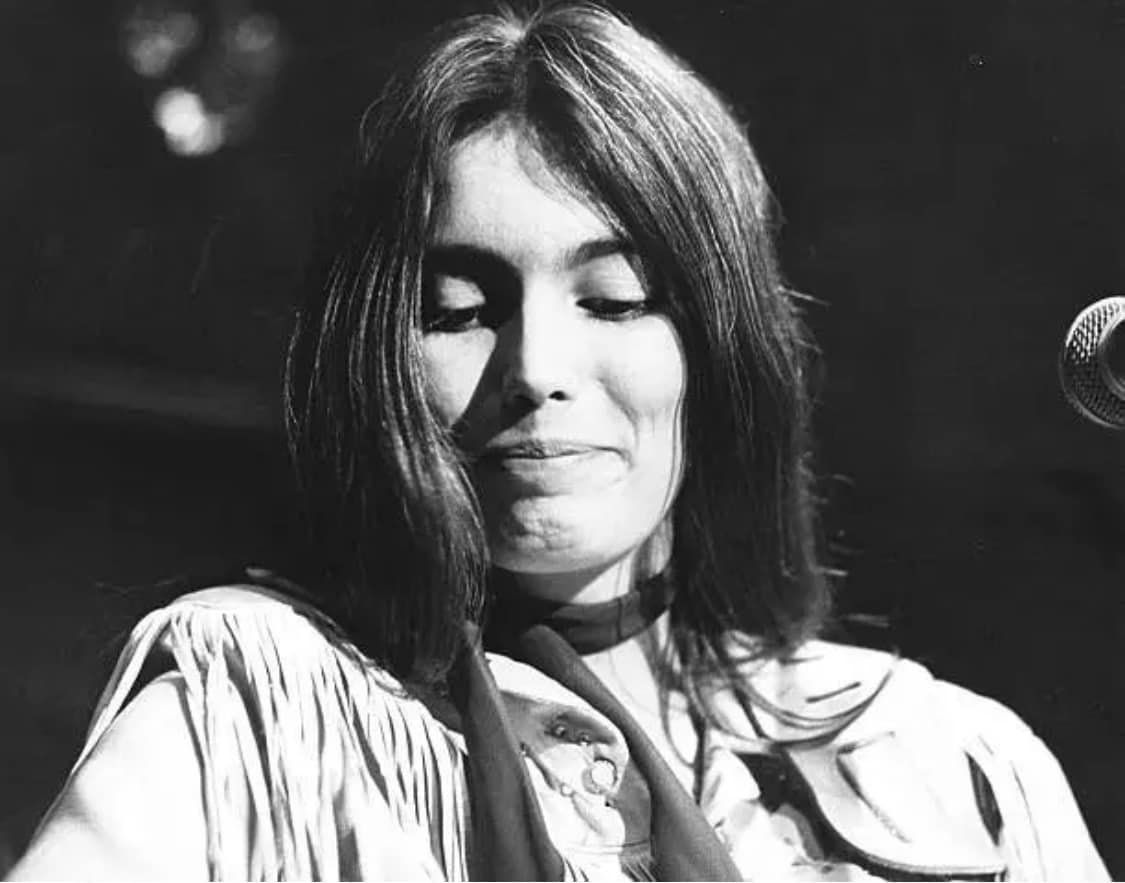
Never Be Anyone Else But You says something almost impossibly simple: real devotion does not need many words. In Emmylou Harris‘s hands, that simplicity becomes the song’s deepest beauty.
Some songs survive because they are grand. Others survive because they are honest. Never Be Anyone Else But You belongs to the second kind, and that is precisely why it has never lost its charm. Long before Emmylou Harris gave the song her own luminous touch, it had already entered American pop memory through Ricky Nelson‘s 1959 hit recording. Written by Baker Knight, one of the finest craftsmen of that era, the song climbed to No. 6 on the Billboard Hot 100. Harris’s version, by contrast, is not remembered as a major chart single in her own career. Its importance is artistic rather than commercial, and in many ways that makes it even more revealing.
That distinction matters. Emmylou Harris was never merely a singer collecting old songs for decoration. She has always had the rare gift of hearing the emotional architecture inside material that others might dismiss as too plain, too old-fashioned, or too familiar. When she approaches a song like Never Be Anyone Else But You, she does not simply cover it. She restores its dignity. She lets the listener hear why such a modest lyric once meant everything to a generation raised on jukeboxes, car radios, and the belief that a love song could be both innocent and everlasting.
The story behind the song begins with Baker Knight, a songwriter whose elegance was often hidden inside deceptively direct lines. He also wrote classics like Lonesome Town, and that tells you a great deal about his sensibility. He understood loneliness, yearning, and romantic certainty in a language that never strained for effect. Never Be Anyone Else But You is built on a vow, but it is not written like a speech. It feels like a confession spoken quietly, almost as if the singer is surprised by the depth of his own feeling. That restraint is a large part of the song’s power.
In Ricky Nelson‘s original, the song carried the bright ache of late-1950s youth: clean melody, direct feeling, and a kind of emotional clarity that early rock and pop could deliver so effortlessly. The record sounded fresh, romantic, and untroubled on the surface, yet even then there was a slight tremor in it. A promise this absolute always carries a shadow nearby: the fear that the world may not stay as simple as the words. That hidden tension is what makes the song endure, and it is also what gives Emmylou Harris so much room to deepen it.
By the time Harris came to the song, she had already built one of the most graceful careers in modern American roots music. From the afterglow of her work with Gram Parsons through albums such as Elite Hotel, Luxury Liner, Blue Kentucky Girl, and Roses in the Snow, she became a bridge between classic country, folk, bluegrass, and the emotional plainspokenness of earlier pop. That is why a song like Never Be Anyone Else But You fits her so naturally. It lives right at the crossroads she has always honored: country sincerity, rockabilly pulse, and deep respect for songcraft.
What changes in a Harris performance is not the lyric itself but the emotional weather around it. Where a younger singer might present the song as a pure declaration, Harris brings a more seasoned tenderness. Her voice has always carried light and ache at the same time. Even when she sings softly, there is a sense that she understands how fragile human promises can be. That does not make the song sad. It makes it fuller. In her phrasing, devotion is not naive. It is chosen. It has looked at distance, disappointment, and passing years, then answered with loyalty anyway.
That is the real meaning of Never Be Anyone Else But You when heard through Emmylou Harris. On paper, it is a straightforward love song. In feeling, it becomes something richer: a statement about faithfulness in a world that rarely stays still. The lyric does not rely on poetic fireworks. There are no elaborate metaphors, no dramatic twists, no grand declarations of suffering. Instead, it offers certainty. And certainty, sung with this much gentleness, can be deeply moving. Harris seems to understand that the plainest words are sometimes the hardest to sing convincingly. You cannot hide behind them. You have to mean them.
There is also a broader cultural reason the song matters. Harris has spent her career keeping the thread intact between musical generations. She has never treated older songs like museum pieces. She sings them as living things. That is especially important with a number like Never Be Anyone Else But You, because it reminds us how much emotional intelligence was present in early pop and rockabilly songwriting. Beneath the smooth melodies and compact arrangements were serious human feelings: longing, constancy, uncertainty, hope. Harris hears all of that, and she brings it forward without ever overplaying it.
Perhaps that is why the song still lingers. It does not need spectacle. It only needs a singer who understands that love songs are often at their most powerful when they sound almost conversational. Emmylou Harris has always known how to inhabit that space between speech and song, between memory and the present tense. In Never Be Anyone Else But You, she gives a familiar classic the grace of maturity. What was once a youthful promise becomes, in her care, something warmer, wiser, and even more believable.
And maybe that is the final gift of her version. It reminds us that some songs do not grow old by standing still. They grow old by being sung again, by passing from one voice to another, carrying the same truth into different seasons of life. Never Be Anyone Else But You remains a beautiful song because the promise at its center is so human. Emmylou Harris makes that promise sound not larger, but deeper. Sometimes that is the more lasting achievement.
