
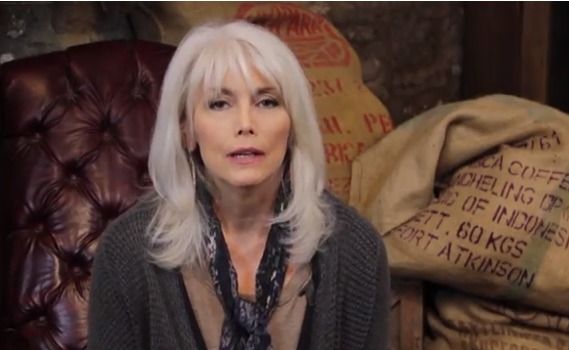
“A Love That Will Never Grow Old” is one of Emmylou Harris’s most quietly devastating recordings—a love song of such tenderness and moral courage that its beauty only deepens when one remembers how strangely the Oscars failed to embrace it.
One of the most important facts to put right at the top is this: “A Love That Will Never Grow Old” was written for Brokeback Mountain by Gustavo Santaolalla and Bernie Taupin, performed by Emmylou Harris, and released on the film’s 2005 soundtrack. It was not a chart single in the usual commercial sense, but it immediately took on the dignity of a major film song. It won the Golden Globe for Best Original Song, was also recognized by other soundtrack and film-music bodies, and yet—here is the controversy that still makes people shake their heads—it was ruled ineligible for the Academy Award for Best Original Song. The reason was technical rather than artistic: the Academy determined that the song was not used prominently enough in the film, falling short of the requirement that an eligible original song be rendered in a clearly audible, intelligible, substantive way within the body of the movie or as the first music cue in the end credits.
That ruling is exactly why the song’s Oscar story still feels like a wound rather than a footnote. The phrase “Oscar controversy” is not mere clickbait here. It points to a real split between award recognition and award eligibility. The Hollywood Foreign Press Association heard greatness and gave it the Globe; the Academy never even let it reach the nomination stage because of the rulebook. That distinction matters. The song was not “snubbed” in the ordinary sense of losing to another nominee. It was kept out on a technicality tied to how it appears in the film. And because Brokeback Mountain itself became one of the most discussed Oscar stories of its era, anything surrounding it took on extra emotional charge.
But rules and categories only explain the scandal. They do not explain the song. To understand why you must hear Emmylou Harris sing it, one has to listen to what she does with the material. The song is built from extraordinary restraint. Santaolalla’s melody is simple, spare, almost wind-borne; Taupin’s lyric speaks with the hush of a promise made against the world rather than in harmony with it. And then there is Harris—that voice, so weathered and luminous, so incapable of vulgar overstatement. She does not attack the song. She shelters it. She sings as if love itself were something fragile, worth protecting not because it is weak, but because the world has always been too eager to wound it. The result is not a performance that begs for tears. It is something rarer: a performance that seems to know sorrow already, and therefore has no need to display it.
The deeper meaning of “A Love That Will Never Grow Old” becomes even more powerful in the context of Brokeback Mountain. This is not a loud anthem of defiance. It is a song of fidelity, tenderness, and endurance. The lyric’s emotional center is not rebellion but constancy—the belief that love can remain true even when time, fear, and social judgment try to reduce it. In the film’s emotional world, that is devastating. The song becomes a kind of blessing spoken over a love that history and circumstance refuse to bless openly. And perhaps that is one reason the song lingers so long after the film ends: it gives voice to what the characters themselves cannot always say fully aloud.
There is also something profoundly right about Emmylou Harris being the one to sing it. Few artists in American music have carried sorrow with such grace. By 2005, she was already long established as one of the great interpreters of loneliness, devotion, and hard-won tenderness. Her presence on the soundtrack gives the song an older moral depth, as though the love in question has already passed through trial and judgment and yet remains unbroken. A younger singer might have made it merely pretty. Harris makes it feel eternal. She sings the title not as a slogan, but as a vow tested by pain.
And that is why you must hear it. Not because of the Oscars alone, though the Oscar story certainly sharpens the sense of injustice. Not because it won the Golden Globe, though it did. Not even because it belongs to one of the most significant American films of its century. You must hear it because “A Love That Will Never Grow Old” is one of those rare songs where everything aligns: the right film, the right composers, the right singer, the right emotional truth. The Academy’s rule may have kept it off the ballot, but it could not diminish what is actually there in the music. Sometimes awards reveal greatness. Sometimes they merely fail to contain it. In this case, the song outlived the category that excluded it.
So the controversy is real—but the real reason to return to Emmylou Harris singing “A Love That Will Never Grow Old” is simpler, and deeper. It is one of the loveliest songs ever written for a film, and in her voice it becomes more than a soundtrack piece. It becomes a remembrance, a benediction, and a quiet act of faith in love’s permanence, even when the world proves unworthy of it.
