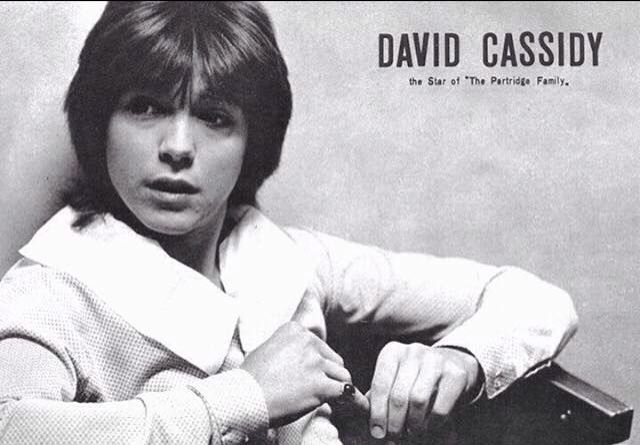
On “Rosa’s Cantina”, David Cassidy sounds less like a poster on a bedroom wall and more like a restless singer looking for another door into adulthood.
“Rosa’s Cantina” comes from David Cassidy’s rare 1976 RCA release Gettin’ It in the Street, an album that sits in one of the most revealing corners of his catalog. By that point, Cassidy had already lived through a level of fame that could flatten almost any artist into an image. The Partridge Family years had made him a household name, and his early solo success had carried the glow of teen-idol devotion. But by the middle of the 1970s, the musical world around him was changing quickly, and so was the question facing Cassidy: what happens when the screaming fades enough for people to actually hear the singer?
That question gives Gettin’ It in the Street its quiet tension. Released by RCA in 1976, the record did not become the kind of widely remembered commercial landmark that follows an artist around forever. Instead, it became something more elusive: a buried chapter, a collector’s piece, a late-night discovery for listeners willing to move past the familiar photographs and the television mythology. In that setting, “Rosa’s Cantina” feels especially interesting. It is not remembered as one of Cassidy’s signature hits, yet its very obscurity makes it a sharper lens. It asks to be heard without the usual noise around his name.
The title alone suggests a place rather than a confession. A cantina is a room of stories: voices at tables, music from a corner, strangers passing through, someone waiting too long for someone else to return. Whether the song is heard as character sketch, mood piece, or travel-worn pop-rock vignette, “Rosa’s Cantina” carries the appeal of a setting where glamour has been replaced by atmosphere. It belongs to the side of the 1970s that was fascinated by roads, small bars, American restlessness, and the blurred line between escape and loneliness. For an artist still trying to be heard beyond his old frame, that kind of landscape mattered.
Cassidy’s voice had always been more flexible than his public image allowed. On the biggest records associated with him, the brightness of the arrangements and the machinery of pop fame could make the singing seem effortless almost to a fault. But in the period surrounding Gettin’ It in the Street, his performances often reveal something more complicated: a desire to roughen the edges, to step away from sweetness, to let the music carry a little dust. “Rosa’s Cantina” benefits from that shift. It does not need to announce a reinvention in capital letters. Its interest is subtler. It catches Cassidy in motion, not fully free of the past, but no longer content to live inside it.
The mid-1970s were not an easy moment for former teen idols. Rock radio had hardened in some places and stretched out in others; singer-songwriters were still shaping adult pop; disco was gaining force; punk was beginning to unsettle old assumptions. In that crowded landscape, a David Cassidy record could be judged before the needle even touched the vinyl. That is part of why songs like “Rosa’s Cantina” deserve a second hearing. They were not simply competing with other music. They were competing with memory, with branding, with the stubborn idea that a young performer adored by millions could not also be searching for something musically serious.
What makes an overlooked song valuable is not always that it was secretly destined to be a hit. Sometimes its value lies in what it reveals at the margins. “Rosa’s Cantina” opens a small, shadowed room inside Cassidy’s story. It reminds us that careers are not only made of peaks and headlines. They are also made of experiments, departures, half-lit tracks on records that slipped past the crowd. In a more patient listening culture, this kind of song might have found its own circle of believers sooner. Instead, it waited.
There is also a human poignancy in hearing Cassidy try to occupy a more adult musical space. Fame had given him access, but it had also given him a problem: people thought they already knew him. Gettin’ It in the Street pushed against that certainty. “Rosa’s Cantina” does not erase the familiar Cassidy; it complicates him. The voice is recognizable, but the room around it feels different. The song invites the listener to imagine him not under television lights, not surrounded by youthful hysteria, but somewhere smaller and less polished, letting a story unfold in a setting where reputation matters less than tone.
That is why the track still has a quiet pull for anyone exploring the less-traveled paths of 1970s pop and rock. It is not merely a rarity for completists. It is evidence of an artist trying to loosen the grip of a public role and find another vocabulary. The album title, Gettin’ It in the Street, almost sounds like a declaration of contact with the outside world, with real places and rougher weather. “Rosa’s Cantina” fits that idea beautifully: a song that feels as though it belongs near a doorway, somewhere between the old life and whatever might come next.
To hear it now is to hear more than a deep cut. It is to hear the pressure around a singer who had been loved loudly, perhaps too loudly for some people to listen closely. In the space that remains, “Rosa’s Cantina” becomes a reminder that overlooked songs often keep the most honest maps. They show not only where an artist stood, but where he was trying to go.
