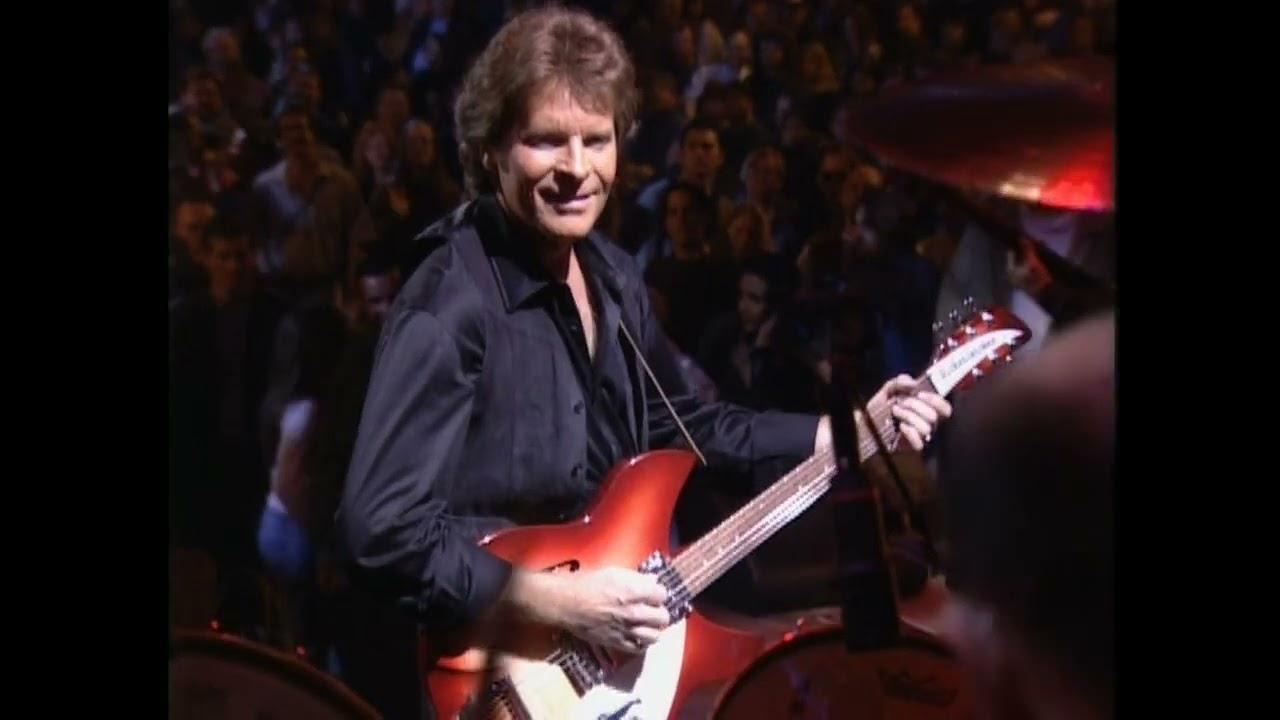
In a record shadowed by history and hard questions, John Fogerty’s acoustic promise to his daughter made I Will Walk With You feel quietly immense.
John Fogerty released I Will Walk With You on his 2004 solo album Déjà Vu All Over Again, where the song stands as one of the album’s most intimate turns: an acoustic ballad written as a dedication to his daughter. That context matters. It is not simply a gentle track tucked between stronger statements, nor a sentimental pause placed there for contrast. It is a father’s vow set against a record that often looks outward at a troubled world, then suddenly narrows its focus to the one person a parent most wants to protect.
Déjà Vu All Over Again arrived seven years after Fogerty’s Grammy-winning 1997 album Blue Moon Swamp, and it carried a different kind of weight. The title track, Déjà Vu (All Over Again), was widely heard in the atmosphere of the Iraq War and in the long American echo of Vietnam, a subject Fogerty had approached decades earlier through the charged urgency of Creedence Clearwater Revival. By 2004, his voice still had that unmistakable grain, but the setting around it felt more reflective. The album moved between protest, roots-rock bite, humor, and domestic observation. In that company, I Will Walk With You feels like the small room at the center of a noisy house.
Fogerty has always had a remarkable gift for plain speech. His greatest songs rarely need elaborate language to make their point. They often work because they sound carved from something older than fashion: train rhythms, porch guitars, radio static, Southern imagery filtered through a California imagination, and a voice that could make a line feel both familiar and urgent. On I Will Walk With You, that directness is turned inward. The song does not try to overwhelm the listener with grand orchestration or dramatic confession. Its power comes from its scale. A guitar, a melody, and a promise are enough.
That promise is the emotional center of the recording. A song written for a child carries a special risk: it can become too soft, too decorated, too eager to announce its tenderness. Fogerty avoids that by keeping the feeling close to the ground. The acoustic arrangement gives the song room to breathe. Instead of sounding like a public declaration, it feels almost like something spoken beside a bed, on a porch, or in the quiet after a long day. The words are shaped around presence rather than spectacle. The title itself, I Will Walk With You, is not a claim of control; it is a pledge of companionship.
That distinction gives the song its lasting emotional interest. A parent cannot promise to remove every difficulty from a child’s path. What can be promised is steadiness: a hand nearby, a voice that remains available, a love that does not need to perform itself loudly in order to be real. Heard within the larger frame of Déjà Vu All Over Again, the ballad becomes more than a family dedication. It becomes Fogerty’s answer, in miniature, to the unease surrounding the album. If the title track looks at history repeating itself, I Will Walk With You looks at the next generation and asks what kind of tenderness can survive inside that repetition.
There is also something revealing about hearing Fogerty in this mode. Many listeners first come to him through force: the drive of Fortunate Son, the foggy dread of Bad Moon Rising, the rolling confidence of Proud Mary, or the swampy snap of Green River. Those songs made him one of American rock’s most recognizable voices. But I Will Walk With You shows another kind of strength. It does not lean on volume. It does not need the mythic landscape of the old Creedence records. It finds gravity in restraint, in the simple act of a singer allowing affection to remain unarmored.
The recording context deepens that feeling because the album surrounding it is so aware of time. Fogerty was not a young man trying to announce himself in 2004; he was an artist with history behind him, a catalog full of public memory, and a voice already tied to several generations of American listening. To write a song for his daughter at that stage was to place private love inside a long musical life. It suggests continuity rather than nostalgia: the artist who once sang about storms, rivers, roads, soldiers, and restless nights now turns to a child and offers the most elemental road song of all, not about escape, but about staying near.
That is why I Will Walk With You deserves to be heard as more than a tender album cut. It is a quiet hinge on Déjà Vu All Over Again, a moment where the public and private sides of Fogerty’s writing meet. The world outside the song may be unsettled, history may feel circular, and the old anxieties may return in new forms. But inside this acoustic ballad, the answer is beautifully modest: keep walking, stay close, let love be measured not by grand speeches, but by faithful steps.
