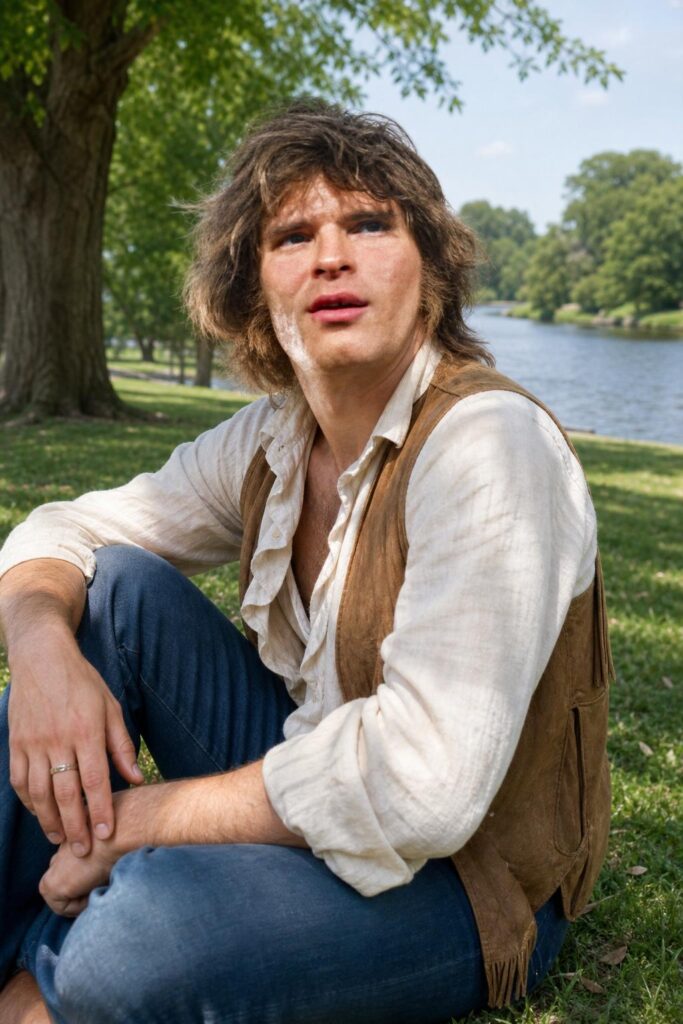
On John Fogerty’s Garden Party, a song about pleasing yourself becomes warmer, wiser, and more communal when Don Henley and Timothy B. Schmit step into the harmony.
John Fogerty recorded his cover of Rick Nelson’s Garden Party for his 2009 album The Blue Ridge Rangers Rides Again, and the version carries a quietly meaningful detail: backing vocals by Don Henley and Timothy B. Schmit. That collaboration is more than a pleasant guest credit. It places three distinct American rock-and-country voices around a song that has always been about artistic expectation, public memory, and the pressure to remain exactly as people first loved you.
Garden Party was written by Rick Nelson and released in 1972 by Rick Nelson and the Stone Canyon Band. Its origin has long been tied to Nelson’s experience at a Madison Square Garden oldies concert, where he felt the audience wanted the past more than the artist standing in front of them. Out of that uneasy night came one of the most graceful songs ever written about creative self-respect. Rather than answering rejection with bitterness, Nelson shaped the experience into a breezy, country-rock reflection whose central lesson is disarmingly simple: an artist cannot please everyone forever, so he eventually has to live with his own voice.
That idea fits Fogerty with unusual precision. As the unmistakable voice and songwriter behind many of Creedence Clearwater Revival’s most enduring recordings, Fogerty has lived for decades with the strange double blessing of being loved for a sound that became larger than any single season of his life. His voice can call up swampy guitars, radio heat, working-class imagery, and the compressed urgency of late-1960s rock almost instantly. But by the time he made The Blue Ridge Rangers Rides Again, he was not simply revisiting familiar territory. He was returning to older songs through the lens of a man who understood what it means to carry a public identity and still keep moving.
The album itself matters to the way this performance lands. In 1973, after the end of Creedence Clearwater Revival, Fogerty released The Blue Ridge Rangers, a roots-minded covers project that reached into country, gospel, and early rock-and-roll material. Its title suggested a band, but the original project was famously centered on Fogerty himself, playing and singing with the self-reliance of a musician rebuilding his path. The 2009 sequel, The Blue Ridge Rangers Rides Again, keeps the spirit of American roots music but opens the room to guests. That shift changes the emotional temperature. What once felt like a solitary act of rediscovery now feels like a conversation.
On Garden Party, that conversation is especially resonant because Don Henley and Timothy B. Schmit bring with them their own history in harmony-rich American music. Henley’s voice is associated with a sharp, reflective intelligence; Schmit’s with a high, smooth tenderness that has long softened and lifted country-rock textures. Neither presence overwhelms Fogerty. Instead, their backing vocals give the song a shared horizon, as if Nelson’s lesson is being passed among artists who know something about audience expectation, reinvention, and the long echo of famous songs.
Fogerty does not need to imitate Nelson for the cover to work. In fact, the performance gains strength because he approaches Garden Party through his own grain and phrasing. His vocal carries a sturdy plainness, the kind of delivery that makes a philosophical lyric feel like something learned on the road rather than written in a room for effect. Around him, Henley and Schmit add polish without smoothing away the song’s rueful edge. Their harmonies suggest friendship, recognition, and maybe a little relief. The result is not a dramatic reinterpretation, but a deepening: a familiar song becomes less like one man’s response to one difficult night and more like a wider statement about how musicians survive the weight of being remembered.
That is the beauty of this collaboration. It does not ask for attention through spectacle. It works through placement, tone, and the quiet authority of voices that have all traveled through different versions of the same problem. A song written after a crowd seemed to want yesterday becomes, in Fogerty’s hands, a late-career affirmation sung with two fellow travelers nearby. The famous lesson still stands, but the loneliness around it softens. You can hear the self-reliance in the lyric, yet you can also hear the comfort of company.
In that sense, Fogerty’s Garden Party is one of those covers that reveals its purpose slowly. It honors Rick Nelson’s original without trapping it in memory. It lets the song breathe inside a new circle of voices. And it reminds us that the old line about pleasing yourself is not only a defiant motto; sometimes it is a hard-won peace, made warmer when other voices understand exactly why it had to be sung.
