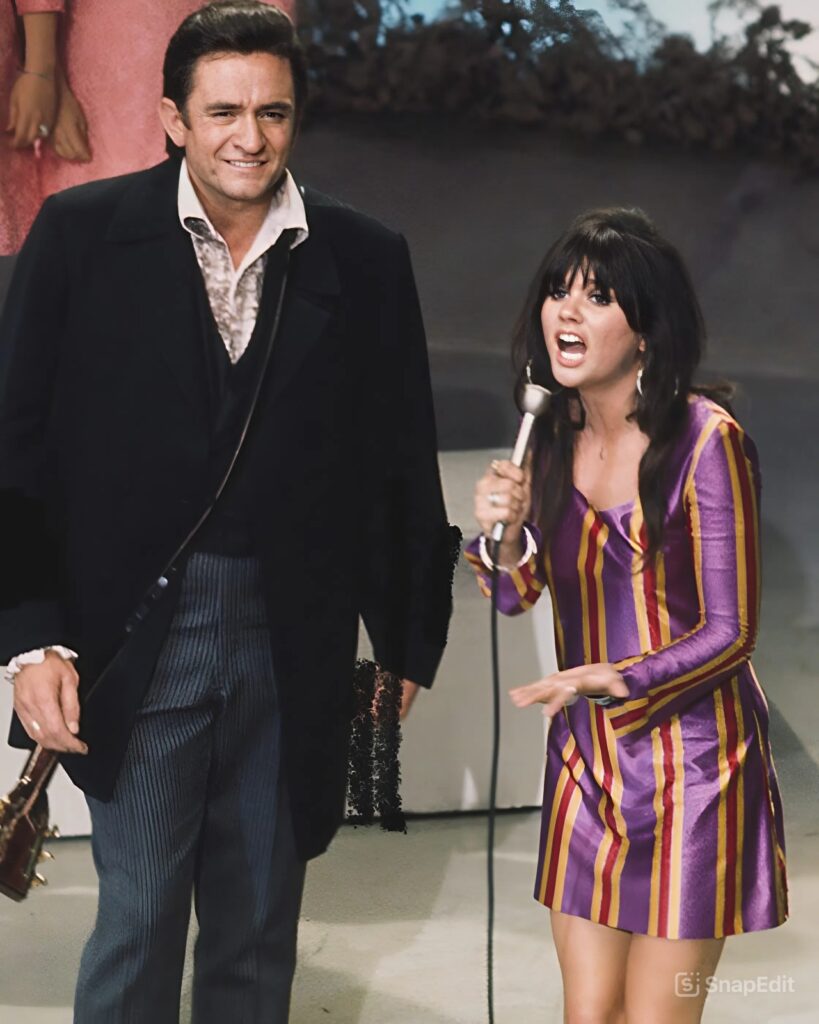
On The Johnny Cash Show, Linda Ronstadt turned Long Long Time into something larger than a hit: a quiet, wounded confession about loving faithfully and learning that love may never come back the same way.
There are television performances that entertain, and then there are performances that seem to leave a mark on the room. Linda Ronstadt’s Long Long Time on The Johnny Cash Show belongs in the second category. Seen in the context of that era, it feels like a moment when the emotional truth of a song mattered more than spectacle, more than image, more than anything clever. Ronstadt was still early in her solo rise, but the voice was already unmistakable: clear, tremulous, aching, and strong enough to carry sadness without ever collapsing into self-pity.
Released in 1970 on her album Silk Purse, Long Long Time became Ronstadt’s first major solo breakthrough after her years with the Stone Poneys. Written by Gary White and produced by Elliot Mazer, the song reached No. 25 on the Billboard Hot 100 and climbed to No. 8 on Billboard’s Easy Listening chart. It also brought Ronstadt one of her earliest major Grammy recognitions, a sign that the music world was beginning to understand what listeners already felt: this was not just a fine singer with crossover appeal, but an artist with a rare emotional instrument.
That is why the The Johnny Cash Show appearance matters so much. Cash’s program was one of the most important American showcases of its time, a place where country, folk, pop, and singer-songwriter traditions could meet before a broad national audience. To sing a song as inward and bruised as Long Long Time in that setting was no small thing. The show’s atmosphere favored honesty. It did not ask performers to overwhelm the audience. It asked them to reach them. Ronstadt did exactly that.
What makes Long Long Time so enduring is its restraint. This is not a song about dramatic betrayal or theatrical heartbreak. It is about a quieter sorrow: loving someone with patience, dignity, and constancy, and slowly realizing that devotion alone cannot make love return. That idea lives in the song’s most devastating emotional turn, when the narrator admits she cannot become what the other person wants. There is heartbreak in that line, yes, but also self-knowledge. The song does not beg forever. It grieves, and then it stands up straight.
Ronstadt understood that balance better than almost anyone. On The Johnny Cash Show, she does not oversing the pain. She allows it to gather. That was one of her great gifts. She could sing with power, but she knew when power would ruin a song’s inner life. Here, the ache is in the control, in the way she lets the phrases breathe, in the way the melody seems to rise not toward triumph but toward a kind of lonely acceptance. And then comes that famous climactic reach, the note that seems to stretch the word time until it becomes almost physical. Even decades later, it still catches in the chest.
There is also something important about where Long Long Time sits in Ronstadt’s career. Before the huge commercial peak of the mid-1970s, before Heart Like a Wheel, before the arena-level stardom and genre-crossing dominance, there was this song: intimate, wounded, and deeply human. It announced a central truth about her art. Linda Ronstadt was never merely singing notes beautifully. She was finding the emotional pressure inside a lyric and releasing it with astonishing precision. That is why even her earliest television appearances remain so compelling. You can hear the future, but you can also hear the vulnerability of an artist still carving out her place.
In musical terms, Long Long Time sits at a beautiful crossroads of country and pop, but labels only go so far. What people remember is the feeling. The song moves with an almost conversational sadness, never rushing the listener, never forcing the point. The arrangement on the hit recording supports the vocal without crowding it, and that same emotional architecture carries beautifully into the television performance. On a show associated with plainspoken emotional truth, the song found its natural home.
Part of the lasting power of this performance is that it now feels like a preserved piece of emotional history. It reminds us of a time when a singer could hold a national audience still with a song about unreturned love and quiet endurance. No irony, no overstatement, no need to explain the wound. Just a voice, a melody, and the painful wisdom that some feelings outlast hope.
That may be why Long Long Time continues to resonate so deeply. Its sadness is mature sadness. It understands that the most difficult heartbreak is often not the loudest. Sometimes it is simply the long realization that love has lasted in one heart longer than it ever lived in the other. In Ronstadt’s hands, and especially on The Johnny Cash Show, that realization becomes unforgettable. She does not just sing about waiting. For a few minutes, she makes us feel the full weight of time itself.
