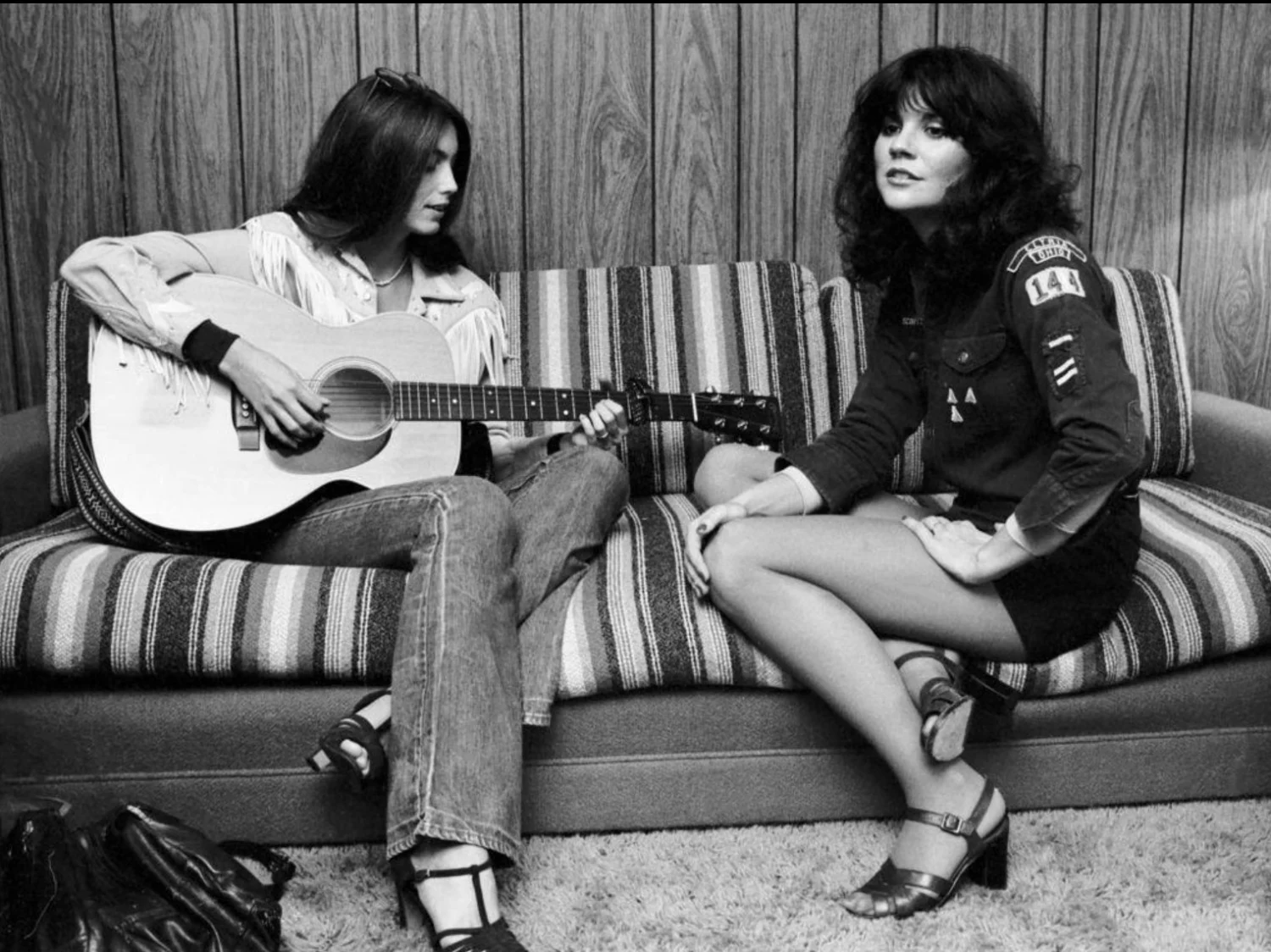
The Dark End of the Street is a confession wrapped in velvet sorrow—Linda Ronstadt sings forbidden love so plainly, so tenderly, that the secrecy becomes even more heartbreaking.
When Linda Ronstadt recorded The Dark End of the Street for her 1974 album Heart Like a Wheel, she was standing on the edge of a new kind of stardom. That album would go on to reach No. 1 on the Billboard 200, confirming her as one of the defining voices of the decade. Yet this song was not one of the album’s big hit singles. It did not storm radio the way You’re No Good or When Will I Be Loved did. Instead, it lived in a quieter place inside the record, almost like a candle burning in a back room. And perhaps that is exactly why it still cuts so deep. Some songs chase the spotlight. This one survives in the half-light.
The song itself already carried a heavy history before Ronstadt ever touched it. Written by Dan Penn and Chips Moman, The Dark End of the Street was first made famous by James Carr in 1967. Carr’s original version became a soul landmark, reaching No. 10 on the Billboard R&B chart and No. 77 on the Billboard Hot 100. From the beginning, the song was daring in its emotional honesty. It did not dress up infidelity in glamour. It did not pretend secrecy was thrilling. Instead, it understood the sadness of it, the burden of loving someone in borrowed time, in hidden corners, in places where daylight feels like a threat.
That is the paradox at the center of the song, and it is also what makes Ronstadt’s reading so unforgettable. This is a secret love song sung in plain sight. There is no wink in her voice, no trace of smugness, no dramatic theater. She does not make the lovers sound reckless and romantic. She makes them sound human. Tired. Tender. Cornered by their own hearts. That choice matters. In Ronstadt’s hands, The Dark End of the Street becomes less about scandal and more about the quiet ache of two people who already know the world has no place for what they feel.
Produced during the Heart Like a Wheel era, when Ronstadt was refining the blend of rock, country, folk, and torch-song vulnerability that became her signature, the performance feels remarkably restrained. She had a voice powerful enough to lift the roof off a room, but one of her greatest gifts was knowing when not to overpower a song. Here, she leans into the lyric with a kind of emotional patience. She lets the pain arrive gradually. Each line seems to walk carefully toward the next, as if even the act of telling the truth might be dangerous.
And the lyric itself remains devastating. These lovers meet where they cannot be seen, not because their feelings are small, but because they are too complicated for the clean moral language of public life. That is what gives the song its lasting weight. It is not celebrating betrayal. It is mourning a love that can survive only in fragments. There is deep shame in the words, yes, but also dignity. The song knows that people are weak, that desire can outrun decency, that affection can bloom where it should not. Very few popular songs speak that truth with such sadness and such mercy.
Linda Ronstadt understood that mercy. She had one of the clearest voices in American popular music, but clarity in her case never meant emotional distance. In fact, it often meant the opposite. Her phrasing on The Dark End of the Street is so open, so unguarded, that the listener hears not just what the song says, but what it cannot solve. There is no redemption offered here, no neat lesson waiting at the end. Only the knowledge that some loves are real and still cannot be blessed.
That may be one reason the performance lingers so powerfully. Many singers have recorded this song, and several have done it beautifully, but Ronstadt brings a particular kind of ache to it: not the rough fever of Southern soul, but the stillness of someone looking directly at sorrow and refusing to look away. Her version feels less like a dramatic confession than like a memory that never healed properly. It has the hush of late night, the weight of a closed car door, the terrible intimacy of a promise whispered where no promise can safely live.
There is also something deeply revealing about its place within Heart Like a Wheel. That album is filled with emotional contrasts: strength and fragility, movement and loneliness, toughness and surrender. In the middle of that rich musical landscape, The Dark End of the Street stands as one of the purest examples of Ronstadt’s interpretive genius. She did not need to have written a song to make it feel lived-in. She had the rare ability to enter another writer’s truth and leave behind something unmistakably her own.
More than fifty years later, the song still breaks the heart because its emotional conflict has not aged. The language may be classic, the arrangement rooted in its era, but the feeling is timeless. Love remains messy. Regret remains private. And some of the deepest wounds are the ones people carry quietly, without witnesses, except for the songs that remember them.
That is why Linda Ronstadt’s version of The Dark End of the Street endures. It does not ask to be admired from a distance. It asks to be felt. It stands there in plain sight, singing about a love that could never stand there in plain sight at all. And in that contradiction lies its lasting power: a hidden sorrow made visible, if only for the length of a song.
