
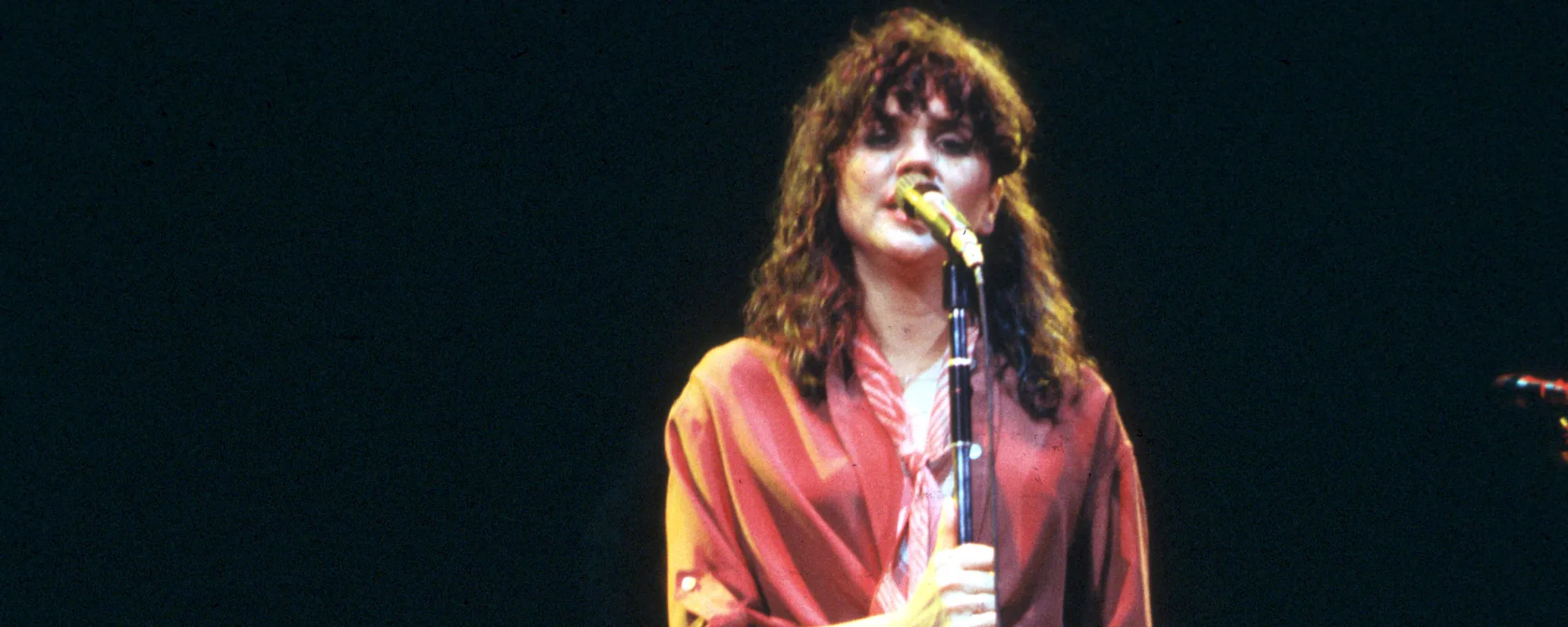
“Dark End of the Street” feels almost too fragile in Linda Ronstadt’s hands — soft as confession, haunted as memory, and devastating precisely because she never forces the pain.
There are songs that sound sad, and there are songs that sound as though they already know there is no clean way out. “Dark End of the Street” belongs to that second, more dangerous category, and when Linda Ronstadt sings it, the hurt lands with a kind of brutal quiet. Her version was not a hit single of its own. It appeared as track 4 on Heart Like a Wheel, released in November 1974, and it lived inside the album that became her great commercial and artistic breakthrough — No. 1 on the Billboard 200, the record that finally made clear just how much emotional ground her voice could cover. That matters, because “Dark End of the Street” was not tossed onto some minor album as filler. It sat near the heart of the record, among songs that helped define why Linda Ronstadt became indispensable.
The song itself already carried heavy history before Ronstadt ever touched it. “The Dark End of the Street” was written by Dan Penn and Chips Moman and first recorded by James Carr in 1966, with Carr’s version becoming his signature song and reaching No. 10 on Billboard’s R&B chart and No. 77 on the Hot 100. The writers reportedly set out to create the ultimate “cheatin’ song,” and that matters because the lyric is built on moral danger from the start: secrecy, shame, desire, and the knowledge that love here cannot walk in daylight. This is not heartbreak after innocence. It is heartbreak already compromised by guilt. That is one reason the song has always cut so deep. It is sad, yes — but it is also trapped.
What Linda Ronstadt does with that material is extraordinary. She does not try to out-soul James Carr, nor does she turn the song into a country showcase with exaggerated tears. She makes it haunted. That is the crucial difference. In her hands, the song feels less like a dramatic confession and more like a private reckoning happening after the room has gone quiet. Her voice on Heart Like a Wheel was one of the great instruments in American music — clear, controlled, luminous — but on “Dark End of the Street” she uses that beauty not to decorate the song, only to expose it. The result is almost unbearable. She sounds calm enough to stay composed, yet wounded enough that the composure itself becomes part of the pain.
That is why the performance hits so brutally hard. A lesser singer might have played the song bigger, dirtier, more obviously broken. Ronstadt does something far more devastating: she lets the sadness remain soft. She trusts understatement. She lets the lyric’s secrecy do the damage. By the time she reaches the emotional center of the song, the listener is no longer hearing just forbidden love. One hears exhaustion, longing, and the terrible knowledge that some attachments survive even when they cannot be honored openly. This is one of the oldest truths in great country and soul music alike: the deepest hurt is often not loud. It is the hurt that has already learned to live in shadows.
The album context makes that hurt even sharper. Heart Like a Wheel is remembered first for major songs like “You’re No Good,” “When Will I Be Loved,” and “I Can’t Help It (If I’m Still in Love with You),” but Apple Music’s retrospective on the album specifically notes that Ronstadt “embody[ies] the heartache” of “The Dark End of the Street.” That is exactly the phrase. She does not merely sing the song well; she inhabits its bruise. And because the album as a whole moves across rock, country, and balladry with such ease, this track stands out as one of the record’s most intimate wounds — not the loudest moment, perhaps, but one of the deepest.
There is also something timeless about how she handles the song’s central image. The “dark end of the street” is not just a physical place. In songs like this, it becomes the emotional corner where desire and regret meet. Ronstadt understood that instinctively. She sings the song as though the street in question is not merely outside somewhere, but inside the self — the hidden place where people keep what they cannot explain, justify, or stop feeling. That reading is interpretive, but it is exactly why the song lingers. It stops being only a narrative of forbidden love and becomes a larger meditation on all the feelings people carry in secret. Supported by the song’s original theme and by Ronstadt’s inward, restrained delivery, that deeper reading feels earned rather than imposed.
So yes, Linda Ronstadt makes “Dark End of the Street” hit brutally hard. Not by shouting, not by oversinging, and not by trying to turn it into something bigger than it already is. She does it by understanding that some songs are most devastating when they remain almost breakably delicate. In her voice, the song becomes soft, haunted, and impossible to shake — the sound of love already living where it should not, and sorrow already knowing it will never fully leave.
