
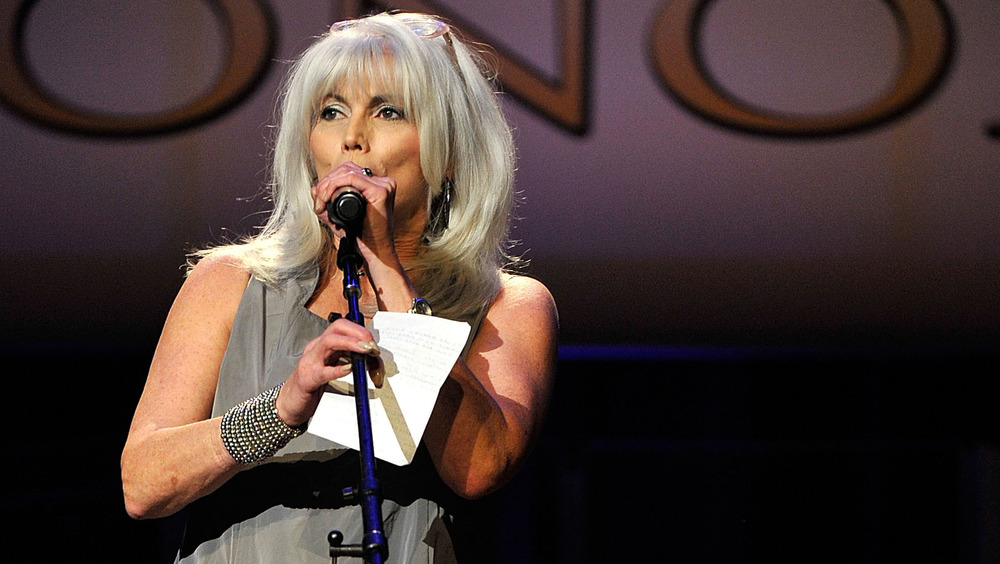
Emmylou Harris finds the soul of Hold On in its bruised wisdom: a song about endurance, mercy, and the hard grace of staying upright when life has already taken its toll.
Some songs arrive as hits. Others arrive as companions. Emmylou Harris’s connection to Hold On belongs to that second, far more lasting category. The song itself was written by Tom Waits and Kathleen Brennan, first appearing on Waits’s 1999 album Mule Variations, a record that reached No. 30 on the Billboard 200. Harris’s reading of Hold On was never a big radio event and was not known as a major standalone Billboard country chart single in her catalog. Yet that lack of chart thunder is almost beside the point. What matters here is the way she steps inside the lyric and turns it into something deeply human, intimate, and strangely consoling.
That has always been one of Harris’s rare gifts. From Pieces of the Sky to Wrecking Ball and beyond, she has known how to approach a song not as a vehicle for display, but as a place to live for a few minutes. Hold On is exactly the kind of song that rewards such patience. On paper, it looks simple. The title suggests encouragement. The chorus sounds almost like plain advice. But beneath that surface lives a much harder truth. This is not a song about easy optimism. It is a song about carrying on after disillusionment, after mistakes, after the world has shown its rough edges. It understands that survival is rarely glorious. Most of the time, it is quiet.
That is why the lyric hits so deeply. Waits and Brennan gave Hold On the language of weathered people, the kind who have learned that dignity is not the same thing as triumph. One of the song’s unforgettable ideas is that life leaves marks, and that those marks do not cancel a person; they become part of the story. In Harris’s hands, that truth sounds even more tender. Her voice, long admired for its clarity, carries in her later work a beautiful grain, a silvered edge that can suggest both ache and mercy at once. She does not over-sing the pain. She lets it settle into the phrasing. She lets silence do some of the work. That restraint is what makes the performance linger.
The emotional meaning of Hold On lies in the gap between what the words say and what the heart hears. On the surface, the song offers encouragement: hold on, stay with it, do not give up yet. But underneath, it recognizes just how difficult that request can be. This is encouragement spoken by someone who knows about regret, loneliness, and the small humiliations that gather over a lifetime. It is not the voice of a preacher shouting from a distance. It is the voice of someone sitting beside you in the dark. That is also why Harris is such a natural interpreter for it. She has always sung as though she respects sorrow, not because sorrow is noble, but because it is real.
There is also something unmistakably spiritual in Hold On, though not in a narrow or doctrinal way. Like much of Harris’s finest work, it lives in that borderland where country, folk, and gospel feeling meet. The song does not promise rescue on demand. It promises only that persistence matters. That may be one reason it remains so moving years later. Many bigger songs burn brightly and fade. Hold On stays because it speaks to the long middle stretch of life, the stretch where people keep going without applause, without certainty, and often without explanation.
For listeners who came to love Emmylou Harris through her classic country sides, Hold On reveals another dimension of her art. This is not the Emmylou of dazzling harmony alone, nor only the guardian of tradition. This is Harris as emotional interpreter, drawn to songs that do not flatter the listener but tell the truth softly enough to be received. She hears the humility in Hold On, the worn beauty in it, the strange comfort of a song that does not deny hardship but still refuses despair.
And perhaps that is why this performance continues to matter, even without the familiar milestones of a major chart hit. It speaks in a quieter register than commercial success can measure. Hold On endures because it does not chase grandeur. It offers something rarer: a little strength, a little understanding, and the feeling that someone else has walked through the same weather and kept moving. In the world of Emmylou Harris, that kind of truth has always counted for more than noise.
