
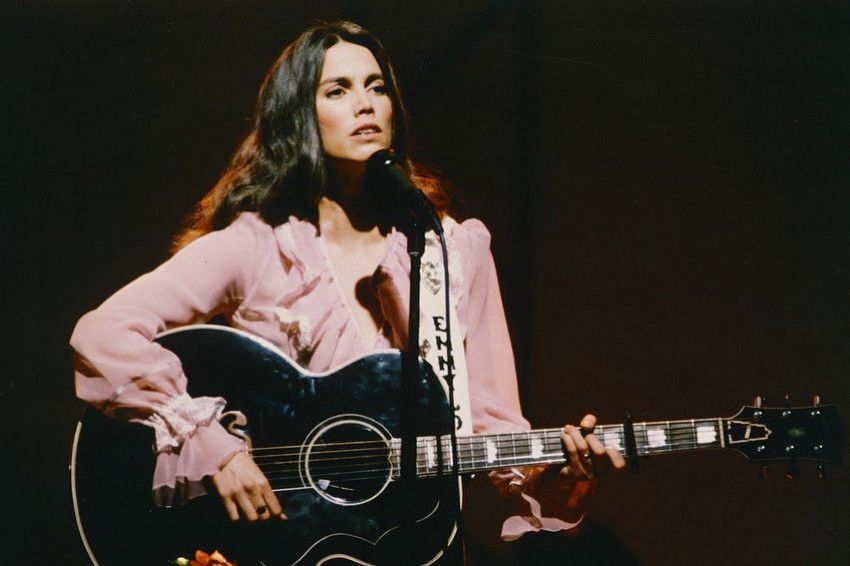
Away in a Manger becomes something beautifully intimate in Emmylou Harris‘s voice: less a public carol than a private moment of grace, humility, and winter stillness.
Emmylou Harris‘s recording of Away in a Manger was not released as a major chart single, so it did not earn its own place on the Billboard country singles rankings. But the album that carried it, Christmas Album from 1979, later reissued under the more familiar title Light of the Stable, reached No. 17 on Billboard’s Top Country Albums chart. That matters because it tells us something important: this was not a novelty side project or a token seasonal release. It was a carefully made, musically serious holiday record from an artist already admired for bringing rare elegance and emotional truth to everything she touched.
And that is exactly what makes her version of Away in a Manger so lasting. This is one of the best-known Christmas hymns in the English-speaking world, a song many people first encountered in church pews, school programs, candlelit services, or quiet family gatherings. By the time Emmylou Harris recorded it, the carol already carried generations of memory. A less sensitive singer might have leaned too hard on sentiment. Harris did the opposite. She sang it with restraint, with warmth, and with the kind of luminous calm that lets the melody speak for itself.
The song itself is older than many listeners realize. Away in a Manger first appeared in print in the late 19th century, and for many years it was mistakenly linked to Martin Luther. Modern scholarship has found no reliable evidence for that attribution, but the misunderstanding helped give the carol an aura of old-world devotion. What has always kept it alive, though, is not myth but mood. Its words dwell on the Nativity in small, human images: the child, the stillness, the nearness of heaven expressed not through thunder but through tenderness. That quiet simplicity is the song’s whole power, and it suits Emmylou Harris almost uncannily well.
By 1979, Harris had already established herself as one of the defining voices in modern country music, though even that phrase does not fully capture her range. She was a country singer, yes, but also an interpreter steeped in folk, gospel, bluegrass, and old American songcraft. Her gift was never just technical purity. It was emotional clarity. She could sing softly without losing authority, and she could make familiar material feel newly inhabited. On Christmas Album, produced by Brian Ahern, that gift is everywhere. The production is tasteful and rooted, never overdecorated, and Away in a Manger benefits especially from that discipline. It arrives without fuss. It stays because of feeling.
What makes this performance so moving is the way Harris refuses to treat reverence as heaviness. Some singers approach sacred music as if solemnity alone will create depth. Harris understands something more difficult: true reverence can sound light, transparent, almost weightless. Her phrasing is unhurried. Her tone is clear but never cold. There is no theatrical push for grandeur. Instead, she draws the listener inward, toward the song’s center, where humility becomes its own kind of majesty. In her hands, the manger scene does not feel distant or painted onto a stained-glass window. It feels near. Human. Gently illuminated.
That may be why this recording has endured so well outside the machinery of hit-making. It was not the loudest Christmas recording of its era, nor the most heavily promoted, nor the one designed for seasonal spectacle. Yet for many listeners, it remains one of the most cherished moments in Emmylou Harris‘s holiday catalog because it carries the atmosphere people often hope Christmas music will bring and rarely find: peace without emptiness, faith without performance, beauty without excess. Even those who come to the song more through memory than doctrine can hear in it something deeply consoling. Harris does not preach the song. She inhabits it.
There is also a deeper artistic significance here. Throughout her career, Emmylou Harris had a remarkable instinct for honoring older material without embalming it. She did not sing traditions as museum pieces. She sang them as living things. That instinct shapes Away in a Manger from beginning to end. The carol remains recognizably traditional, but her reading gives it a fresh interior life. She reveals the emotional architecture of the hymn: innocence, shelter, wonder, and the longing for a peace that the modern world never seems able to hold for very long.
Within the broader context of Light of the Stable, that matters even more. The album as a whole is one of the finest seasonal records to come out of Nashville in its era, balancing sacred songs, roots textures, and a kind of reflective warmth that never tips into syrup. Away in a Manger is one of its clearest statements of purpose. It reminds us that Christmas music does not need to dazzle to endure. Sometimes it only needs honesty, a steady melody, and a voice capable of carrying both devotion and memory in the same breath.
That is why this recording still feels so fresh decades later. Listen closely and you hear more than a beloved carol. You hear Emmylou Harris doing what she has always done at her best: taking a song people think they know and returning it to them with greater depth, finer shading, and a tenderness that seems to glow from within. Away in a Manger is often treated as a simple hymn for the season. In her hands, it becomes a meditation on gentleness itself. And in a noisy world, that may be the rarest gift any singer can offer.
