
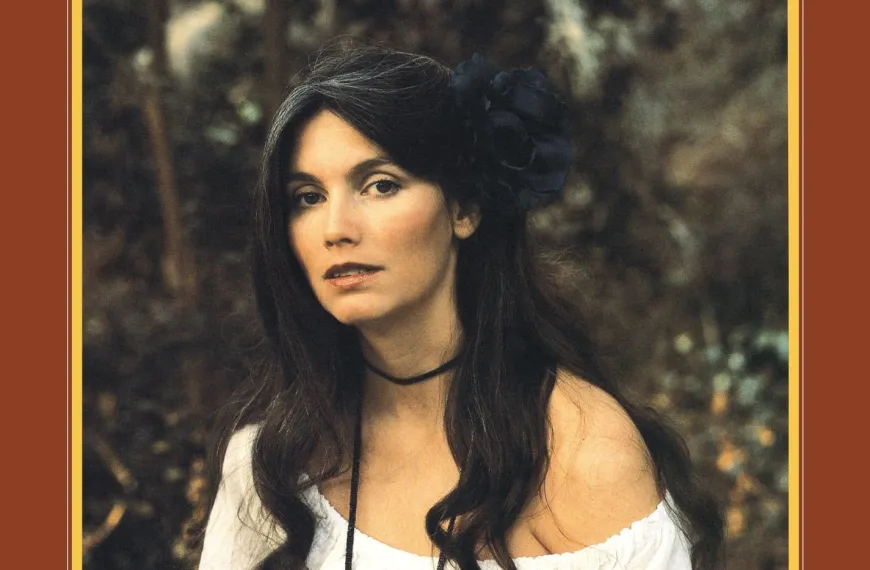
Tragedy becomes something richer in Emmylou Harris‘ hands: not just a heartbreak song, but a swift, shining rush of memory, longing, and the kind of sorrow that never really leaves the room.
Emmylou Harris recorded Tragedy for her 1977 album Luxury Liner, and even though it was not one of the record’s major charting singles, it arrived as part of an album that reached No. 1 on Billboard’s Top Country Albums chart. That matters, because Tragedy was never merely filler on a great record. In the sweep of Luxury Liner, it stood as a vivid reminder of one of Harris’s rare gifts: she could take an older song, polish neither its pain nor its wildness away, and make it sound as if it had been waiting for her all along. The song itself had a strong commercial life before she touched it. Written by Fred Burch and Gerald Nelson, Tragedy had already been a hit for Thomas Wayne, whose 1959 version climbed to No. 5 on the Billboard Hot 100.
What makes Harris’s recording so memorable is that she does not treat the song like a museum piece. She treats it like living weather. The arrangement moves with crisp, nervous energy, but her voice carries a steadier ache, as if she understands that the biggest heartbreaks are not always loud. That contrast gives the performance its emotional charge. The title word itself, Tragedy, might sound almost exaggerated on paper, the kind of dramatic cry that belongs to the golden age of jukebox confessionals. But Harris understood something essential about songs from that era: when love falls apart, even briefly, it can feel absolute. In that sense, the word is not too large at all. It is exactly the size of the feeling.
By the time Emmylou Harris recorded it, she had already become one of the most important interpreters in modern country and roots music. She was never simply collecting old songs; she was listening for their hidden pulse. On Luxury Liner, produced by Brian Ahern, she continued building that remarkable bridge between traditional country, folk sensitivity, and rock-and-roll drive. Tragedy fits beautifully into that mission. It carries traces of late-1950s pop drama and rockabilly urgency, yet Harris and her band give it a cleaner, more muscular country-rock frame. The result is not nostalgia for nostalgia’s sake. It is restoration. She returns the song to us with its heart still beating.
The story behind Harris’s version is really the story behind much of her best work: a fearless respect for American songcraft. She had an uncanny instinct for choosing material that was already familiar to some listeners, but not so overexposed that it had lost its emotional mystery. Tragedy was a perfect example. In lesser hands, it might have been played for retro charm, all surface and no shadow. Harris instead finds the loneliness underneath the hook. Even in a brisk performance, there is a flicker of disbelief in the phrasing, that wounded pause between loving someone and realizing they are gone. She does not overstate the feeling. She lets the song’s shape do much of the work, and that restraint makes the sadness more believable.
The meaning of Tragedy is simple on the surface and more enduring beneath it. It is a song about romantic loss, yes, but it is also about scale: the way the heart enlarges sorrow until it fills the whole horizon. That is one reason the song has lasted across generations and arrangements. The lyric does not analyze heartbreak in complicated terms. It names it directly, almost helplessly. Yet in Harris’s performance, that emotional directness becomes mature rather than naive. Her voice adds perspective. She sounds like someone who knows that people survive these moments, but also knows they are not easily dismissed. The wound may close, but the memory keeps its shape.
There is also something distinctly Emmylou Harris about the way beauty and ache sit side by side here. Few singers have ever sounded so graceful while carrying so much sadness. She had a way of making even quick songs feel haunted around the edges. On Tragedy, the rhythm presses forward, the band stays lean and alert, and yet the emotional impression that remains is not speed but echo. You finish the song remembering not just its melody, but its atmosphere. That is the difference between a good cover and a lasting interpretation. Harris does not simply sing the song well; she changes the emotional light around it.
It is worth remembering, too, where Luxury Liner sat in her career. These were the years when Harris was defining what country music could sound like after the first wave of cosmic American music had cracked open old boundaries. She honored tradition without becoming trapped by it. She loved the old forms, but she never sounded trapped in the past. Tragedy benefited from that freedom. Her version respects the song’s history while giving it a fresh authority, as though the youthful cry of the original had grown into something more seasoned, but no less sincere.
That may be why the song still lands so powerfully today. Some recordings impress us because they are grand. Others stay with us because they feel true. Emmylou Harris‘s Tragedy belongs to the second kind. It reminds us that heartbreak songs do not need elaborate explanations to endure. They need a believable voice, a melody with motion, and a singer who understands that the smallest personal loss can feel, in the moment, like the end of the world. Harris knew that, and she sang it with elegance instead of excess. Decades later, that choice is exactly why the performance still glows.
In the end, Tragedy is one of those recordings that quietly reveals the depth of Harris’s artistry. She could revive a song from another era without embalming it. She could preserve its innocence while adding her own weathered wisdom. And she could make an old heartbreak sound newly personal. That is no small achievement. It is the kind of interpretive grace that turns a cover into a companion, and a familiar old lament into something timeless.
