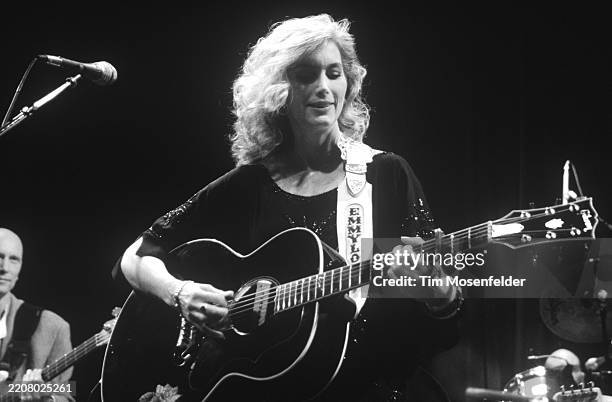
The mystery inside “Pancho & Lefty” never fades because the song refuses to solve itself; in Emmylou Harris’ hands, that uncertainty becomes even more alluring, more sorrowful, and somehow more human.
There are story songs that tell you everything, and there are story songs that leave one door forever half-open. Emmylou Harris’ “Pancho & Lefty” belongs to the second kind. That is exactly why listeners keep returning to it, and why they keep arguing over it long after the record stops spinning. Harris recorded the song for Luxury Liner, released on December 28, 1976, and although her version was not issued as a single, it became one of the most important tracks on an album that itself reached No. 1 on the Billboard country chart. More than that, Luxury Liner is often remembered in part because it included the first cover version of Townes Van Zandt’s 1972 composition, years before the later Willie Nelson and Merle Haggard hit brought the song to mass country-radio fame. In other words, Emmylou was not following a standard. She was helping create one.
That historical fact matters, because it changes the entire emotional frame. By the time many listeners came to know “Pancho & Lefty,” the song already had a legendary reputation. But when Emmylou Harris chose it, the mystery was still living much closer to the ground. Townes Van Zandt’s original release in 1972 on The Late Great Townes Van Zandt had gone largely unnoticed in chart terms, and neither the single nor the parent album became a commercial breakthrough. Harris heard greatness where the wider market had not yet fully looked. She later said she felt it was “her song,” and that claim makes emotional sense: she did not merely cover it, she adopted it, carried it forward, and helped reveal its afterlife.
And what is the mystery, really? That is the question that keeps fans clicking, listening, and debating. Is Pancho a doomed outlaw in the old border-ballad tradition? Is Lefty a betrayer, a survivor, a coward, a ghost of conscience? Is the song about friendship, guilt, and the price of escape? Or is it, as so many of Townes Van Zandt’s greatest songs are, about the strange inability of human beings to outrun themselves? Even Van Zandt himself did not pin it down. He admitted in later recollections that the song seemed to come “out of the blue,” and he openly said he had long wondered what it was really about. That uncertainty is not a weakness in the writing. It is the source of its permanence. A solved song can be admired. An unsolved song can be lived with.
What makes Emmylou Harris’ version so compelling is that she does not try to solve it for us either. She sings the song with extraordinary clarity, but never with explanatory force. That distinction is everything. Some singers approach a narrative ballad as though their task is to underline its meaning in thick ink. Harris does the opposite. She leaves the shadows where they belong. Her voice is lucid, almost merciful, and because of that mercy, the song becomes even sadder. She does not present Lefty simply as villain or Pancho simply as martyr. She sings the story as if both men are already receding into myth, half-remembered and half-misunderstood, the way old stories often are in the minds of those who keep telling them.
That is why the song keeps people arguing. It is not only a tale of betrayal. It is a tale of sympathy. One of the finest descriptions of the song’s power came years later when Rolling Stone called it a work conveying friendship, duplicity, and guilt on a scale larger than most songs can manage. That is exactly right. “Pancho & Lefty” is not gripping because it contains a twist. It is gripping because it never lets guilt settle in one neat place. Pancho may die, but Lefty must go on living. In many listeners’ minds, that is the real punishment. Death ends one man’s suffering; memory keeps the other man’s alive.
There is another reason true fans stay with Emmylou’s reading in particular. Her version sits inside Luxury Liner, an album rich with tradition, restless movement, and emotional intelligence. It was her second successive No. 1 country album, but unlike the record before it, it had no No. 1 singles. That gives the album, and this track within it, a slightly different aura. It feels less built around one obvious commercial centerpiece and more around atmosphere, curation, and instinct. “Pancho & Lefty” thrives in exactly that kind of setting. It is not merely consumed; it is contemplated.
And perhaps that is the deepest answer. The mystery inside Emmylou Harris’ “Pancho & Lefty” keeps listeners returning because it mirrors the mysteries people never quite solve in life itself: why loyalty fails, why guilt lasts, why one soul falls and another survives, why the past never tells its story the same way twice. Harris understood that such a song should not be overperformed. It should be haunted. So she let it remain spacious, unresolved, and just out of reach.
That is why fans keep listening. Not to find the final answer, but to hear the questions sing more beautifully each time.
