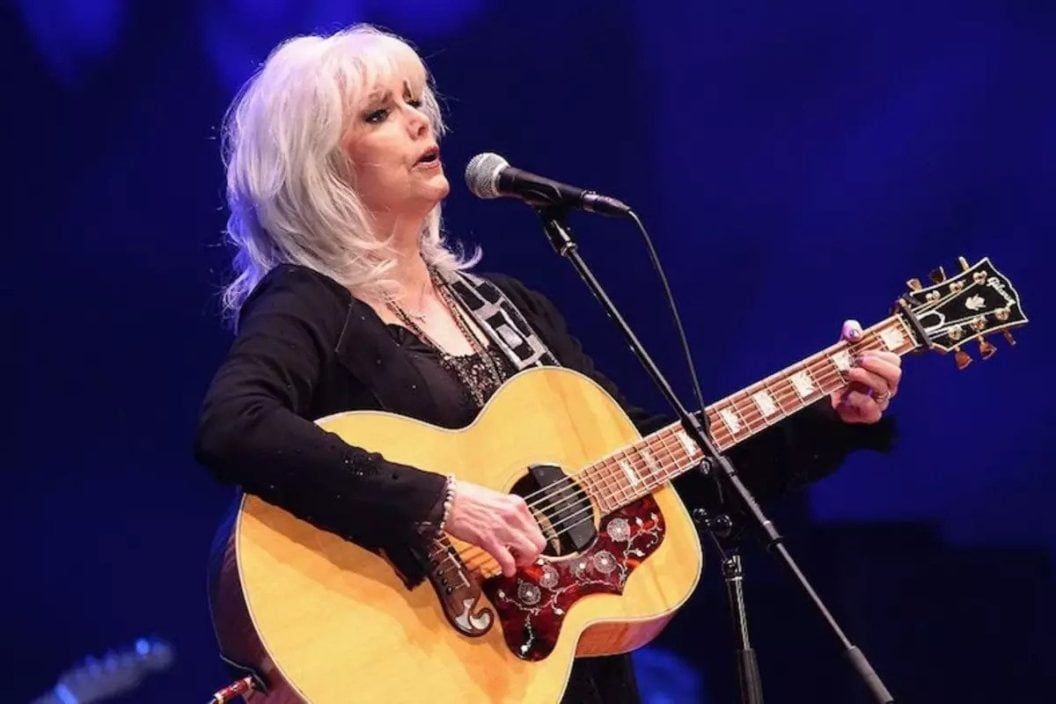
“The First Noel” in Emmylou Harris’ hands is a hush made musical—Christmas not as spectacle, but as memory: a simple carol held up to the light until it turns almost translucent with feeling.
Here are the essential facts first, set clearly on the table. “The First Noel” appears on Emmylou Harris’ first Christmas album, Light of the Stable, released in November 1979, produced by Brian Ahern for Warner Bros. Unlike a hit single built for radio rotation, “The First Noel” did not enter the standard U.S. singles charts; it was issued in 1979 as a promotional single (paired with “Silent Night”), but it did not chart. The album itself did chart: No. 102 on the Billboard 200 and No. 22 on Top Country Albums (in the early 1980/1981 chart runs).
Once those numbers are anchored, what remains is the far more lasting truth: “The First Noel” is one of those recordings that doesn’t need a chart peak to prove its weight. It moves differently. It doesn’t “perform” Christmas; it remembers it. On Light of the Stable, Harris leans into the carol’s old English spine—its plainspoken narrative of angels, fields, and wonder—yet she sings it with the emotional intelligence of someone who knows that wonder is not only for the young. It can return, quietly, when the room is still and the year has been heavy.
Part of the song’s quiet power is how sparingly it is treated. Contemporary notes on the album have often singled out Harris’s rendition as strikingly uncluttered—an approach that lets the melody stand nearly on its own, so every breath feels like candlelight. In a season where arrangements can swell into orchestral certainty, Harris chooses something braver: restraint. And restraint, in her case, doesn’t mean emotional distance. It means intimacy—being close enough to the lyric that you can hear the human behind the “angel.”
That choice also fits the deeper identity of Light of the Stable. This record was never a novelty Christmas album dressed in tinsel. It was conceived as a country-and-roots rendering of sacred and traditional material—music meant to sit beside winter evenings, not compete with them. The album is famous, too, for the company Harris keeps: it includes harmony voices from Dolly Parton, Linda Ronstadt, Neil Young, and Willie Nelson, among others, giving the project a communal, fireside glow rather than a spotlight glare. Even when those guests aren’t the point of a given track, their presence in the wider album frames the whole record as a gathering—friends stepping up to a microphone not to dazzle, but to belong.
So what is “The First Noel” about when you strip it down to its emotional core? It’s about news that arrives in the dark and changes the meaning of the dark. A message carried by ordinary air to ordinary people—“certain poor shepherds”—and suddenly the night is not empty anymore. Harris sings that transformation without theatrics. She doesn’t rush the phrases as if eager to reach the chorus; she lets the lines unfold as if each one is a small step through snow. In her voice, the word “Noel” becomes less a chorus hook and more a bell tone—something that rings, then fades, then rings again in the mind.
And perhaps that is why this particular recording has endured as a private favorite for so many listeners: it grants permission to feel the season without having to pretend the season is uncomplicated. There’s a tenderness here that doesn’t deny time’s passage. It simply suggests that, for a few minutes, time can soften—enough to let an old carol feel new again.
In the end, Emmylou Harris doesn’t so much “cover” “The First Noel” as she reintroduces it—gently, reverently—to the part of us that still recognizes quiet miracles. And if the charts tell you where the album landed, the song itself tells you something more personal: where the heart lands, when it finally comes to rest.
