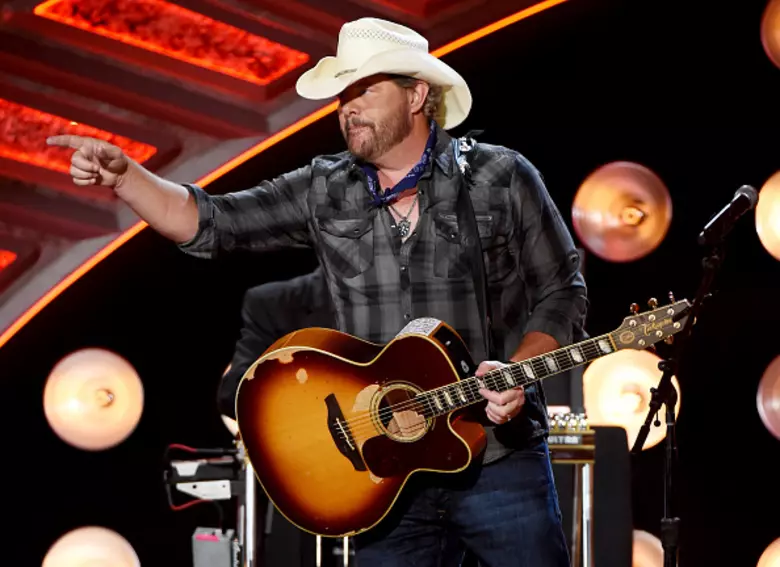
“As Good as I Once Was” turns middle age into a grin you can hear—laughing at lost stamina, yet insisting there’s still one last burst of fire when it matters most.
Released as a single on May 9, 2005, Toby Keith’s “As Good as I Once Was” arrived like a barstool confession that somehow became a national singalong. It was the second single from Honkytonk University (released May 17, 2005 on DreamWorks Nashville), and it quickly proved to be the album’s defining moment. Co-written by Toby Keith and Scotty Emerick, and co-produced by Toby Keith with James Stroud, the track has that rare “effortless” feel—like it’s always existed—while still being tightly engineered to land every punchline and every sigh.
Its chart story reads like the arc of a perfect night out. The song debuted at No. 37 on Billboard’s Hot Country Songs chart (week of May 21, 2005), then climbed all the way to No. 1, beginning a six-week run at the top starting July 23, 2005—one of Keith’s longest runs at No. 1 (tied with “Beer for My Horses”). That’s the kind of dominance you don’t get from hype alone; you get it from recognition—people hearing their own lives in the lyric. And the crossover was real: it finished No. 84 on the Billboard Hot 100 year-end chart for 2005, while landing No. 2 on Billboard’s Country Songs year-end chart. Later, the industry stamped its approval in a different way: the song was named BMI’s Country Song of the Year for 2006.
But the numbers only frame the deeper reason this record lasts. “As Good as I Once Was” is built on a truth most songs avoid because it’s too ordinary—time changes you. Not just in the mirror, but in the knees, the back, the recovery time. Yet Keith doesn’t sing this as tragedy. He sings it as lived-in comedy with a tender bruise underneath. The narrator knows the body isn’t what it used to be; he knows the big talk doesn’t always cash out anymore. Still, he refuses to surrender the one thing that matters in a honky-tonk philosophy: pride with a sense of humor.
The genius of the chorus is its compromise with reality. He’s not claiming he can still do it all, all the time. He’s claiming something more human—more believable, and somehow more moving: he can still be great “once,” even if he can’t be great “always.” That single word “once” is where the laughter and the ache meet. It’s the sound of a person who has learned the limits… and learned how to live inside them without losing the spark that makes him himself.
The verses turn that philosophy into scenes—little snapshots of male ego under pressure: the bar challenge, the temptation, the old reflex to prove something even when wisdom says, let it go. In Keith’s delivery, you can hear the smirk, but also the honesty: aging doesn’t erase desire or courage; it simply negotiates with them. And that’s why the song plays so well in the rearview mirror of your own life. It’s not about being young again. It’s about accepting that you’re not… and finding a strange freedom in that acceptance.
Even the context around the album adds a quiet layer of poignancy. Honkytonk University became Keith’s last studio album released through DreamWorks before the label’s collapse, and “As Good as I Once Was” stands as its biggest statement—one of those late-label-era classics that outlive the business story entirely.
In the end, Toby Keith didn’t write a sermon about getting older. He wrote a toast. “As Good as I Once Was” raises a glass to the body’s betrayals, the heart’s stubbornness, and the small victories that still matter—especially the ones that come when you decide, for one more night, to be as good—once—as you ever were.
