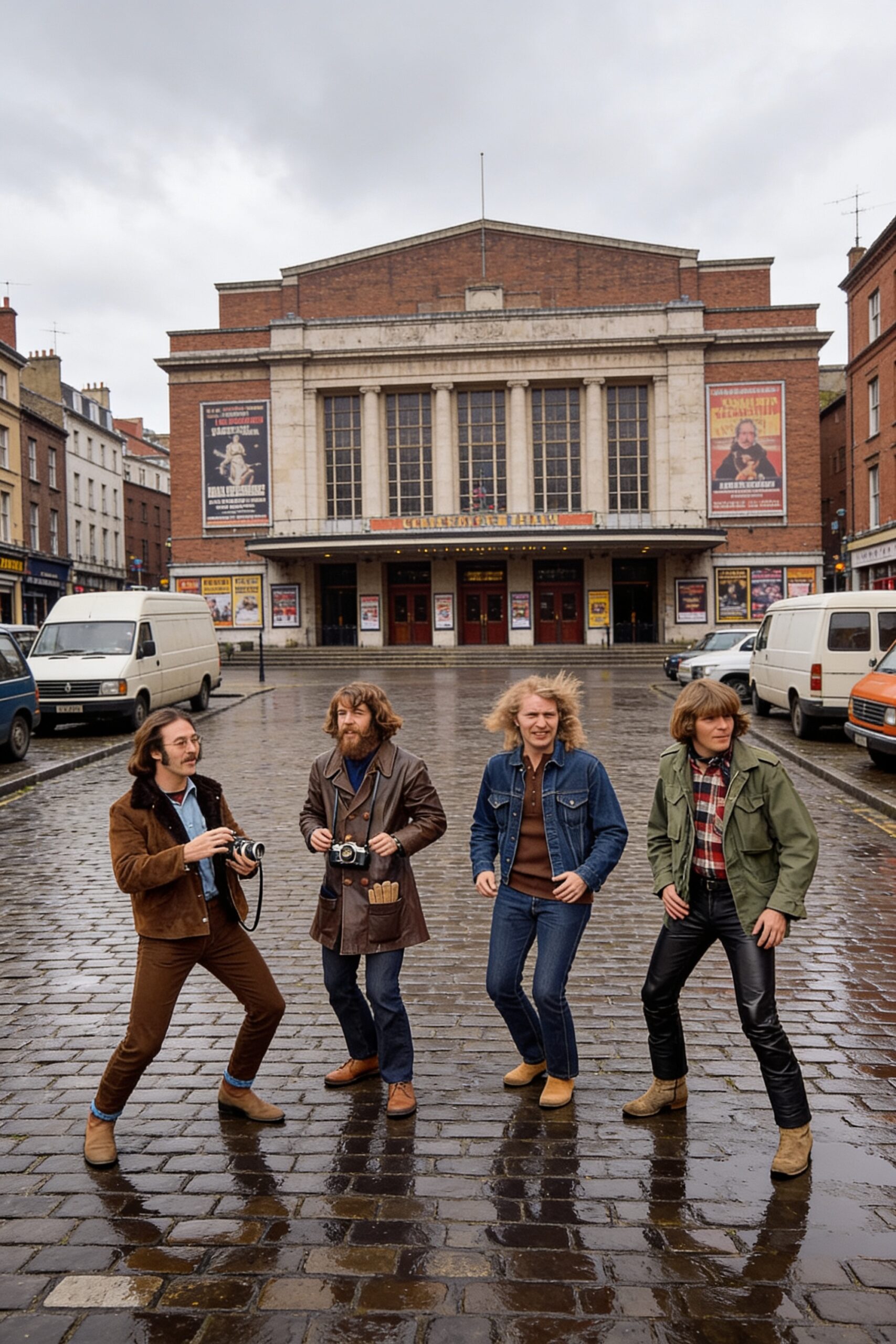
On Poorboy Shuffle, Creedence Clearwater Revival paused the roar of 1969 and let a small acoustic sketch carry the album’s street-corner soul.
Creedence Clearwater Revival released Willy and the Poor Boys in 1969, the same extraordinary year that also brought Bayou Country and Green River. In the middle of that astonishing run, Poorboy Shuffle arrived not as a hit single, not as a grand statement, and not even as a vocal performance, but as a short acoustic instrumental track composed and produced by John Fogerty. Its modest size is part of its meaning. Placed on an album filled with some of the band’s most enduring songs, it works like a porch step between larger rooms, a brief moment when the listener hears the imagined band from the album cover and title world breathing in real time.
Willy and the Poor Boys is often remembered for the direct punch of Fortunate Son, the public-square charm of Down on the Corner, and the folk-rooted familiarity of The Midnight Special. Those songs made the album feel both topical and old-souled, as if John Fogerty were filtering American tradition through the urgency of the late 1960s. But Poorboy Shuffle belongs to a different kind of listening. It does not announce itself. It does not argue. It shuffles in, acoustic and informal, suggesting the sound of musicians gathered close enough to hear the scrape of strings and the breath between phrases.
That matters because the album itself is built around a kind of imagined community. The name Willy and the Poor Boys evokes a band playing outside the usual machinery of fame: corner music, hand-me-down rhythm, songs passed from person to person. Down on the Corner gives that idea its most memorable shape, but Poorboy Shuffle quietly deepens it. Without lyrics, the track becomes almost scenic. It lets the listener picture the music before the spotlight, before the chart position, before the big chorus. It is the sound of a group tuning itself to a shared pulse.
For a band as forceful as Creedence Clearwater Revival, restraint could be revealing. The familiar CCR image is built from John Fogerty’s cutting vocal edge, Doug Clifford’s no-nonsense drumming, Stu Cook’s grounded bass lines, and Tom Fogerty’s rhythm-guitar foundation. Their best-known recordings often feel compressed, tough, and unsentimental. Yet Poorboy Shuffle shows another side of the same instinct. It is lean, but not hard. It is roots-minded without becoming museum music. It carries a casualness that feels carefully chosen, the kind of rough-edged simplicity that Fogerty often used to make songs feel older than their release dates.
As an album deep cut, Poorboy Shuffle also helps explain why Willy and the Poor Boys works as more than a collection of singles. Its sequencing gives the record texture. Coming after the folk standard Cotton Fields and before the heavier blues mood of Feelin’ Blue, the instrumental acts like a hinge. It keeps the album’s world intact, reminding us that CCR were not only writing songs about characters, places, and pressures; they were creating an atmosphere in which those songs could belong together.
The late 1960s gave American rock plenty of elaborate studio experiments, but Creedence Clearwater Revival often found power in plain materials. Poorboy Shuffle is a small example of that discipline. It trusts feel over spectacle. It asks the listener to value a groove, a gesture, a few acoustic lines moving with unhurried confidence. In doing so, it becomes easy to overlook on first pass and oddly rewarding on return. Deep cuts often survive this way, not because they dominate memory, but because they make an album feel lived-in.
There is also something revealing about John Fogerty placing an instrumental miniature on a record so closely associated with social observation. Fortunate Son points outward with sharp anger. Don’t Look Now looks at labor and responsibility with a quieter severity. Effigy closes the album in a darker political shadow. Against that weight, Poorboy Shuffle offers a human-scale pause. It does not escape the world of the album; it gives that world a street corner, a porch, a patch of open air where music can exist before it becomes a message.
That is why the track remains worth hearing closely. Poorboy Shuffle may be brief, but it carries the album’s fictional band in miniature. It reminds us that not every important moment on a classic rock record arrives with a famous chorus. Sometimes it comes as a shuffle, a breath, a modest acoustic passage that holds the whole scene together. On Willy and the Poor Boys, this little instrumental does not need to be larger. Its quiet usefulness is the point: it turns the album from a set of powerful songs into a place you can almost stand inside.
