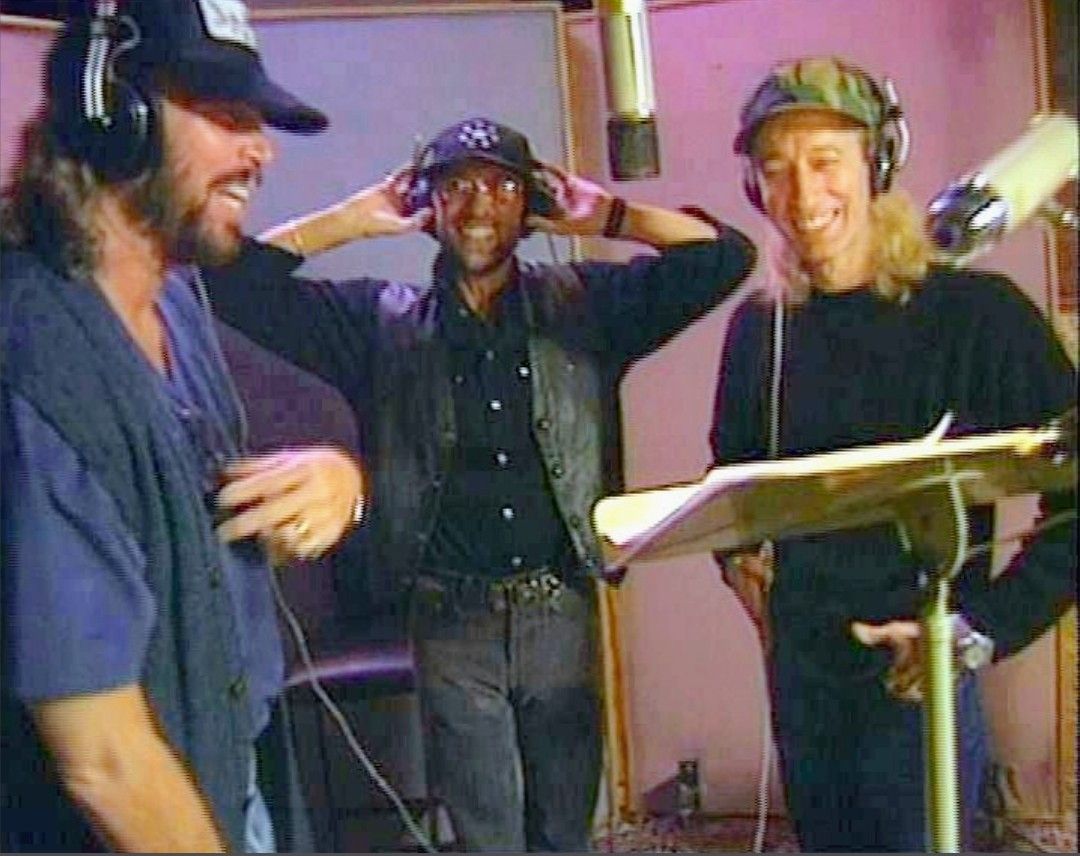
On Kiss of Life, the Bee Gees sounded anything but nostalgic. In the middle of the 1993 Size Isn’t Everything era, they pushed forward with speed, nerve, and Robin Gibb’s sharp-edged lead.
Released on the Bee Gees‘ 1993 album Size Isn’t Everything, Kiss of Life arrived during a period when the group was proving that survival and reinvention were not separate things. By that point, Barry, Robin, and Maurice Gibb had already lived through multiple musical lives: beat group beginnings, psychedelic turns, soft-pop grandeur, disco domination, and the long, complicated aftermath that followed disco’s backlash in the United States. What makes Kiss of Life so compelling in that context is not simply that it is energetic. It is that the energy feels purposeful. This is not the sound of a band trying to imitate youth. It is the sound of three seasoned songwriters refusing to shrink into memory.
Size Isn’t Everything was a key record in that early-1990s chapter. It did not arrive with the broad cultural takeover of Saturday Night Fever, and it was never meant to. Instead, it carried the steadier, more difficult power of endurance. The album showed the Bee Gees leaning into polished adult pop while still leaving room for tension, rhythm, and melodic urgency. Within that setting, Kiss of Life stands out as one of the livelier signals of intent. Driven by Robin Gibb‘s lead vocal, the song pushes with a kind of lean, restless momentum that suits the era perfectly. Robin had always been the brother whose voice could suggest ache and defiance at the same time, and here that quality gives the track its emotional shape.
There is something striking about hearing Robin at the center of a song this kinetic. His voice had long carried a dramatic quiver, a tremor that made even bright melodies sound slightly troubled, slightly unresolved. On Kiss of Life, that texture becomes an asset in a different way. Rather than floating over a ballad, it rides a driving pop-rock arrangement that keeps everything moving forward. The result is a song that feels urgent without becoming heavy, melodic without becoming soft. The title promises revival, but the performance does not treat revival as comfort. It sounds more like a jolt, a sudden return of blood to the system.
That matters in the larger story of the Bee Gees because comeback eras are often misunderstood. People tend to imagine them as a simple return to form, as if an artist merely walks back into a familiar room. But the best comeback records do something else: they reveal how much the artist has changed, and how much of that change can be turned into strength. Kiss of Life belongs to that kind of moment. The Bee Gees were no longer the brothers of the late 1960s, and they were certainly no longer the public symbols so closely tied to disco-era excess in the popular imagination. By 1993, they were elder craftsmen inside a younger industry’s machinery, and songs like this showed that craft could still generate force.
The arrangement helps tell that story. Kiss of Life carries a bright, muscular pulse, closer in spirit to streamlined pop-rock than to the lush melancholy many listeners associate with Robin’s most dramatic leads. The rhythm section keeps the track moving with confidence, while the layered Bee Gees harmonies remind you that even in a harder-driving setting, this group never stopped thinking in terms of vocal architecture. They were always builders of texture. Even when the surface feels sleek and immediate, there is careful design underneath: melodic hooks tucked into the corners, harmonies that widen the emotional frame, and that unmistakable sense that three brothers are still hearing the song from different angles at once.
It also reveals something essential about the Bee Gees as album artists in the 1990s. By then, they were not relying on novelty, trend-chasing, or old formulas dusted off for easy applause. They were writing from experience, but they were arranging for the present tense. That distinction is important. Kiss of Life does not ask to be admired as a relic of past greatness. It wants to live in the room as a current performance, with snap in its rhythm and pressure in its vocal line. In a catalog so often discussed through massive era-defining hits, songs like this show the quieter achievement: the ability to keep making records that sounded engaged, alert, and fully inhabited.
And perhaps that is why the song carries such a particular kind of pleasure. It is not built on nostalgia, even though hearing the Bee Gees always brings history with it. Instead, it offers a more active feeling, the thrill of hearing a familiar group refuse to become static. Robin’s lead gives Kiss of Life its edge, but the deeper satisfaction comes from the group chemistry around him. Barry, Robin, and Maurice were still doing what they had always done best: finding ways to turn tension into melody and melody into identity.
In the long arc of the Bee Gees story, Kiss of Life may not be the first title casual listeners reach for, but that is part of its value. It catches the band in a less mythologized light, not as symbols of a vanished era, but as working artists still capable of speed, bite, and elegance. In the Size Isn’t Everything period, that meant everything. The song feels like a reminder that a comeback is not always a grand public event. Sometimes it is a spark inside the catalog, a track that proves the engine is still running hot.
