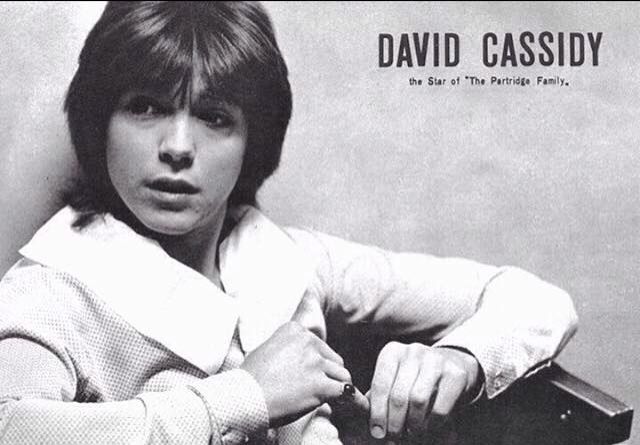
David Cassidy’s 1974 recording of If I Didn’t Care carried an old standard into the bright, complicated glare of pop fame.
When David Cassidy released If I Didn’t Care as a single in the United Kingdom in 1974, he was not simply borrowing a beautiful melody from another era. He was stepping into one of the most recognizable love songs of the pre-rock period, a Jack Lawrence composition from 1939 that had already been made famous by The Ink Spots. Cassidy’s version became a UK hit, reaching the Top 10 during a period when his name still carried the force of television fame, magazine covers, packed venues, and the intense affection of a generation that had first known him through The Partridge Family.
That context gives the single its particular tension. By 1974, David Cassidy was living inside a kind of celebrity that could easily flatten a performer into an image: the bright smile, the posters, the television role, the rush of young fans around every public appearance. Yet If I Didn’t Care belonged to a different world. It came from the age of vocal groups, late-night radio, elegant phrasing, and love songs that did not need to shout in order to sound wounded. For Cassidy to sing it was to move, however briefly, away from the frenzy and toward something quieter and more exposed.
Jack Lawrence wrote the song with a simple but enduring emotional device: love expressed as a question. Instead of declaring feeling in broad strokes, If I Didn’t Care circles around doubt, devotion, and the fear that emotion may be too large for ordinary speech. That is part of why The Ink Spots made such a lasting impression with it in 1939. Their recording wrapped the song in close harmony and a conversational intimacy that helped define a style of romantic pop before rock and roll changed the shape of popular music.
Cassidy’s 1974 reading did not need to recreate that earlier world exactly. Its meaning came from the distance between eras. His voice, familiar to millions through television and polished pop records, brought a lighter, youthful tenor to a song that already carried decades of memory. The result is not merely a cover version; it is a meeting of two forms of American popular feeling. On one side stands the old standard, built for restraint and grace. On the other stands the 1970s pop star, surrounded by a culture that demanded constant visibility, constant charm, and constant emotional availability.
What makes If I Didn’t Care stand out in Cassidy’s singles story is that it asks very little from the listener in terms of spectacle. It is not a song of grand production drama or swaggering reinvention. Its power depends on whether the singer can make the question feel sincere. Cassidy’s appeal had often been tied to warmth and vulnerability, but here those qualities are placed in a more traditional frame. The melody gives him room to soften the edges of his teen-idol image and let the song’s older romantic grammar do much of the work.
In Britain, where Cassidy enjoyed major chart success in the early 1970s, the single found an audience that was already willing to hear him as more than a television personality. His UK hits had shown a strong appetite for his ballads and carefully shaped pop performances, and If I Didn’t Care continued that thread. Its success in 1974 suggests not only the durability of Cassidy’s following, but also the durability of the song itself. A standard written before the Second World War could still speak through a young 1970s star and find its way onto contemporary radio.
There is something quietly revealing about that. Popular music often moves by replacing one sound with another, but standards survive by being rediscovered in new voices. When Cassidy sang If I Didn’t Care, he was not competing with The Ink Spots so much as entering a conversation they had helped begin. His version sits in the gap between memory and immediacy: an old song carried by a young celebrity, a tender question delivered at a moment when his public life was anything but quiet.
He did not have to oversing it. In fact, the song resists that kind of treatment. Its emotional force lies in hesitation, in the delicate space between confidence and uncertainty. Cassidy’s version works best when heard as a pause within a loud career moment, a single that allows the voice to step forward without the machinery of fame crowding every corner of the frame. It reminds us that even performers surrounded by noise can sometimes be most affecting when they choose a song that lowers the temperature.
Nearly a century after Jack Lawrence wrote it, If I Didn’t Care remains one of those songs that can change shape without losing its center. The Ink Spots gave it its first great popular identity; David Cassidy gave it a 1974 pop-era echo that still feels worth revisiting. His UK hit version does not ask us to forget the standard’s history. It asks us to hear how that history sounded when filtered through a young star trying, for the length of a song, to let tenderness stand apart from the crowd.
