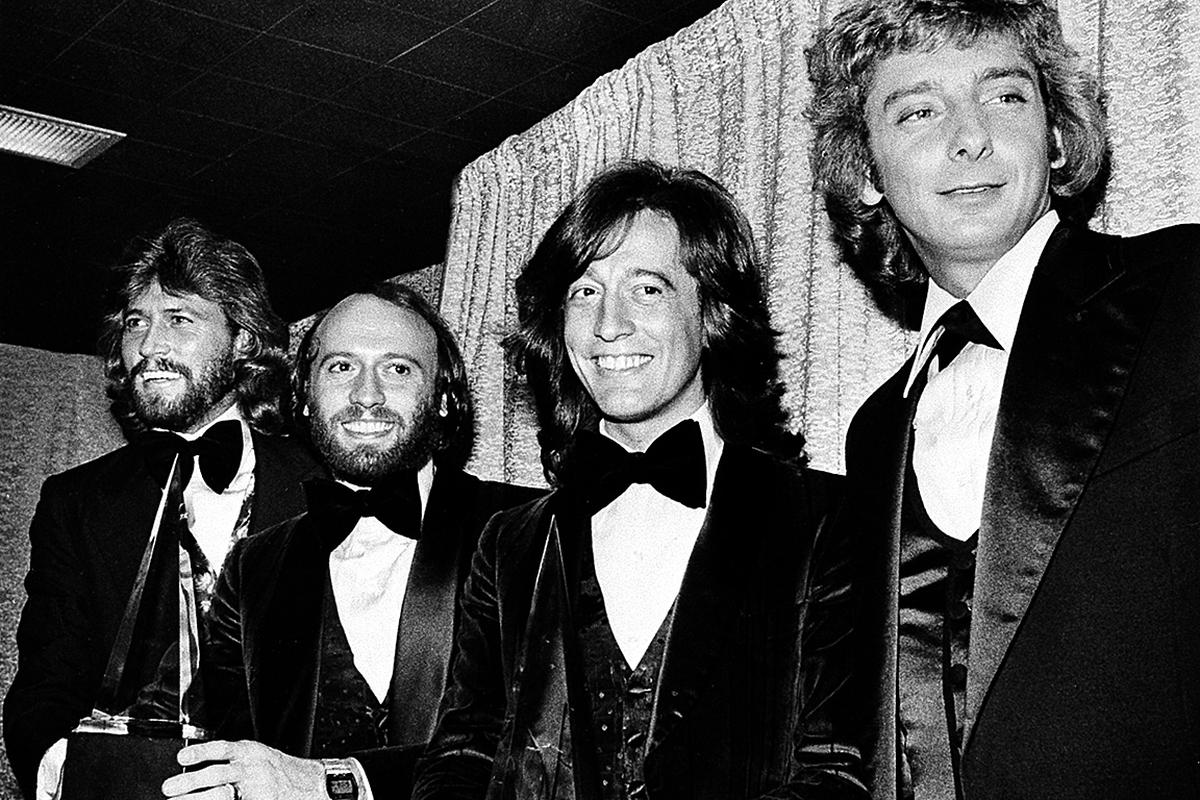
In the middle of a live triumph, I Started a Joke returned as a softer memory — not as spectacle, but as a reminder of how deeply the Bee Gees could still touch the silence in a room.
There is something especially moving about hearing “I Started a Joke” not as a full spotlight number, but as part of the acoustic medley on Here at Last… Bee Gees… Live. That 1977 live album, recorded at The Forum in Los Angeles on December 20, 1976, captured the Bee Gees at a remarkable turning point. They were already changing in the public imagination, stepping into a brighter, rhythm-driven phase that would soon become part of pop history. Yet on this record, in that acoustic sequence, they paused and looked back. And when they reached “I Started a Joke”, the effect was not simply nostalgic. It was intimate, almost disarming.
Here at Last… Bee Gees… Live became the group’s first official concert album and reached No. 8 on the Billboard 200 in the United States. That matters, because this was not a minor archival release or a casual souvenir. It was a major statement from a band reminding listeners that beneath the harmonies, beneath the changing trends, and beneath the crowd’s excitement, their songwriting still carried real emotional weight. The acoustic medley itself was beautifully chosen: “New York Mining Disaster 1941,” “Run to Me,” “World,” “Holiday,” “I Can’t See Nobody,” and finally “I Started a Joke”. It plays less like a medley designed for efficiency and more like a walk through old rooms in a familiar house.
The original “I Started a Joke” first appeared on the 1968 album Idea, one of the most haunting records in the Bee Gees catalogue. Sung by Robin Gibb, the song became one of their most unforgettable late-1960s hits, reaching No. 6 on the Billboard Hot 100 in early 1969. Even now, its lyric still feels strange and wounded in the best possible way: a man says something almost carelessly, then watches the world react in ways he never intended, until he himself is left outside the laughter. Few pop songs of that era captured emotional isolation with such elegance. It was melancholy without becoming heavy-handed, poetic without losing its human ache.
That is exactly why its appearance in the 1977 acoustic medley matters so much. On the live album, “I Started a Joke” is not expanded into a grand centerpiece. It is offered briefly, but that brevity gives it a special force. Instead of standing apart from the rest of the set, it arrives like a remembered feeling, one that still has not entirely gone away. The arrangement strips away distance. The song feels closer to the listener, closer to the brothers themselves, and closer to the years in which these songs were first written. In a concert setting, where energy can easily overwhelm subtlety, the Bee Gees did something wiser: they trusted memory.
And memory is really the key to this performance. By 1977, audiences knew the group for different reasons than they had in 1968. Voices mature, styles evolve, entire careers can be rewritten by success. But the acoustic medley on Here at Last… Bee Gees… Live reminds us that the emotional core of the Bee Gees never disappeared. The moment “I Started a Joke” enters, the room seems to change temperature. You can almost feel the audience leaning inward. It is no longer about momentum or showmanship. It becomes a shared recollection — a song many had carried with them for years, now returned in a gentler frame.
There is also something deeply fitting about hearing this song in an acoustic setting. Its meaning has always lived in its vulnerability. The lyric suggests regret, misunderstanding, and the lonely absurdity of being unable to stop the consequences of one stray moment. Robin’s voice, so distinct and tremulous, gave the studio version its unforgettable ache. In the live medley, that ache is not recreated through drama. It is suggested through restraint. That may be why the performance lingers. It understands that some songs do not need to be pushed harder with age; they only need to be held more carefully.
What makes this version especially memorable is the contrast surrounding it. Here at Last… Bee Gees… Live is not a sorrowful album. It is vibrant, confident, and full of a band enjoying its connection with a large audience. That is precisely why the acoustic section lands so beautifully. In the middle of applause and movement, the medley opens a quieter window. And inside that window, “I Started a Joke” feels almost like the emotional center of the evening, even though it is only one part of a larger sequence. Sometimes the songs that stay with us are not the loudest ones. They are the ones that seem to pass by softly, then return later in the mind with greater force.
For many listeners, this live fragment is a reminder of what made the Bee Gees exceptional long before trends and labels began to define them too narrowly. They could write for the dance floor, certainly. They could command radio. But they also knew how to turn inward, how to make a vast concert space feel suddenly personal. In the acoustic medley from Here at Last… Bee Gees… Live, “I Started a Joke” becomes more than a beloved old song. It becomes a memory carried onstage, offered back to the audience, and left there glowing for a few unforgettable moments.
That is why this performance still matters. It does not compete with the original recording from Idea; it deepens it. It shows what time can do to a song when the right artists return to it with humility, affection, and a sense of lived experience. The studio version gave us heartbreak wrapped in melody. The 1977 live medley gave us something quieter and, in some ways, even more affecting: the sound of a classic song being remembered by the very people who once gave it to the world.
