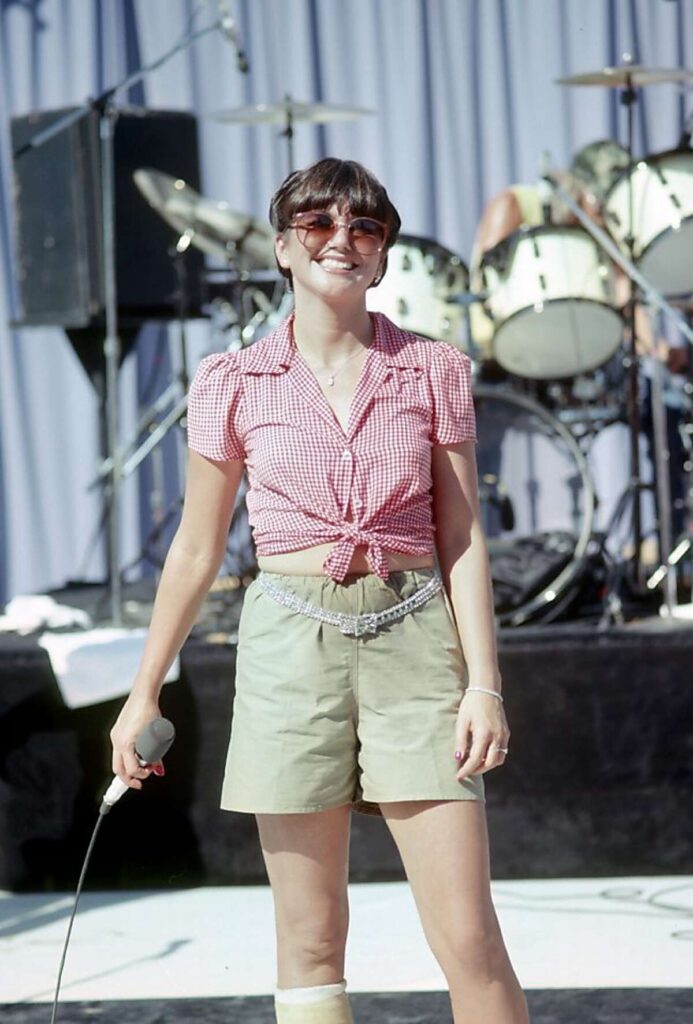
On “High Sierra”, three of American music’s most beloved voices do not compete for the spotlight; they rise together like weather moving across a mountain range.
Linda Ronstadt, Dolly Parton, and Emmylou Harris recorded “High Sierra” for their 1999 collaborative album Trio II, the long-awaited follow-up to their celebrated 1987 album Trio. Written by Harley Allen, the song sits near the spiritual center of the record: spare, reflective, and rooted in the kind of harmony singing that feels older than the recording itself. It is not a showcase built on vocal force. It is a study in restraint, trust, and the quiet power that emerges when three distinct musical lives lean into the same sorrow.
By the time Trio II appeared in 1999, the partnership between Ronstadt, Parton, and Harris already carried the weight of affection and expectation. Their first Trio album had become one of the great vocal collaborations in modern country and folk-rooted music, not because it sounded like a novelty project, but because it honored an older tradition with unusual grace. Each woman came from a different road: Ronstadt from rock, pop, Mexican music, standards, and country-rock; Parton from the hills of East Tennessee and the sharp emotional intelligence of country songwriting; Harris from the borderlands of folk, country, bluegrass, and alternative Americana. Together, they found a place where genre labels seemed too small.
“High Sierra” reflects that meeting place beautifully. The title itself suggests height and distance, a landscape where memory has room to echo. The arrangement does not rush to tell the listener what to feel. Instead, it opens space around the voices, allowing the harmonies to carry the song’s emotional architecture. There is a mountain-music clarity in the way the lines are shaped, but also a polished sensitivity that belongs to three artists who knew how to make a studio performance feel intimate rather than sealed off.
What makes the recording so moving is the balance among the singers. Dolly Parton brings a crystalline Appalachian brightness, a sound that can seem delicate at first and then cut straight through the room. Emmylou Harris adds a silvery ache, the kind of tone that seems to hover just above the ground. Linda Ronstadt anchors the blend with warmth and emotional weight, a voice capable of great power but here used with tender discipline. No one voice erases the others. The beauty lies in the way each timbre remains identifiable while becoming part of a larger whole.
That was always the rare gift of this trio. Many superstar collaborations sound like a gathering of famous names; this one sounded like a chosen language. On Trio II, and especially on “High Sierra”, the singers do something more difficult than taking turns impressing the listener. They listen to each other inside the performance. The harmonies feel carefully placed but never stiff. They carry the patience of musicians who understand that the strongest emotional moments often arrive when a voice holds back just enough to let another voice bloom beside it.
The album’s history also deepens the feeling around the track. Trio II was not a quick sequel rushed into the marketplace. The singers’ schedules, careers, and recording circumstances meant the project took time to reach the public. When it finally did, it arrived in a country-music landscape very different from the one that greeted their first trio album. The late 1990s favored polished radio production and more defined commercial lanes, yet this record seemed to stand slightly apart from the moment. It was not trying to sound old-fashioned, exactly. It was trying to sound honest to the relationship among the voices.
In that sense, “High Sierra” feels less like a period piece than a reminder of what harmony can do when it is treated as emotional conversation. The song’s imagery and melodic shape invite thoughts of distance, loss, and searching, but the recording never collapses into despair. There is consolation in the blend itself. When Ronstadt, Parton, and Harris sing together, the ache is shared, and because it is shared, it becomes more bearable. The voices do not solve the sadness; they give it company.
Hearing the track now, the emotional meaning has only grown. It captures three artists at a point when their individual legends were already secure, yet the performance is humble in the best sense. They serve the song, the harmony, and the atmosphere. There is no need for spectacle. The drama is in the breath before a line, the slight lift of a harmony, the way one singer’s color changes the meaning of another’s note. “High Sierra” asks the listener to slow down and meet it on its own terms.
That may be why it remains such a quietly rewarding part of Trio II. It does not announce itself with thunder. It lingers like a view seen from a high place: wide, clear, and touched by something unreachable. In the shared voices of Linda Ronstadt, Dolly Parton, and Emmylou Harris, the song becomes more than a performance. It becomes a landscape of friendship, memory, and grace, carried by three women who understood that the most enduring harmonies are not merely sung together; they are trusted into being.
