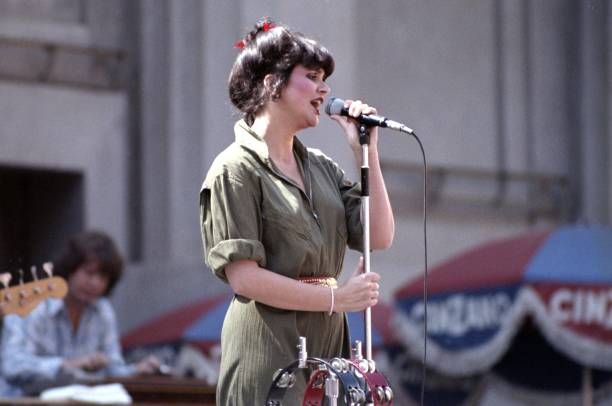
On Frenesí, Linda Ronstadt turned Bobby Capó’s Piel Canela into something both elegant and intimate: a love song carried by memory, language, and restraint.
Linda Ronstadt recorded her interpretation of Piel Canela for her 1992 Spanish-language album Frenesí, a project that widened the emotional map of her Latin music work beyond the Mexican ranchera and mariachi traditions she had celebrated so beautifully on Canciones de Mi Padre and Más Canciones. Where those earlier albums reached into the music of family, inheritance, and Mexican song, Frenesí moved through Latin pop, bolero, and Caribbean-rooted repertoire with a different kind of pulse. It was polished, cosmopolitan, and romantic, yet it still carried the seriousness of an artist singing from inside a language that mattered to her.
Piel Canela, written by Puerto Rican songwriter and performer Bobby Capó, had already lived many lives before Ronstadt brought it into her catalog. The title translates as cinnamon skin, and the song is one of the great Spanish-language declarations of romantic devotion, famous for placing the beloved above the impossible losses of nature itself. Its lyric imagines the sea losing its immensity, the sky losing its stars, and still insists that none of it would matter as much as the person being addressed. At its center is that simple, insistent phrase: the beloved matters more than anything else. In lesser hands, such a lyric can become merely pretty. Ronstadt hears the weight inside the sweetness.
That is what makes her Frenesí version feel so revealing. Ronstadt had long been admired for a voice that could fill a rock arrangement, float through country balladry, or carry the grand sweep of American standards. But in Piel Canela, she does not treat power as volume. She sings with brightness, yes, but also with a careful sense of line. The words are allowed to breathe. The melody has room to smile. The emotion does not rush toward drama; it moves with poise, as if desire has learned manners without losing its heat.
By 1992, Ronstadt’s Spanish-language recordings were not a side note to her career. They were a major artistic chapter, one that asked listeners who knew her from radio rock, country-pop, and orchestral pop to hear another root system beneath that familiar voice. Frenesí won the Grammy Award for Best Tropical Latin Album, a recognition that reflected not only her fame but the care with which she approached repertoire associated with Latin American song traditions. Her choice of Bobby Capó’s Piel Canela was especially meaningful because the song belonged to a broad shared memory across the Spanish-speaking world. It was not a novelty; it was a standard. To sing it well required affection, clarity, and humility.
Ronstadt’s interpretation works because it respects the song’s natural elegance. Piel Canela is sensual, but not heavy-handed. It praises beauty, but its deeper force comes from devotion rather than description. The repetition of the beloved’s importance can sound almost conversational, like someone trying to say the same truth again because no single phrase can hold it. Ronstadt leans into that quality. Her Spanish phrasing gives the song a graceful forward motion, and her vocal tone brings a kind of golden calm to Capó’s melody. She does not make the song sound like a museum piece. She makes it sound lived-in.
There is also a quiet cultural complexity in hearing Ronstadt sing Piel Canela during this period of her career. She was one of the most recognizable American singers of her generation, yet her Spanish-language era reminded the public that American music itself has never had only one language, one border, or one kind of emotional accent. Her work in Spanish did not feel like an escape from her identity as a pop and rock singer; it felt like an expansion of it. The voice that once carried the ache of Long Long Time, the sharp energy of You’re No Good, and the lush classicism of her standards albums could also enter a bolero-inflected world and sound entirely at home.
In that sense, Piel Canela on Frenesí is more than a cover of a beloved song. It is a meeting point. Bobby Capó’s composition brings the lyric grace and romantic confidence of mid-century Latin song; Ronstadt brings decades of interpretive intelligence, a musician’s instinct for emotional proportion, and a personal connection to Spanish-language performance that had become increasingly central to her public artistry. The result is not a reinvention that tries to overshadow the original. It is a respectful relighting of the room.
What lingers after Ronstadt’s version is the feeling that she understood the song’s central contradiction: Piel Canela is extravagant in what it says, but most moving when it is sung with control. The lyric claims that the cosmos could collapse and love would remain the only thing that matters. Ronstadt does not need to dramatize that claim. She lets the melody carry it. She lets the Spanish vowels open and settle. She lets the rhythm keep its warmth. And in doing so, she turns a famous romantic standard into a personal act of listening, as if every word had traveled a long way before reaching her voice.
For listeners discovering Frenesí through Piel Canela, the song offers a doorway into one of Ronstadt’s most important artistic passages. It shows her not as a singer borrowing a style, but as an interpreter willing to meet a song on its own terms. It reminds us that language can change the color of a voice, that repertoire can reveal ancestry and imagination at the same time, and that a familiar love song can still feel newly tender when sung by someone who knows how to honor both its surface beauty and its deeper pulse.
