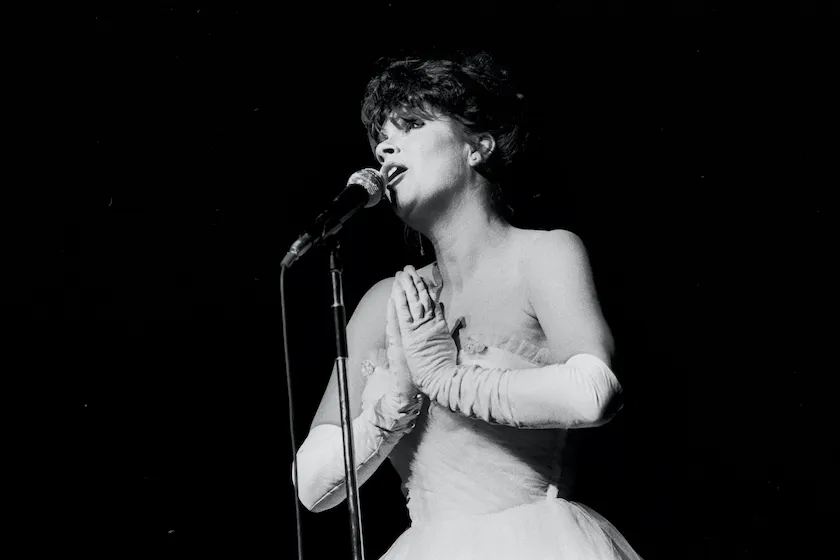
In 1984, Linda Ronstadt met “Skylark” not as nostalgia, but as a question carried on breath.
Linda Ronstadt recorded “Skylark” for Lush Life, her 1984 album of American popular standards made with arranger and conductor Nelson Riddle. It was the second album in their celebrated standards collaboration, following What’s New in 1983, and it placed a singer widely known for rock, country-rock, and pop radio inside a very different architecture: long melodic lines, orchestral patience, and lyrics that ask for delicacy rather than force.
The choice of “Skylark” mattered. Written by Hoagy Carmichael with lyrics by Johnny Mercer, the song belongs to the Great American Songbook, but it does not behave like a showpiece in the usual sense. Its melody rises and bends as if following something just out of sight. Mercer’s lyric addresses a bird as a messenger, asking whether it has seen a lost or imagined love. The language is plain enough to be understood instantly, yet the emotional position is fragile: the singer is not declaring certainty, but searching for news from the air.
That searching quality is where Ronstadt’s interpretation finds its center. By 1984, listeners already knew the power in her voice. She could send a chorus across a room with remarkable clarity. On Lush Life, and especially on “Skylark”, she does something more difficult than displaying that power. She narrows the beam. The vocal line is controlled, but not stiff; tender, but not decorative. She lets the melody open in measured phrases, allowing the words to arrive as thoughts rather than announcements.
Nelson Riddle’s setting gives her space without leaving her exposed. His orchestral language had deep roots in mid-century popular music, but the album does not simply imitate an earlier era. It translates that era through Ronstadt’s contemporary voice. Around her, the arrangement carries a soft grandeur: harmonies that seem to suspend time, instrumental colors that move with restraint, and a pace that honors the song’s inward motion. Nothing rushes the question at the heart of the lyric.
What distinguishes Ronstadt’s “Skylark” is the way she treats longing as something disciplined. She does not lean on obvious heartbreak. She does not turn the song into a confession that overwhelms its shape. Instead, she listens to the melody’s own uncertainty. The upward reaches feel like glances toward distance; the softer turns feel like the recognition that no answer may come. In that balance, the performance becomes less about sorrow than about the courage to remain open when certainty has disappeared.
The broader context of Lush Life deepens that impression. In the early 1980s, popular music was being reshaped by video, synthesizers, and new production styles. Ronstadt’s decision to sing standards with Riddle placed her in conversation with a repertoire that many listeners associated with an older generation. Yet the result was not a retreat. It was an act of artistic expansion. She approached these songs not as museum pieces, but as living forms that could reveal new shades through a different singer’s timing, breath, and emotional intelligence.
That is why “Skylark” sits so gracefully within the standards era of her career. Ronstadt does not try to become a nightclub ghost from another decade. She remains unmistakably herself, bringing a clean tone and direct emotional presence to a song built from suggestion. The interpretation works because she trusts the composition. Carmichael’s melody is allowed to wander; Mercer’s lyric is allowed to ask; Riddle’s orchestra is allowed to frame the uncertainty without explaining it away.
There is a particular kind of maturity in singing softly when one has the ability to sing with force. Ronstadt’s performance understands that some songs lose their truth when they are pushed too hard. “Skylark” asks for lift, but also for humility. The bird may know where love has gone, or it may simply keep flying. The singer can only send the question upward and wait.
Heard within Lush Life, Ronstadt’s “Skylark” becomes a portrait of an artist stepping into a demanding tradition without surrendering her own identity. It carries the elegance of the old songbook and the clarity of a modern voice discovering how much can be said by holding back. The performance endures not because it freezes the past, but because it lets longing breathe in the present tense.
In the end, the beauty of this 1984 interpretation is its refusal to close the distance. Ronstadt leaves the song where it belongs: somewhere above certainty, moving through open air, asking for a sign and finding grace in the asking.
