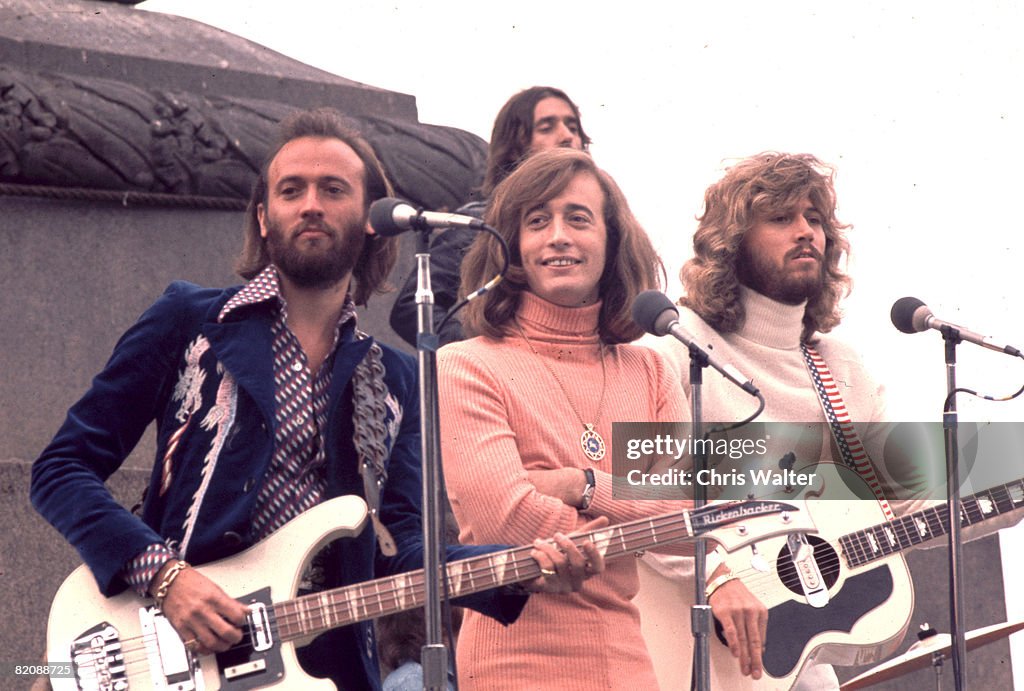
Let There Be Love captures the Bee Gees in one of their most tender early moments, turning a simple plea into a lasting meditation on comfort, unity, and emotional grace.
Before the white suits, the falsetto thunder, and the era-defining pulse of disco, the Bee Gees were masters of ornate, searching pop songs that seemed to drift out of another emotional climate altogether. Let There Be Love, from their 1968 album Idea, belongs to that earlier chapter. It was not one of the group’s major standalone hit singles, so the song itself did not claim a notable chart position of its own. But the album that carried it mattered greatly: Idea reached No. 4 on the UK Albums Chart and No. 17 on the U.S. Billboard 200, confirming how central the brothers already were to late-1960s pop. In that setting, Let There Be Love feels like one of the record’s quiet treasures, a song that did not need chart fireworks to leave a mark.
It is also worth noting that this is the Bee Gees’ own composition, not the older standard with the same title that had already circulated through popular music. Their Let There Be Love is very much part of the group’s late-1960s identity: richly melodic, emotionally vulnerable, and shaped by the shared instinct of Barry Gibb, Robin Gibb, and Maurice Gibb for songs that sounded at once intimate and theatrical. That balance was one of their great gifts. They could make a line feel personal even when the arrangement suggested something almost symphonic.
By the time Idea arrived, the brothers were working in an astonishing burst of creativity. The album also included songs now remembered more immediately, especially I Started a Joke and I’ve Gotta Get a Message to You. Those titles understandably drew much of the public attention. Yet that is part of what makes Let There Be Love so moving today. It sits just off the main road, waiting for listeners who are willing to stay with the album and hear what lived between the better-known landmarks. And what lives there is beautiful.
Musically, the song carries the signature atmosphere of the Bee Gees’ pre-disco years: soft dramatic build, careful harmony, and a melody that seems to rise with quiet longing rather than force. The brothers were especially skilled at writing songs that sounded fragile without becoming weak. Let There Be Love does exactly that. The title may sound grand, even universal, but the emotional effect is closer to a private prayer. This is not a slogan. It is a wish. The song asks for love not as decoration, not as romance for its own sake, but as a human necessity, something that makes life livable.
That is one reason the song still lingers. In the late 1960s, the world was full of noise, change, and fracture. Many artists responded with confrontation, psychedelia, protest, or irony. The Bee Gees, at least in songs like this one, often chose another route: melancholy, tenderness, and a direct appeal to feeling. Let There Be Love sounds like a retreat from hardness. It suggests that gentleness can be its own form of strength. The brothers rarely had to shout to be persuasive. Their harmonies carried conviction in a more inward way.
There is also something deeply characteristic in the emotional texture of the song. So much of the Bee Gees’ finest work lives in that space between hope and ache. Even when the lyric reaches toward light, there is usually a shadow around it, some sense that love is precious because it is never fully secure. That tension gives Let There Be Love its lasting emotional weight. It is not naïve. It does not assume love is easy or automatic. It asks for love because the world without it feels cold, brittle, and incomplete.
For listeners who came to the Bee Gees through the later triumph of Saturday Night Fever, songs like this can be revelatory. They remind us that the group’s greatness did not begin with rhythm; it began with writing. Long before they became a symbol of one era, they were already among the most emotionally articulate songwriters of their generation. Let There Be Love may not carry the public mythology of their biggest titles, but it reveals the heart of the brothers with unusual clarity. There is no need for spectacle here. The feeling is enough.
And perhaps that is why the song has aged so gracefully. It does not depend on fashion. It does not chase impact. It simply opens its hands and asks for something eternal. In that sense, Let There Be Love remains one of those album tracks that can stop a listener unexpectedly, not because it was the loudest song in the room, but because it speaks in a voice that still sounds sincere. Among the many phases of the Bee Gees, this early chamber-pop period continues to hold a special glow, and Let There Be Love is one of its most tender reflections.
There are songs that dominate history, and there are songs that quietly deepen it. Let There Be Love belongs to the second kind. Heard now, it feels less like a relic and more like a reminder: that beneath all the fame, reinvention, and changing styles, the Bee Gees always understood one enduring truth. The simplest emotional plea, when sung with conviction, can outlast almost anything.
