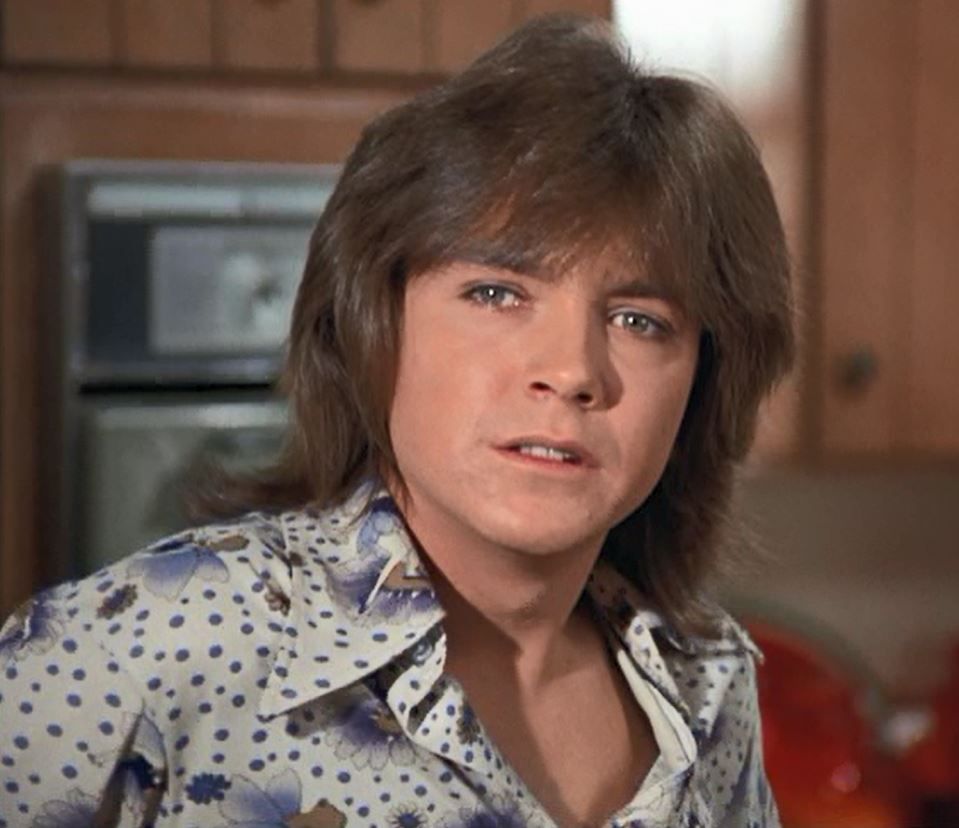
On a record built for devotion and daydreams, David Cassidy slipped in a Shel Silverstein song that sounded older, stranger, and more human than the poster on the bedroom wall.
When David Cassidy released Dreams Are Nuthin’ More Than Wishes in 1973, he was not merely a singer with a successful album. In Britain especially, he was a full-scale pop phenomenon, a face in magazines, a voice on radios, and a symbol of a kind of bright, almost overwhelming early-’70s adoration. The album reached No. 1 on the UK Albums Chart, placing Cassidy at the center of a moment when television fame, teen-pop glamour, and carefully shaped studio craft all met in one rush of public attention. Yet tucked inside that very public success was an unexpected choice: Cassidy’s cover of “Some Old Woman”, written by Shel Silverstein.
That pairing still feels surprising. Silverstein’s name carried many associations, and not all of them belonged comfortably beside the polished image of a young pop idol. He was the writer behind songs that could be comic, sharp, tender, and quietly off-center, including material associated with artists far outside the soft glow of teen magazines. His songwriting often had a crooked little doorway in it: step through, and what first sounded plain could turn into something wry, wounded, or deeply observant. To hear Cassidy take on “Some Old Woman” on a UK chart-topping album was to hear a small complication enter the dream.
Dreams Are Nuthin’ More Than Wishes was released during a period when Cassidy was trying, in public and in the studio, to exist as more than the role that had made him famous through The Partridge Family. His voice was familiar to millions, but familiarity can become a cage. A singer adored for youth and beauty is often expected to remain emotionally simple, to deliver sweetness without shadow and romance without ambiguity. That is part of what makes “Some Old Woman” so interesting in this setting. The song does not flatter the fantasy around him. It asks for a different kind of listening.
Silverstein’s writing rarely behaves like standard pop decoration. Even when his songs are easy to follow, they tend to carry a sly intelligence, a sideways sympathy for people who do not fit smoothly into the bright middle of things. In Cassidy’s hands, “Some Old Woman” becomes less a novelty than a small act of reinterpretation. The surprise is not that he turns it into something grand. The surprise is that he allows it to stay modest. He sings within the shape of the song rather than trying to overpower it, and that restraint matters. It lets the listener notice the distance between the album’s dreamy title and the more complicated world the song quietly suggests.
There is a particular tension in hearing Cassidy’s youthful voice approach material with age in its very title. In 1973, his image was tied to brightness, movement, and the almost impossible freshness demanded of young stars. “Some Old Woman” points in another direction. It brings the idea of time into the room. It hints at lives beyond the spotlight, beyond the scream of the audience, beyond the surface of pop desire. That contrast gives the cover its unusual flavor. Cassidy does not sound like he is pretending to be old; instead, he sounds as if he is momentarily stepping outside the machinery around him and looking at a different kind of story.
The arrangement, like much of Cassidy’s early solo work, sits within the soft pop vocabulary of the era: melodic, approachable, shaped for radio ears and home turntables. But the material itself resists being heard as simple product. The song’s presence on a hugely successful UK album makes it feel almost like a private corner in a very public house. Fans may have come to the record for charm, romance, and the reassurance of a voice they already loved. What they found in “Some Old Woman” was something less expected: a glimpse of Cassidy engaging with a songwriter whose gift was to make ordinary human frailty feel both peculiar and true.
That is why the cover remains worth revisiting. It does not require a dramatic myth to justify its place. It matters because it slightly unsettles the story people think they know about Cassidy’s early-’70s recording career. He was, of course, a teen idol, and that truth shaped everything around him. But he was also a working singer navigating material, producers, expectations, and the uneasy boundary between image and interpretation. A song like “Some Old Woman” reminds us that the records made during peak fame can contain more texture than their packaging suggests.
There is also something quietly moving about the fact that a Shel Silverstein song could sit on an album bought in such numbers by listeners who may have been drawn first by Cassidy’s smile, his television fame, or the romance of his voice. Pop history is full of these hidden crossings: a strange songwriter meets a polished star, a playful title opens into reflection, a chart-topping album carries a track that feels almost too curious to be accidental. David Cassidy did not need to become someone else to sing “Some Old Woman”. He only needed to let a different shade pass through the music.
Heard now, the track feels like a reminder that even the most carefully managed pop moment can leave room for an odd, tender interruption. In the middle of Dreams Are Nuthin’ More Than Wishes, a record tied forever to the height of Cassidy’s UK fame, “Some Old Woman” still leans away from the obvious. It does not chase the applause. It waits, a little wistful and a little strange, for anyone willing to hear the young star singing toward a world much larger than the dream built around him.
