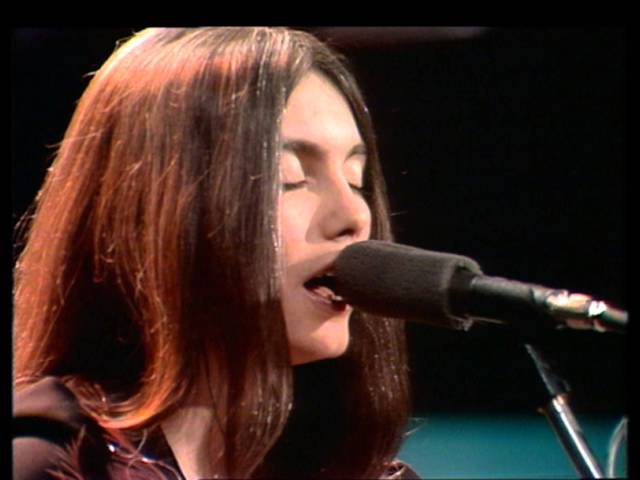
In “If I Needed You”, Emmylou Harris and Don Williams proved that a country duet does not have to reach for grandeur to leave a lasting mark; sometimes the deepest feeling arrives in the softest voice.
There are country hits that announce themselves in bold letters, and then there are songs like “If I Needed You”, which seem to walk into the room quietly and stay for the rest of your life. Released by Emmylou Harris and Don Williams on Harris’s 1981 album Cimarron, this gentle reading of a Townes Van Zandt song became one of the most affecting duets of its era. It climbed to No. 3 on Billboard’s Hot Country Singles chart and reached No. 1 in Canada on the RPM country chart, but statistics only tell part of the story. Its real achievement was subtler: it showed how restraint, trust, and emotional discipline can make a performance feel timeless.
The song itself had already carried a kind of quiet myth. Townes Van Zandt first released “If I Needed You” on his 1972 album The Late Great Townes Van Zandt. Over the years, he spoke about the song as something that seemed to come to him almost in a dream, and that origin fits the writing perfectly. The lyric has the clarity of a lullaby and the ache of a confession. “If I needed you, would you come to me / Would you come to me and ease my pain” is not ornate songwriting. It is simpler than that, and therefore harder to forget. The words move like a plainspoken promise offered in the dark, without performance, without decoration, and without any attempt to impress.
When Emmylou Harris brought the song to Cimarron, she did not try to reinvent it with drama. That was the wisdom of her choice. She and Don Williams turned it into a duet that feels less like a showcase and more like a shared confidence. In lesser hands, a duet can become a contest of presence, phrasing, or personality. Here, neither singer pushes forward to claim the moment. Don Williams, with that famously steady, unhurried warmth in his voice, sounds like the human embodiment of reassurance. Emmylou Harris, by contrast, brings a silver, almost hovering tenderness. Together, they do not collide; they settle beside one another. That is why the performance still feels so honest.
This is where the idea of Harris’s collaborative restraint becomes so important. By the time “If I Needed You” appeared, Emmylou Harris had already built a reputation not only as a major artist in her own right, but as one of country music’s most sensitive interpreters of other writers’ songs. She understood something many singers never fully learn: not every song needs to be conquered. Some songs need to be listened to from the inside before they can be sung at all. On this track, Harris resists every temptation to over-color the lyric. She does not crowd it with sentiment. She does not stretch every line for effect. Instead, she leaves room for silence, room for breath, and room for Don Williams to stand shoulder to shoulder with her in the song’s emotional center.
That restraint is exactly what gives the duet its lasting power. The song is about devotion, but not the theatrical kind. It is about being present for someone so completely that no grand declaration is required. Even the most beloved lines carry that modesty: the famous image of the “night forlorn” and the “morning’s born” does not feel literary for its own sake. It feels old, familiar, and elemental, like a truth already known before it is spoken. Harris and Williams understood that the lyric’s beauty lies in its gentleness. They sing it as if the promise matters more than the performance.
Cimarron itself has often been viewed as one of the more transitional albums in Emmylou Harris’s catalog, assembled during a period when label schedules and recording realities did not always allow for the clean artistic arc of her most celebrated records. Yet “If I Needed You” rose above all that. In some ways, its durability has outlasted the album’s broader reputation. Listeners return to it not because it was surrounded by noise, but because it escaped noise altogether. It remains one of those recordings that reminds us how much emotional authority can live inside understatement.
There is also something quietly significant about the way this duet helped bring Townes Van Zandt to a wider country audience. He was revered by songwriters and serious listeners long before the mainstream fully caught up with him, but songs like this one opened a door. Harris and Williams did not dilute his writing to make it accessible. They honored its stillness. In doing so, they revealed how naturally Townes Van Zandt’s writing could live inside a country hit when handled with care. That was no small feat. It required taste, patience, and a willingness to let the song’s emotional architecture remain intact.
And perhaps that is why “If I Needed You” still feels so definitive in conversations about Emmylou Harris and collaboration. She had the voice to dominate almost any recording she entered, yet some of her most memorable work came from choosing not to dominate at all. Here, she models a rare kind of artistic confidence: the confidence to share, to soften, and to trust the material. Don Williams meets her there with equal grace, and together they create a performance that feels like companionship set to music.
Many hits fade because they are too tied to the fashion of their moment. “If I Needed You” has endured because it was never chasing a moment. It was built on something older and steadier: melody, balance, humility, and emotional truth. The record does not beg to be admired. It simply asks to be heard. More than four decades later, that may be exactly why it still reaches people so deeply. In a catalog full of elegant performances, this one remains special because it teaches a lesson that country music at its best has always known: tenderness, when sung without vanity, can be stronger than force.
