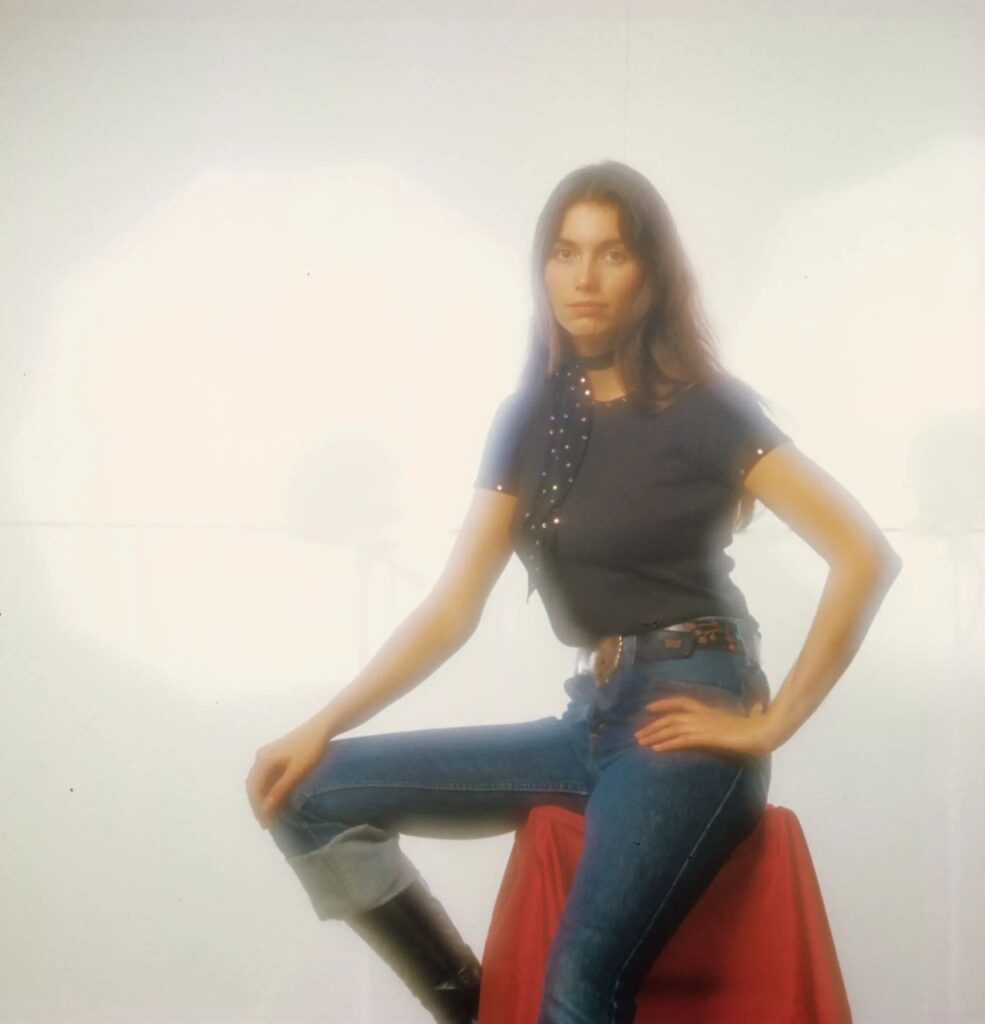

“Queen of the Silver Dollar” still reigns because Emmylou Harris turns a barroom portrait into something larger than nightlife—half legend, half loneliness, all shimmer and shadow.
Some songs do not merely introduce a character; they let her walk straight into the room and take possession of it. “Queen of the Silver Dollar” does exactly that. From the first lines, she is already there—glittering a little, wounded a little, proud enough not to explain herself to anyone. That is why the song still feels so alive. In Emmylou Harris’s hands, it is not just a clever country number about a woman in a smoky bar. It becomes a small drama about survival, glamour, and the strange kind of royalty people sometimes build for themselves when life has denied them gentler crowns.
The first detail worth bringing forward is that Emmylou Harris recorded “Queen of the Silver Dollar” for Pieces of the Sky, released in 1975, the album that truly launched her as a major country artist. That record reached No. 7 on Billboard’s country albums chart, and “Queen of the Silver Dollar” closed the original album. It was not the headline single, and that matters. The song lived instead as one of those memorable album moments that deepen an artist’s identity—less a radio event than a mood-setting statement. It helped show how naturally Harris could move between sorrow, mischief, and story-song theater without ever sounding artificial.
But the hotter, richer spark behind the song is the woman at its center. She is introduced with such immediate vividness that one almost sees her before fully hearing the melody: arriving each night in full splendor, ruling over a smoky kingdom with a wine glass for a scepter. That image is the whole enchantment. “Queen of the Silver Dollar” sounds playful on the surface, yet underneath it lies a quieter ache. This is not a queen of palaces, safety, or lasting love. She reigns over a barroom world lit by neon and loneliness, where glamour is part costume, part defense. That is what makes the song linger. It understands how closely dignity and sadness can stand together.
The second precious detail is that the song was written by Shel Silverstein and was first recorded by Dr. Hook & the Medicine Show in 1972. In other words, Emmylou Harris was not inventing the character, but inheriting one already drawn in bold lines. Yet her version changes the temperature. Where another performance might lean harder into novelty or swagger, Harris brings something more graceful and observant. She does not mock the woman, and she does not flatten her into mere honky-tonk decoration. She sings as though she recognizes her. That one shift makes all the difference. The song stops being just colorful and becomes quietly compassionate.
That is why the recording still feels like a barroom legend instead of a period curio. Emmylou Harris had a rare gift for finding the human pulse inside songs that might otherwise have remained types or sketches. Here, she lets us feel that the so-called queen is not only dazzling, but possibly tired; not only admired, but perhaps a little trapped by the very role she plays so well. The bar gives her status, identity, an audience. But it is still a bar. The kingdom is still smoky. The crown still disappears with the night. That tension gives the song its emotional weight.
And that, surely, is why one cannot quite look away. The woman in “Queen of the Silver Dollar” is too vivid to dismiss as fantasy, yet too mythic to pin down as ordinary realism. She belongs to that old country-and-American-song tradition of unforgettable female figures who seem to carry an entire life story in the way they enter a room. There is style in her, certainly. There is bravado too. But there is also the suspicion that performance is part of how she keeps herself intact. The song never says that outright, and it does not need to. The best story songs trust the listener to feel the bruise beneath the sparkle.
So yes, “Queen of the Silver Dollar” still reigns. Not because it is simply catchy, though it certainly is, and not because it was pushed as a giant hit, because it was not. It reigns because Emmylou Harris gives the song more than polish—she gives it atmosphere, poise, and a flicker of tenderness. The result is a portrait both wild and sad, theatrical and true. A woman made larger than life by the room around her, and perhaps made lonelier by it too. That is why the song endures like a legend told under low lights: you hear her once, and for a long while after, she is still standing there.
