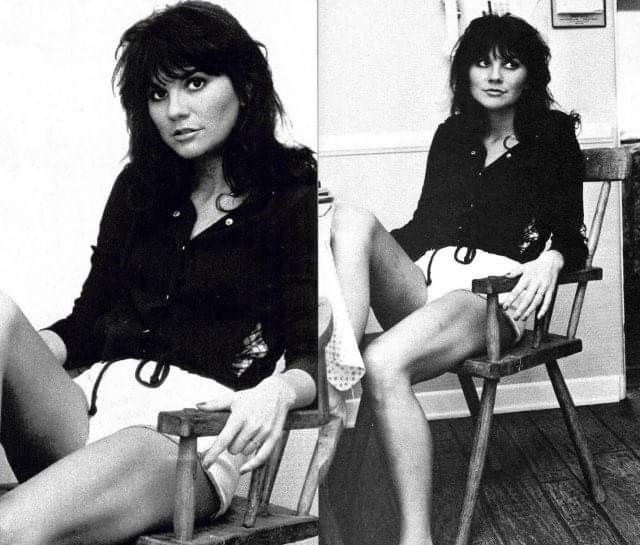
Linda Ronstadt did not simply cover “Ooh Baby Baby” in 1978—she used it to reveal how naturally her rock and country instincts could bloom inside classic soul.
There are performances that feel less like a career detour and more like a quiet unveiling. Linda Ronstadt’s version of “Ooh Baby Baby”, from her 1978 album Living in the USA, belongs in that category. By the time she recorded it, Ronstadt was already one of the defining voices in American popular music, admired for the way she moved between rock, country, folk, and pop with uncommon emotional authority. But this recording showed something else with remarkable clarity: she could enter the language of classic R&B without sounding like a tourist, an imitator, or a singer putting on borrowed clothes.
The song itself already carried deep history. Written by Smokey Robinson and released by Smokey Robinson & the Miracles in 1965, the original “Ooh Baby Baby” became one of the most elegant and vulnerable records of the Motown era. It reached No. 16 on the Billboard Hot 100 and No. 4 on the Billboard R&B chart, and over time it came to be treated not simply as a hit but as a standard of modern soul longing. Its power was never loud. It lived in regret, in apology, in the ache of a voice that sounded wounded and tender at the same time.
When Ronstadt brought the song into Living in the USA, she did not try to out-Smokey Smokey. That would have been a mistake, and she was far too intelligent an interpreter for that. Instead, she reshaped the song through her own strengths: luminous phrasing, emotional directness, and a kind of disciplined ache that had already made her one of the great interpreters of her generation. Her version was released as a single and climbed to No. 7 on the Billboard Hot 100 in early 1979, while also reaching No. 2 on the Adult Contemporary chart. That success mattered. It proved that audiences who knew her from country-rock radio and polished California pop were ready to follow her into more soul-based territory.
That is what makes this recording so interesting in the story of Linda Ronstadt. Her move toward R&B here was not abrupt, and it was not theatrical. It felt earned. She had always been a singer who understood emotional architecture—how to hold back, when to lean into a syllable, when heartbreak should sound bruised rather than broken. On “Ooh Baby Baby”, those instincts met a song that required exactly that kind of restraint. The result is not flashy soul. It is intimate soul, filtered through a singer whose background in rock and country gave her a different but equally persuasive path into the lyric.
And that lyric still lands with unusual force. “I did you wrong, my heart went out to play” remains one of the simplest confessions in popular music, yet in the right voice it opens an entire emotional world. Ronstadt sings it with a softness that never turns weak. There is sorrow in her reading, but also maturity. She sounds less like someone collapsing under remorse than someone finally brave enough to admit it. That emotional steadiness is part of what makes her version so enduring. She does not decorate the song. She listens to it, and then she answers it.
Living in the USA itself was a major moment in her career. Released in 1978, it became the first album by a female artist to ship two million copies in the United States, and it reached No. 1 on the Billboard 200. The record was broad in taste and confident in execution, reflecting the very thing that made Ronstadt such a singular figure: she refused to be trapped by one lane. In that context, “Ooh Baby Baby” was more than a well-chosen cover. It was a statement of artistic reach. She was not abandoning her earlier sound; she was widening the emotional map.
Part of the beauty of Ronstadt’s career is that she treated great songs as living material. She could honor the past without embalming it. With Smokey Robinson’s composition, she recognized that the song’s fragility could survive a change in voice, arrangement, and audience. Her recording keeps the tune’s delicacy intact, yet gives it a slightly different temperature—less vaporous than the Miracles’ original, perhaps, but fuller in tonal warmth, and more grounded in adult reflection.
That is why this track still matters when people talk about cross-genre artistry in American popular music. Too often, “genre crossing” is discussed as branding, reinvention, or market strategy. Ronstadt’s version of “Ooh Baby Baby” reminds us that sometimes it is simply the natural result of a gifted singer hearing the truth inside a song and knowing she can carry it. She brought a rock audience closer to classic soul, but she did it through taste, humility, and vocal intelligence rather than spectacle.
Years later, the recording still feels graceful in a way that never goes out of style. It captures Linda Ronstadt at a point when commercial power and artistic sensitivity were meeting in perfect balance. She had the chart momentum, certainly. But more importantly, she had the courage to slow down, lower the lights, and trust the emotional wisdom of an older song. In doing so, she revealed that her gift was never just range. It was recognition—the ability to find the human center of a song, even one born in another tradition, and make it feel as if it had been waiting for her voice all along.
