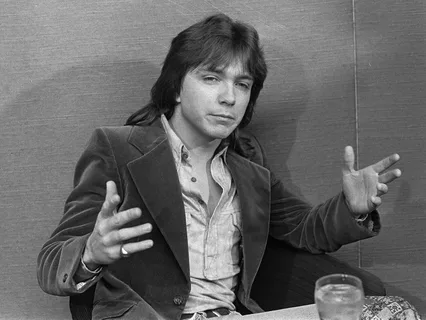
In 1976, David Cassidy stopped asking to be remembered as a teen dream and started insisting on being heard as an adult artist. “Gettin’ It in the Street” was the clearest sound of that change.
When David Cassidy released “Gettin’ It in the Street” in 1976, the song did more than introduce another single. It announced a shift in identity. In Britain, where his solo career remained much stronger than it was in the United States, the record reached No. 7 on the UK Singles Chart. That chart showing mattered, of course, but the deeper importance of the song had less to do with numbers than with tone, attitude, and timing. This was Cassidy stepping away from the polished glow that had once made him one of pop culture’s most recognizable young faces. By the middle of the 1970s, the poster-boy image that had launched him was no longer a gift. It was a shadow. “Gettin’ It in the Street” sounded like a determined attempt to sing in a different light.
That is what makes the song such an important cultural moment. By 1976, The Partridge Family was over, the first wave of teen-idol fever had cooled, and popular music itself had changed. The market was tougher, more rhythm-driven, more urban, and less forgiving of performers who seemed trapped in an earlier version of themselves. Cassidy knew that better than anyone. He had been trying for years to be taken seriously as a musician rather than a manufactured fantasy. He had spoken openly about the pressures of fame, about the strange split between his real self and the image sold to the public, and about his hunger for artistic control. “Gettin’ It in the Street” feels like the moment when that struggle became audible in the music itself.
As a record, it is striking precisely because it does not sound like a nostalgic return to his early hits. The arrangement has bite. There is a harder rhythmic pulse, a streetwise title, and a sense of adult momentum running through it. The mood is not innocent, dreamy, or carefully protected. It is outward-looking, contemporary, and alive to the energy of mid-1970s pop and soul. Cassidy had always been more musically capable than the teen-idol label allowed many people to admit, and here he leaned into that fact. The performance carries swagger, but also effort. You can hear him pushing against expectation, trying to get the listener to meet him in the present rather than in memory.
The song’s meaning lives partly in its title. “Gettin’ It in the Street” suggests real life happening out in the open, where image is tested, not managed. It is a phrase with movement in it, with public space, friction, urgency, and adult experience. That alone made it a revealing choice for Cassidy in 1976. The old image that followed him was rooted in fantasy, in teenage projection, in a kind of sealed-off stardom. This song pointed the other way. It placed him in a busier, rougher, more contemporary world. Even for listeners who did not analyze it in those terms at the time, the difference could be felt immediately. He was no longer singing from inside the frame people had built around him.
There is also a certain poignancy in the song’s chart story. A No. 7 hit in the UK was still a real achievement, but it was not the kind of all-conquering hysteria that had once defined David Cassidy. In America, the record did not restore him to the upper reaches of the charts. That gap between artistic growth and commercial certainty is part of what gives the song its emotional weight today. Reinvention in popular music is often celebrated in hindsight, but in the moment it can be uneasy, imperfect, even lonely. Cassidy was asking his audience to catch up with the man he had become. Some did. Some preferred the safer memory. That tension lives inside the record, and it is one reason the song still feels revealing nearly fifty years later.
Seen from a wider historical angle, “Gettin’ It in the Street” belongs to a familiar but still moving story in pop history: the fight to outgrow an image that brought fame in the first place. Many artists never quite win that battle. Some rebel too violently against the past; others remain frozen in it. Cassidy did something more interesting here. He did not mock his earlier success, and he did not pretend the past had not happened. Instead, he tried to redirect the conversation through sound. He toughened the edges, updated the mood, and gave himself room to be heard as a grown performer. That choice may not have erased the teen-idol label, but it challenged it with unusual clarity.
For listeners returning to the song now, that is the real reward. “Gettin’ It in the Street” is not simply a curio from the later chapter of a famous career. It is a document of transition. It captures David Cassidy at a moment when he wanted more than affection, more than recognition, more than the old screams. He wanted credibility, momentum, and a future. The song may not have entirely changed the public story around him, but it revealed the artist he was trying to become. And that is why it remains so compelling. Underneath the groove and confidence, one hears a man refusing to be embalmed by his own legend. In 1976, that refusal was brave, modern, and deeply human.
