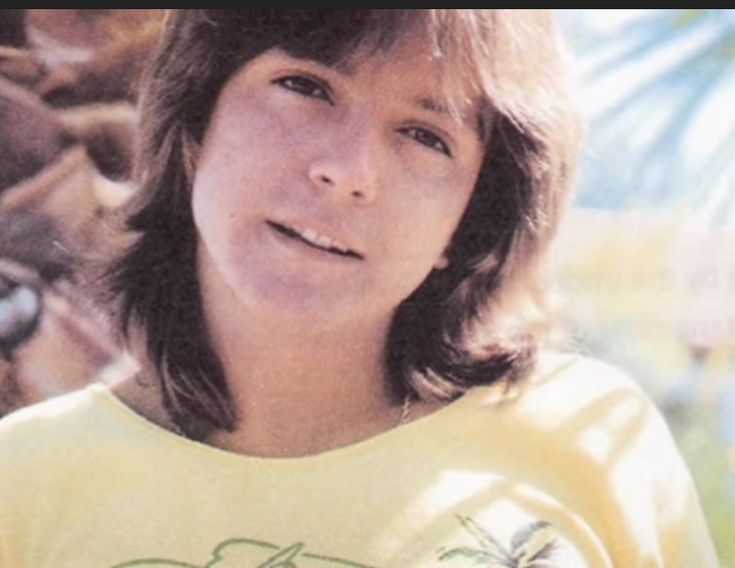
With Tell Me True, David Cassidy sounded less like a memory being revived and more like a grown man asking to be heard on his own terms.
Released on the 1992 studio album Didn’t You Used to Be…, Tell Me True sits in one of the more revealing chapters of David Cassidy’s recording life. Co-written with Sue Shifrin, his then-wife and creative partner, the song belongs to a period when Cassidy was working under the long shadow of a fame that had arrived early, loudly, and in a shape almost too powerful to escape. To many listeners, he was still inseparable from The Partridge Family, from the image of Keith Partridge, from the roar of teenage devotion that followed him through the 1970s. But by 1992, Cassidy was not a boy on a lunchbox or a face on a bedroom wall. He was an adult artist trying to make music from where life had actually taken him.
That is what makes Tell Me True worth returning to now. It does not ask to be heard as a grand reinvention or a dramatic rejection of the past. Its strength is quieter than that. The track carries the warmth and polish of adult pop, but beneath that surface is a more interesting tension: a singer once defined by projection and fantasy choosing a more measured, human scale. Cassidy’s voice, always more flexible than his teen-idol image allowed people to admit, feels here like it is trying to communicate rather than perform a role. There is no need to overstate the emotion. The song works because it allows tenderness to arrive without spectacle.
The title of the album, Didn’t You Used to Be…, already feels like a question aimed directly at the burden of recognition. It suggests the half-remembered encounter, the public gaze that never quite lets an artist become fully present. For someone like David Cassidy, that phrase carried a special weight. He had experienced pop stardom at a level that could make later work seem secondary before it was even heard. When an audience believes it already knows who an artist is, new songs can struggle to breathe. Tell Me True becomes meaningful in that context because it does not fight memory with noise. It simply presents another side of him and trusts that a listener might stay long enough to notice.
Co-writing the song with Sue Shifrin also gives it a sense of intimacy without requiring any invented backstage mythology. Shifrin was an experienced songwriter, and the collaboration places Cassidy not merely as a singer interpreting material handed to him, but as a participant in shaping the emotional language of the track. That detail matters in any reassessment of his career. Cassidy’s public story often became larger than his musicianship, but songs like this remind us that he was not only a product of television pop machinery. He kept writing, recording, adapting, and searching for ways to make his voice belong to the man he had become.
Musically, Tell Me True reflects the adult-contemporary climate of the early 1990s, a period when many artists from earlier pop eras were finding softer, more reflective settings for their work. The arrangement does not need the bright rush of teen-pop immediacy. Instead, it leans toward emotional clarity, the kind of sound that gives the vocal space to carry nuance. Cassidy’s delivery has a conversational quality, as though the drama is happening inside the restraint. That restraint is important. It is the sound of an artist who knows that maturity is not always about sounding larger; sometimes it is about resisting the old temptation to prove too much.
For listeners who know Cassidy primarily through the cultural thunder of his early fame, Tell Me True can feel like a small act of correction. It does not erase the past, and it should not have to. The pop history attached to him is real, and so is the affection that remains around it. But the song widens the frame. It asks whether an artist can be remembered and reconsidered at the same time. It asks whether the face people once adored can be allowed to age into a different kind of credibility. And it suggests that Cassidy’s later recordings deserve to be heard not as footnotes, but as evidence of a musician still reaching for sincerity after the machinery of fame had already written its easiest version of his story.
That is the quiet power of Tell Me True. It does not announce itself as a career statement, yet it reveals one. In its warmth, its grown-up tone, and its refusal to chase the old frenzy, it gives us a David Cassidy who sounds more present than packaged. The song may not be the first recording people mention when his name comes up, but perhaps that is exactly why it matters. Sometimes the most revealing tracks are not the ones that made the loudest entrance. Sometimes they are the ones that wait patiently, years later, for listeners to hear the person behind the memory.
