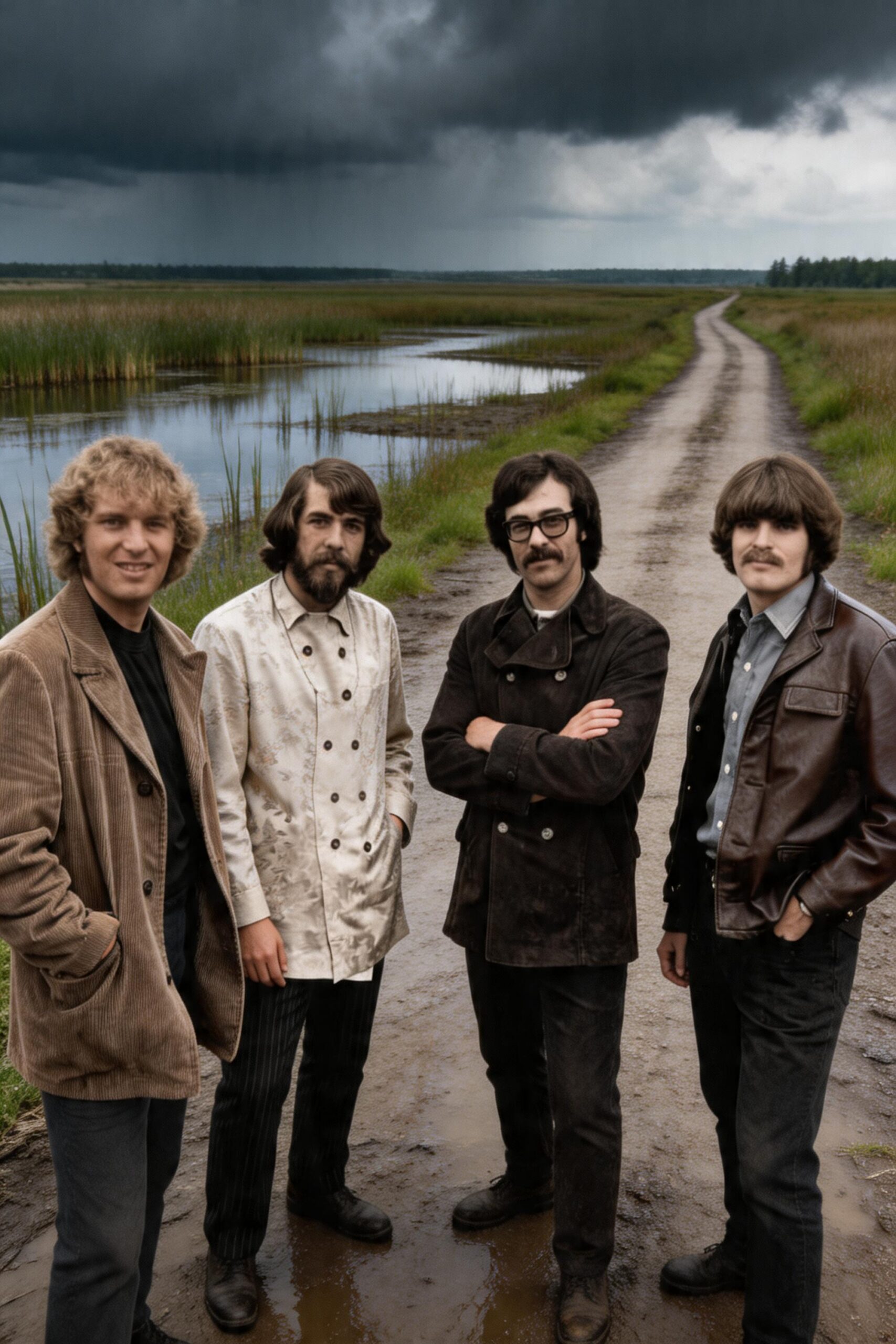
Before the famous name arrived, “Porterville” caught a working band shedding its disguise and finding a harder American voice.
In 1967, The Golliwogs released “Porterville” as a single on Fantasy Records. A year later, after the group had taken the name Creedence Clearwater Revival, the song appeared on the band’s 1968 debut album, Creedence Clearwater Revival. That sequence matters. “Porterville” is not simply an early track later gathered into a first LP; it is one of the clearest hinges between two identities, a record made while the musicians were still carrying an awkward old name but already moving toward the sound that would define them.
The band behind both names was the same core unit: John Fogerty, Tom Fogerty, Stu Cook, and Doug Clifford. They had spent the mid-1960s recording as The Golliwogs, a name that now feels strangely distant from the plain-spoken force of Creedence Clearwater Revival. “Porterville” sits at the point where the costume begins to fall away. It does not yet have the full authority of the later run of Creedence singles, but it contains the essential outline: a tight groove, a wary narrator, sharp guitar, and a refusal to drift into the fashionable excesses of its moment.
That last quality is especially striking because 1967 was a year when much of rock was expanding outward. Arrangements stretched, studio colors multiplied, and the San Francisco area became associated with psychedelic possibility. “Porterville” heads in another direction. It is compact, dry, and tense. Its power comes less from decoration than from pressure. The rhythm section keeps the song close to the ground; the guitar does not float so much as jab and answer; the vocal carries the grain of someone telling a story he has no interest in softening.
The title itself gives the song a rooted, almost physical presence. Porterville is the name of a real California city in the San Joaquin Valley, but in the song it works as more than a map point. It becomes a place of judgment, memory, and escape. The narrator looks back toward a town that seems to have marked him early, a place where family history and public reputation cling tightly. The lyric’s world is not romanticized. It is small enough for gossip, hard enough for resentment, and close enough that leaving does not erase its hold.
That sense of being trapped by origin would become one of John Fogerty’s strongest narrative instincts. Again and again in Creedence songs, he would write in voices that seemed older than the singer’s years: drifters, workers, fugitives, people pressed by money, war, weather, or rumor. “Porterville” is an early example of that gift. The song is not autobiographical in any simple way, and it should not be treated as a diary entry. Its importance lies in craft: Fogerty was already discovering how to build a whole emotional landscape from a few hard images and a voice that sounds as if it has been cornered.
Musically, “Porterville” points toward the roots language Creedence would soon sharpen. There is blues in its tension, country in its plain edges, garage rock in its economy, and rhythm and blues in the way the band leans into the beat. Yet it avoids imitation. The group was from Northern California, not the bayou country that later listeners often imagined around Creedence Clearwater Revival, but Fogerty’s writing was already creating a usable American mythos out of fragments: town names, roads, family burdens, bad luck, and stubborn motion. The roots here are not a matter of geography alone. They are a discipline of sound.
When “Porterville” reappeared on the 1968 debut album, it shared space with material that showed the newly named band still defining its reach. The album included forceful interpretations such as “I Put a Spell on You” and the extended treatment of “Suzie Q”, alongside original writing that hinted at what was coming. In that setting, “Porterville” carried a special kind of evidence. It showed that Creedence did not arrive fully formed by magic; the band’s voice had been assembled through rehearsal, misfires, singles, name changes, and the gradual stripping away of anything that did not serve the song.
The parallel between the lyric and the band’s own transition is tempting: a song about leaving a marked place, recorded by a group about to leave behind a name that no longer fit. That connection should be held lightly, not forced into confession. Still, it gives the record an added resonance. “Porterville” sounds like departure before arrival, like a door closing behind musicians who had learned that clarity could be more powerful than novelty.
What makes the single endure is not polish, but direction. You can hear a band choosing compression over display, character over fashion, and rhythmic conviction over ornament. The later Creedence Clearwater Revival would become far better known, and rightly so, but “Porterville” preserves the earlier moment when the path had just begun to narrow into something unmistakable. It is the sound of roots being chosen, not inherited; of a name changing, but a voice finally coming into focus.
